Janesville Epoxy Flooring has spent more than 20 years on epoxy flooring in Beloit and across Rock County, and the work here runs from a 1920s basement to a laboratory corridor where the floor has to come clean after a spill nobody can see. Those are different jobs with different rules, and we quote them that way rather than pricing every slab off one sheet.
Whatever the building, the slab is opened with a diamond grinder or a shot blaster before any resin touches it. We do not acid etch. We test moisture as a scoped line item, read the cracks and old coating before we put a number down, and tell you plainly when concrete needs repair or replacement before a coating is worth buying.
Our written proposal names the product, the system build and the finished thickness, so you can hold what was quoted against what went down. Warranty exclusions are read aloud before you sign, moisture first. This page covers the specialist floors Beloit’s radiochemistry work calls for and the older homes that make up most of the city.
Radiopharmaceutical Manufacturing and Wisconsin’s DHS 157
Most cities in our service area have nothing like Beloit’s radiopharmaceutical campus. Floors in buildings that handle radioactive material answer to a state rule written around contamination and the eventual cleanup of the site, and that rule shapes what a floor is asked to do long before anyone chooses a resin.
NorthStar’s Campus on Gateway Boulevard
NorthStar’s Beloit campus sits at 1800 Gateway Boulevard on 55 acres. Its facilities page lists a 20,000 square foot isotope processing facility completed in September 2019 with a chemical processing line, analytical and metallurgy labs and radioactive storage, plus an upgrade adding product hot cells. A 30,000 square foot accelerator building finished in January 2021 produces copper-67 on a routine basis.
An actinium-225 production facility of more than 30,000 square feet houses a Rhodotron accelerator, and a 52,000 square foot contract development and manufacturing facility held its grand opening on October 3, 2024. The company describes a cGMP-compliant suite for final dose products. We have no relationship with NorthStar and have not read its floor specifications or license terms.
What the Rule Says About Facility Design
Wisconsin became an NRC Agreement State on August 11, 2003, and the Department of Health Services issues and inspects radioactive materials licenses under chapter DHS 157. Section DHS 157.13(1)(i) requires a new license application to describe how facility design and operating procedures will minimize contamination of the facility and the environment and facilitate eventual decommissioning.
The same section tells license holders to conduct operations so they minimize the introduction of residual radioactivity into the site, including the subsurface. The rule does not name epoxy or any other coating. It sets an outcome, and the facility’s own design and procedures decide how a floor helps reach it.
Why Decommissioning Reaches the Floor
Decommissioning is the day a site is surveyed and cleaned so the license can end. Every crack, open joint and patch of bare concrete is a place where material can lodge and wait for that survey. A floor that sheds contamination at the surface is easier to clear than one that has soaked it into the slab.
That is the practical link between a state licensing rule and a flooring contractor. The rule never mentions us, but the floors in these rooms are expected to make cleanup quicker and leave less waste, and those expectations only come true if the surface was built continuous and sound in the first place.
Looking for epoxy-flooring closer to South Beloit? See Epoxy-Flooring in South Beloit.
Seamless, Nonporous Floors That Can Be Decontaminated
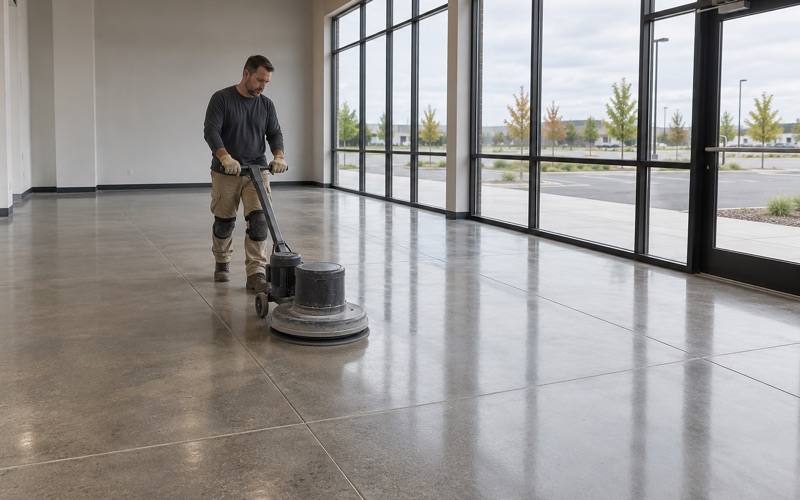
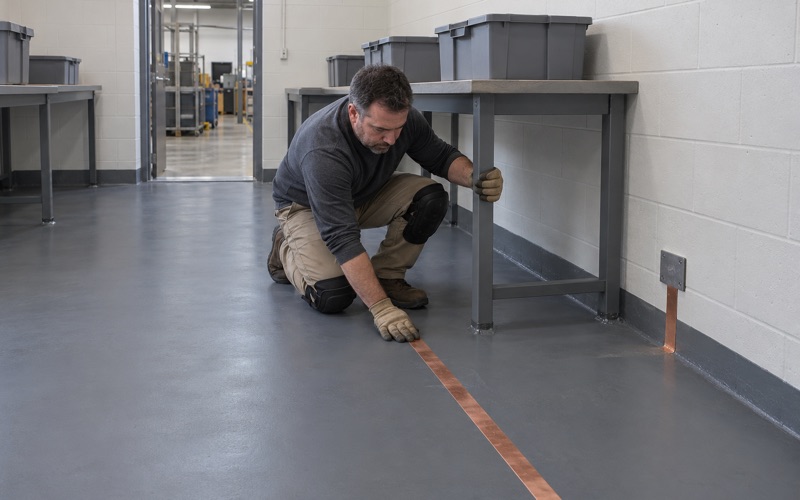
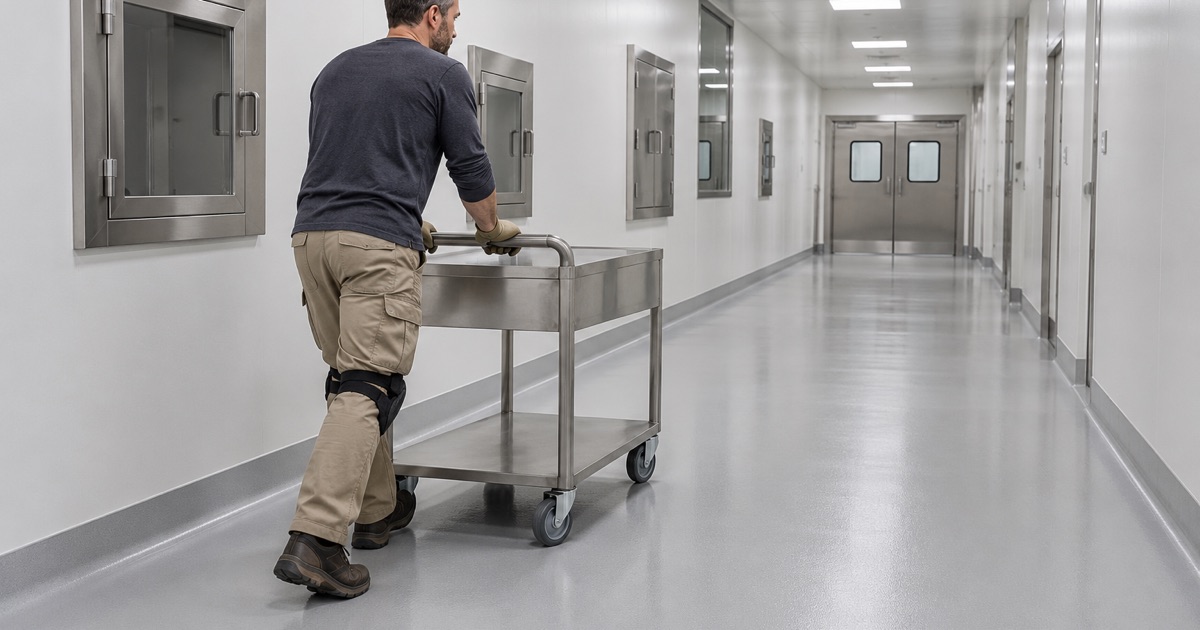
University radiation-safety manuals describe the floor they want in radioactive-material work areas as smooth, nonporous and easily cleanable, and they name sealed concrete among suitable surfaces. A continuous resin floor with a coved base is a common way to reach that standard over a large area, and it is the kind of system we build.
Joints, Cracks and Bare Concrete
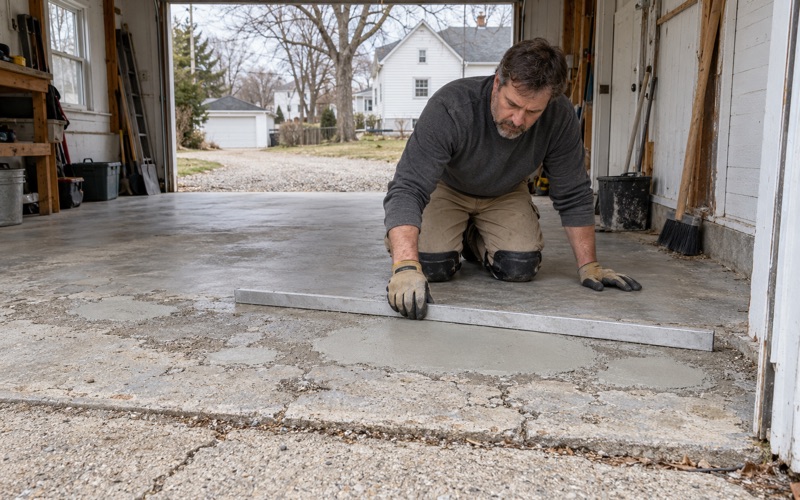
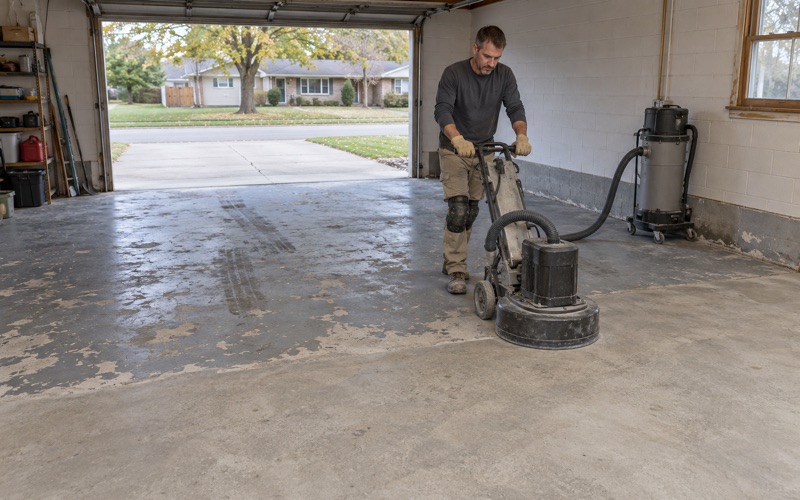
Unsealed concrete is porous, and a saw cut or shrinkage crack is a groove that holds whatever runs into it. Before any coating goes down, we profile the slab to an ICRI CSP range that suits the system, fill cracks, and treat joints with a semirigid filler so cart and equipment wheels do not chip the edges open again.
A hairline crack left under a coating usually returns as a line through it. We read the joints and cracks before quoting and tell you which ones are moving, because a floor meant to decontaminate cleanly cannot carry a known weak spot. If the slab itself needs work first, the proposal says so in plain words.
A Continuous Surface Up the Wall
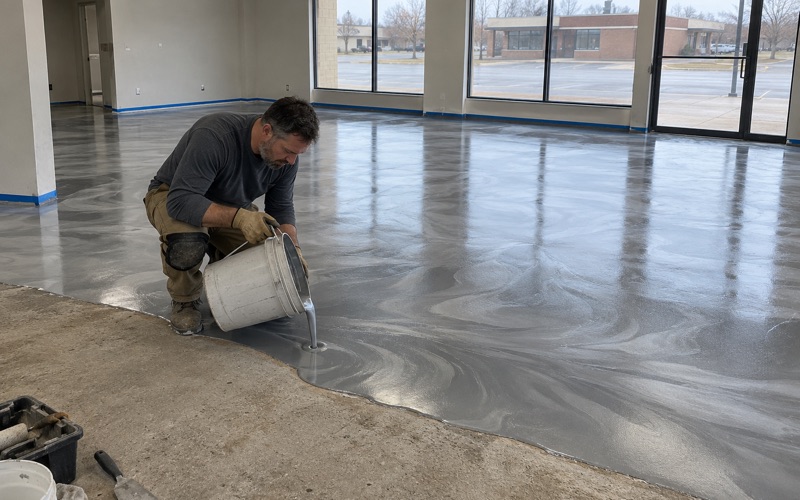
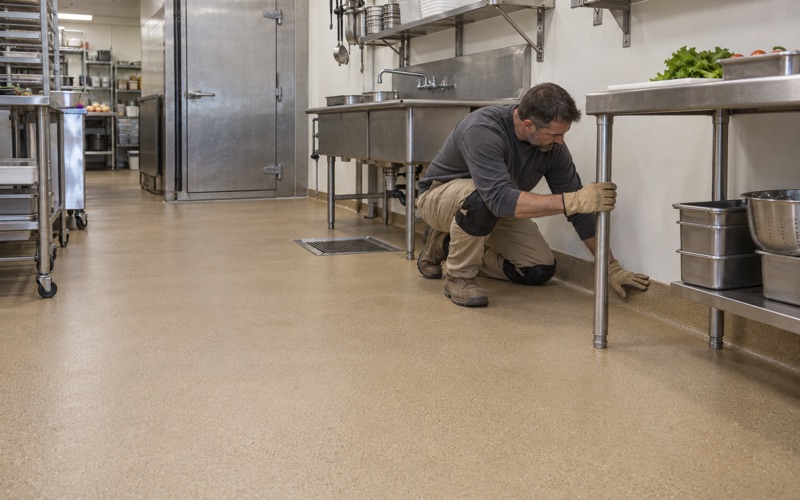
The joint between floor and wall is where a mop leaves residue and where spills collect. A coved base carries the resin up the wall in one piece, so there is no seam to clean around. On a 100% solids epoxy body with a chemical-resistant urethane or polyaspartic topcoat, the whole surface can be wiped and washed as one plane.
Pinholes from outgassing are the quiet defect in these floors, because a pinhole is a pore. We prime and apply against the slab temperature and dew point spread rather than the calendar, and we inspect the cured film before signing off. The proposal states the finished thickness, so the facility can verify it.
What a Coating Will Not Do
A floor coating does not shield radiation, and it does not make a room satisfy a license on its own. Compliance belongs to the license holder’s design, procedures and radiation-safety program. What a well-built floor offers is narrower: a surface that is easier to decontaminate and less likely to trap material against the day of decommissioning.
We say that in the proposal because overselling a coating in this setting does real harm. A facility manager who believes the floor does more than it can may relax a procedure that matters. Our job is to describe the floor honestly and build it to the thickness and profile we wrote down.
Floor Work Inside a Controlled Area
Installing a new floor in a clean, unused room is one kind of job. Grinding or removing an existing floor inside an area where radioactive material has been handled is another, and it is not ordinary surface preparation. The license holder’s radiation-safety program sets the conditions, and a contractor works inside them.
The License Holder Runs the Program
We do not hold a radioactive materials license or any authorization to work in a controlled area. Before any floor is disturbed in such a space, the license holder decides whether it can be, after its own surveys, under its own procedures. That reading follows from the duties in DHS 157.13; we have not read any NorthStar procedure.
In practice this means the work is scheduled through the facility, not booked like a garage. Access, personal protective gear, surveys before and after, and any hold points belong to the program. A bid for this work is a specialist bid that starts with the facility’s radiation-safety staff, not with our crew.
Dust, Slurry and Waste
Diamond grinding and shot blasting raise dust, and wet methods make slurry. On every job we collect both on site and never wash either toward a street drain. In a controlled area that baseline is not enough, because the license holder decides what counts as radioactive waste and how it is packaged and removed.
The rule asks license holders to minimize radioactive waste generation, which favors removing only what has to go. A thin-film coating that can be cleaned may be wiser to keep than to grind off. We would rather raise that question with the facility early than produce a pile of debris that becomes the license holder’s waste problem.
Where We Fit Before and Around It
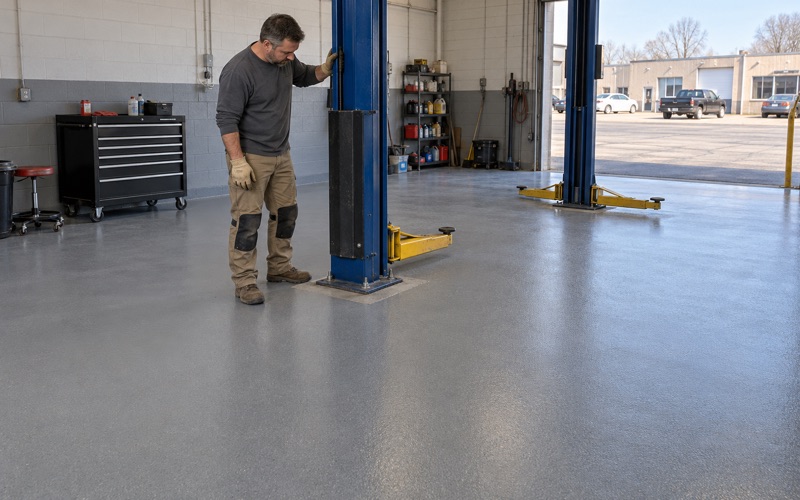
The easier work in these buildings is outside the controlled rooms, or in new space before any material arrives: corridors, support areas, mechanical rooms and shops. Those floors still take careful prep, moisture testing and a stated build, and they can be scheduled overnight or on weekends so production keeps running.
For anything inside a controlled area, we can describe the floor system, its thickness and its cure, and leave the decision about whether and when to disturb a surface where it belongs. A facility that wants that conversation can start it with us, and its radiation-safety staff will set the terms.
Beloit’s Older Homes and Garages
Most of our calls in the city come from houses, not laboratories. Census figures show 55.4 percent of Beloit homes were built before 1960, and 59.4 percent of households own the place they live in. That is an old, owner-led housing stock, and its slabs carry decades of patches, paint and spills.
Basements That Have Seen a Lot
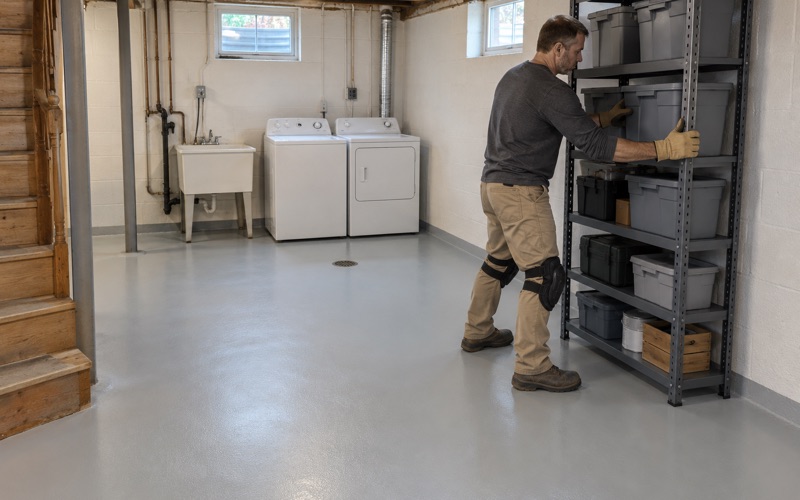
An older basement slab often has no vapor retarder under it at all, and a dry-looking floor can still push moisture through. We run ASTM F1869 calcium chloride tests or ASTM F2170 relative humidity probes before quoting a coating, and where the numbers call for it, a moisture-mitigation primer goes into the scope rather than being sold after a blister.
We do not sell a coating as radon reduction or as a cure for water coming up through a slab. Efflorescence and hydrostatic pressure have causes a floor cannot fix. When a basement needs drainage or crack repair first, we say so before anyone pays for resin that would peel.
Garages Built for a Rock County Winter
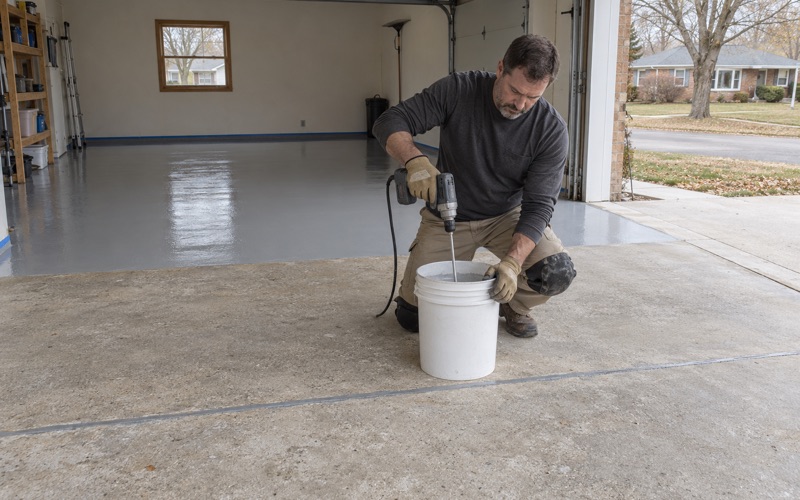
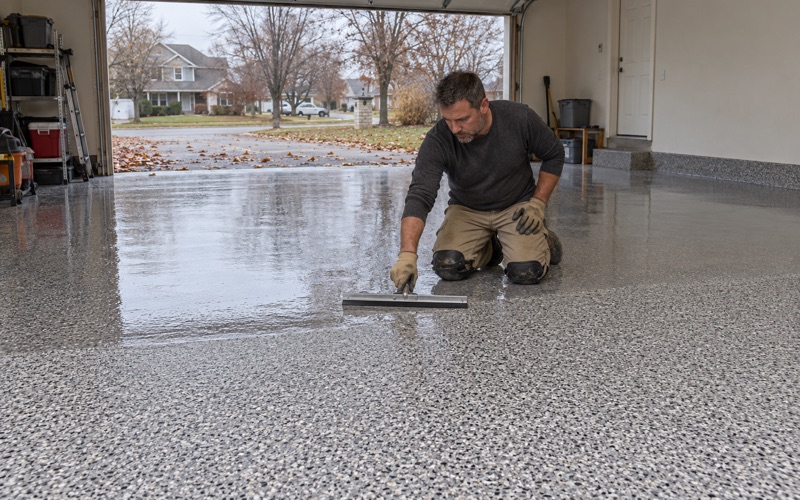
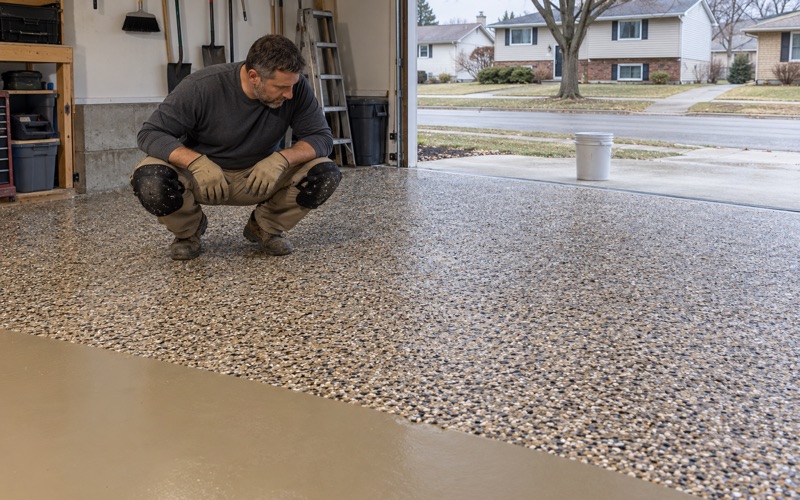
Road salt and calcium chloride brine ride into a garage on the tires all winter. We build garage floors for that, with a ground profile, a 100% solids or polyaspartic system, and a vinyl flake or quartz broadcast that gives the surface grip when meltwater pools near the door.
Curing is scheduled against slab temperature and dew point. An unheated garage can sit too cold for a proper cure for months, and when it does, we tell you plainly that the job waits for spring rather than risking amine blush or hot tire pickup on a floor that never fully cured.
Contracts, Permits and Rentals
Every Wisconsin home job gets a written contract before any deposit, as ATCP 110 requires. We also ask the City of Beloit’s building staff whether a job needs a permit, because replacing a slab and coating one are separate questions. The Town of Beloit is a different municipality with its own inspector.
Owners of rental houses should know the city’s Division of Community and Housing Services enforces a Housing Property Maintenance Code and performs interior rental inspections. A coated floor in a rental is still a floor an inspector walks, so we build it to be cleaned and to hold up between tenants.
- 20+ Years in Concrete Coatings
- Moisture Testing in Every Scope
- Free Written Estimates