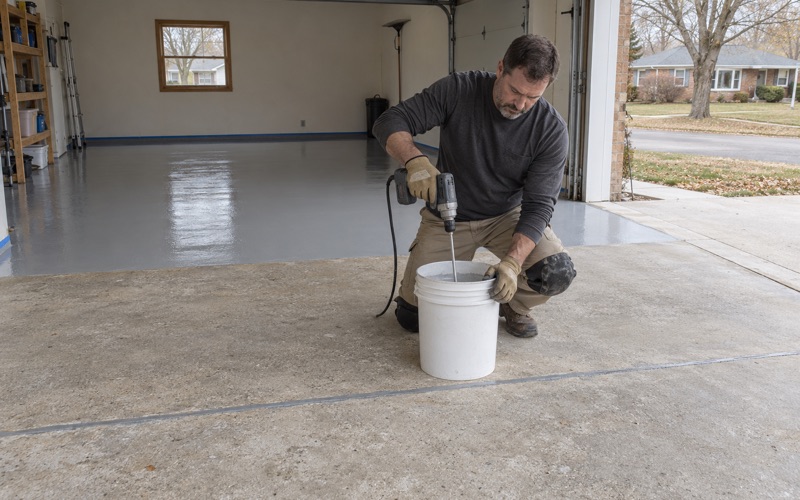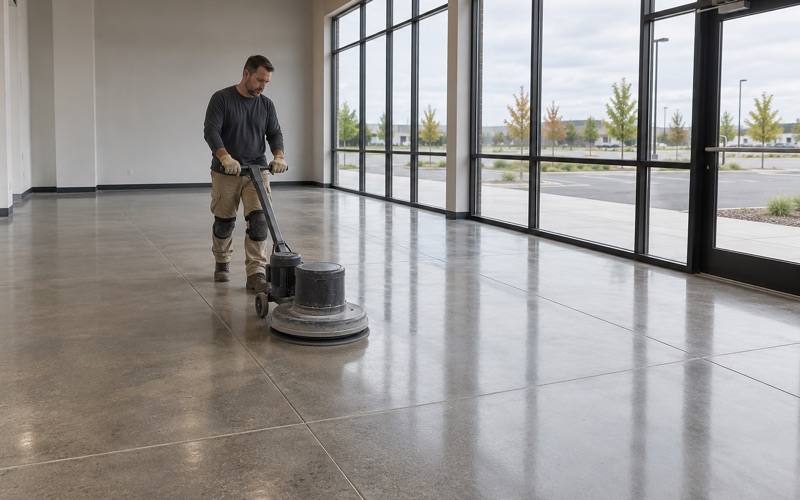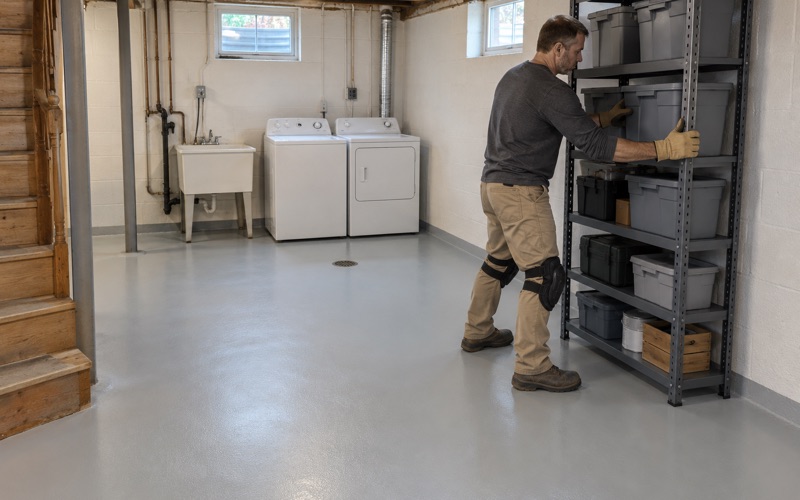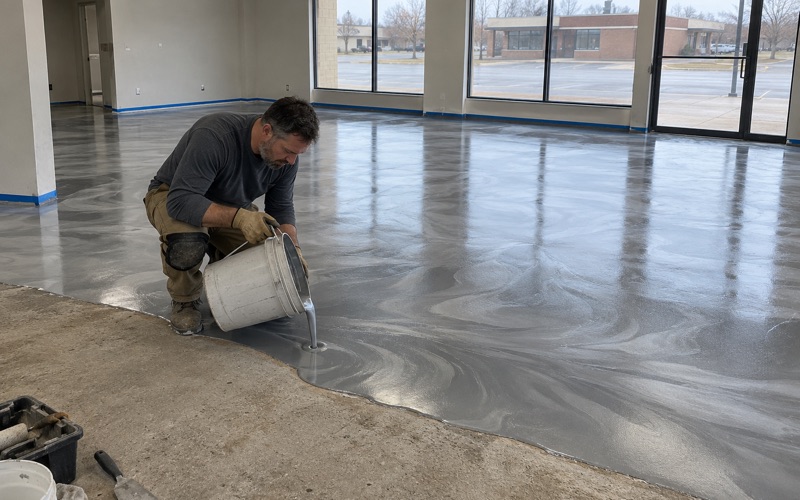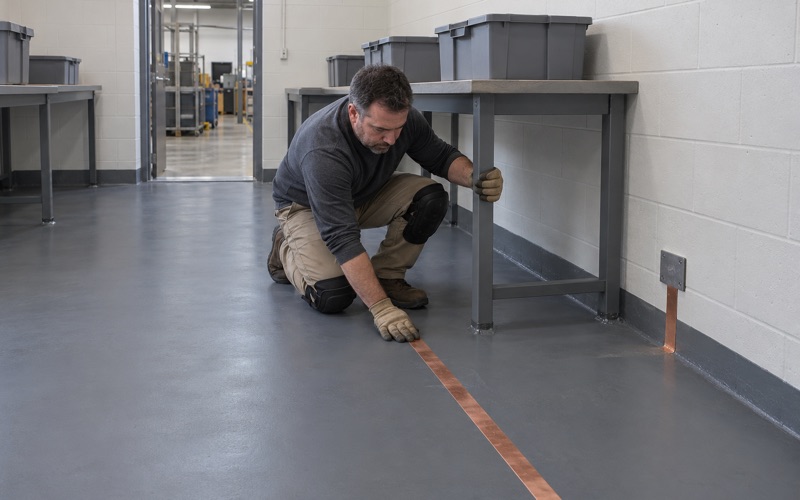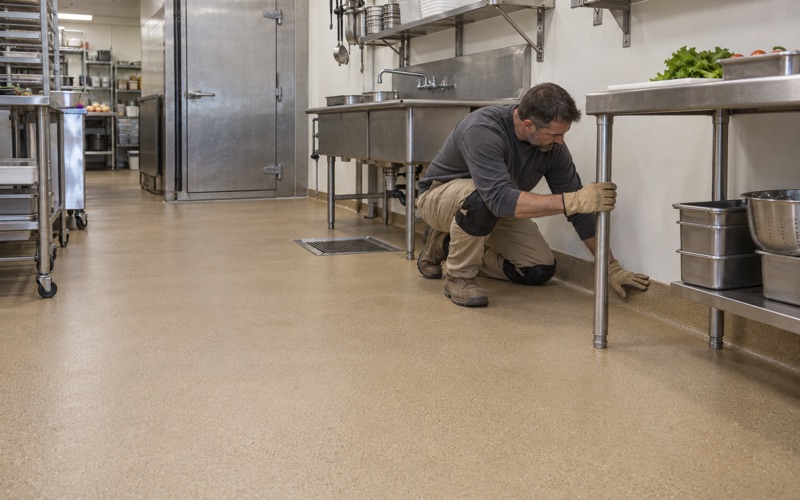
Janesville Epoxy Flooring has spent more than 20 years on epoxy flooring in Belvidere and the wider stateline area, and a growing share of that work starts with a floor that has been sitting still. When a plant, warehouse or shop goes quiet and then comes back under a new layout, the floor has to catch up with the equipment. That means old lines off, damaged concrete repaired and new aisles laid down where people and machines will actually move.
We approach these floors as a sequence rather than a paint job. The slab gets read first, then opened with a diamond grinder or shot blaster, then repaired, and only after that does any coating or marking go down. We never acid etch, because an etched surface gives a coating a weaker bond than a mechanically profiled one.
Every proposal we write names the product, the system build and the finished thickness, so a plant manager can hold the finished floor up against the quote. On Illinois jobs over $1,000 that proposal becomes a written contract, delivered with the consumer rights pamphlet the state requires, before any work is scheduled.
An Idle Assembly Plant and the Markings It Leaves Behind
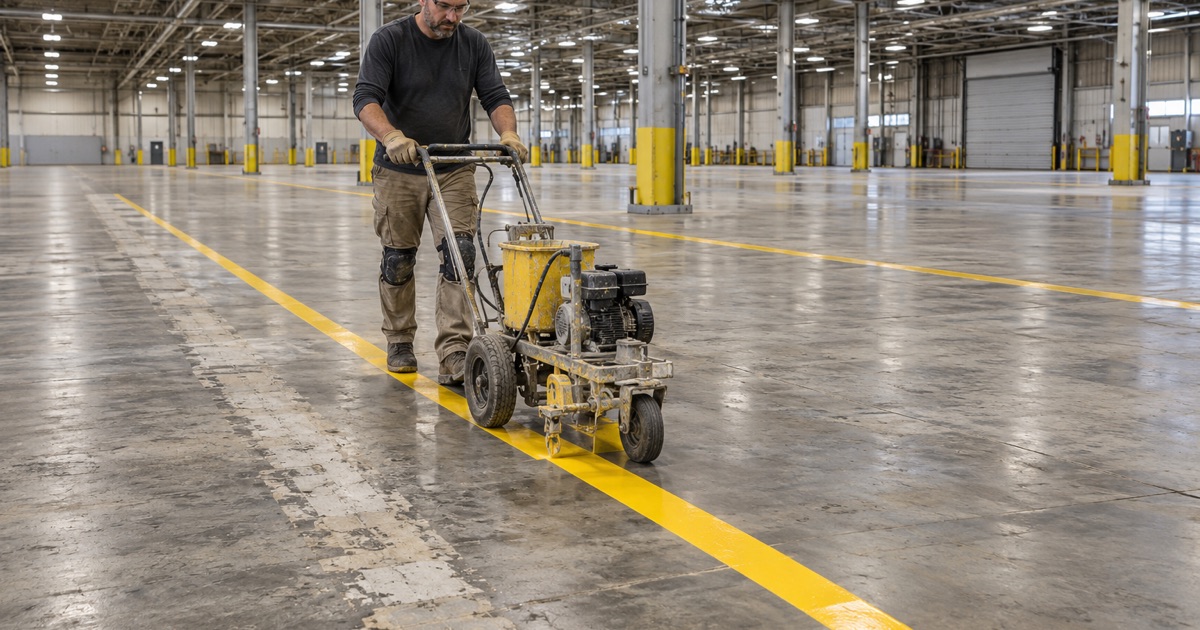
Belvidere Assembly, waiting to retool
The Belvidere Assembly Plant on West Chrysler Drive has been idle since February 2023, when its indefinite closure took effect. In October 2025 the Jeep Cherokee and Compass were assigned to the plant, and the building has to be retooled before either one can be built there. The timeline has already moved once, with pilot production now described as a 2028 target, so we do not treat any reopening date as settled.
We have no contract, bid or relationship with Stellantis or any of its suppliers, and nothing on this page should be read as a description of work at that plant. We mention it because it is the clearest local example of what happens to a floor when a building is laid out for one product and then reworked for another.
Why a new line means the old lines come off
The plant keeps a 38,000-square-foot SIM Room for testing job layouts, which tells you how much of an assembly operation depends on where stations, carts and walkways sit. When a line is retooled, those positions shift. Aisle markings painted for the old line end up running through new equipment, ending at walls that have moved, or pointing forklift traffic down a route nobody uses anymore.
A leftover stripe is not harmless decoration. Someone new to the building cannot tell an obsolete walkway from a current one, and a lane that looks protected may now cross a material route. That is why we treat line removal as the first step of any re-layout, not as an optional cleanup after the new markings are already down.
Taking old markings off without wrecking the slab
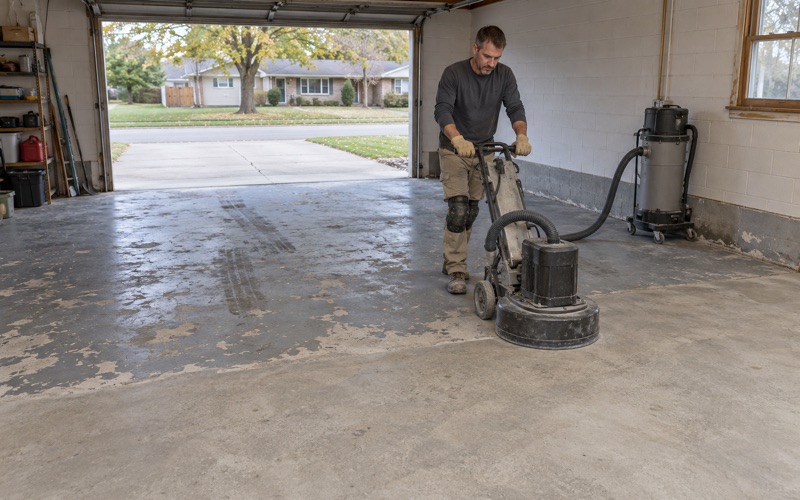
Old paint and coating lines come off with diamond grinding or shot blasting, the same tools we use to profile a slab for new work. Grinding takes the marking down to sound concrete and leaves a surface profile in the ICRI CSP range the next coating needs. Chemical strippers and acid washes leave residue that fights the bond, so we do not use them for this.
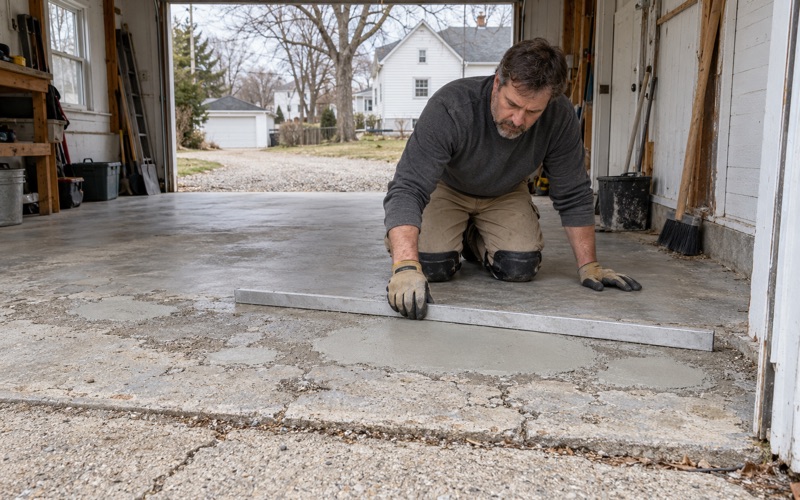
Removal also reveals what the marking was hiding. Faded stripes often sit over hairline cracks, spalled joint edges or patches from an earlier repair. We note each of those as the lines come up, because they become part of the repair scope before any new aisle can be laid out across that stretch of floor.
Looking for epoxy-flooring closer to Milton? See Epoxy-Flooring in Milton.
Inspecting and Repairing a Floor That Sat Idle
What the federal rule asks of a walking surface
Illinois private-sector workplaces fall under federal OSHA, and 29 CFR 1910.22(d) sets the baseline for any floor people walk on. Walking-working surfaces have to be inspected regularly and as necessary and kept in a safe condition. Where a hazard is found, it has to be corrected or repaired before an employee uses that surface again, or guarded until it is.
A floor that has sat idle for months or years has had nobody walking it daily and nobody reporting a broken joint. Before a building comes back into use, that inspection is the natural moment to find the damage. We walk the slab with the facility team, mark the problem areas and price the repair separately from the coating so the two are never blurred.
Reading cracks, joints and old coating before quoting
We look at every control joint, crack and patch before we put a number on a job. Moving cracks, joints with crumbling shoulders and coatings that have lost their bond all change the scope. Sometimes a section of slab needs repair or replacement before it can carry any coating at all, and we say so plainly rather than quoting a topcoat over a problem.
Plant and warehouse joints get a semirigid joint filler before any coating goes over them. That filler supports the edges so forklift and cart wheels roll across instead of chipping the shoulders. A coating bridged over an open joint will crack along that line within weeks of heavy traffic, which is exactly the kind of failure a reopened building cannot afford.
Moisture, temperature and timing
An idle building is often an unheated one, and that affects both the slab and the cure. We test moisture as a line item in every scope, using ASTM F1869 calcium chloride tests or ASTM F2170 in-situ relative humidity probes depending on the slab. Where readings run high, a moisture-mitigation primer goes into the proposal before anything else does.
Curing is scheduled against slab temperature and the dew point spread at the surface, not against a calendar date. Coating a cold slab in a damp building invites amine blush and a soft finish. When the heat is not back on yet, we would rather move the start date than install a floor that fails its first month in service.
Laying Out Aisles and Walkways for the New Layout
Permanent aisles, appropriately marked
Under 29 CFR 1910.176(a), where mechanical handling equipment is used, sufficient safe clearances have to be allowed for aisles, at loading docks, through doorways and wherever turns or passage must be made. Aisles and passageways must be kept clear and in good repair, and permanent aisles and passageways must be appropriately marked.
The rule does not prescribe a color, a line width or a coating type, and we do not pretend otherwise. Those choices come from the building’s own safety program, its equipment and its traffic. Our job is to lay the markings out to the new equipment plan the facility hands us and to make them last under the traffic they will see.
Building a marking system that holds up
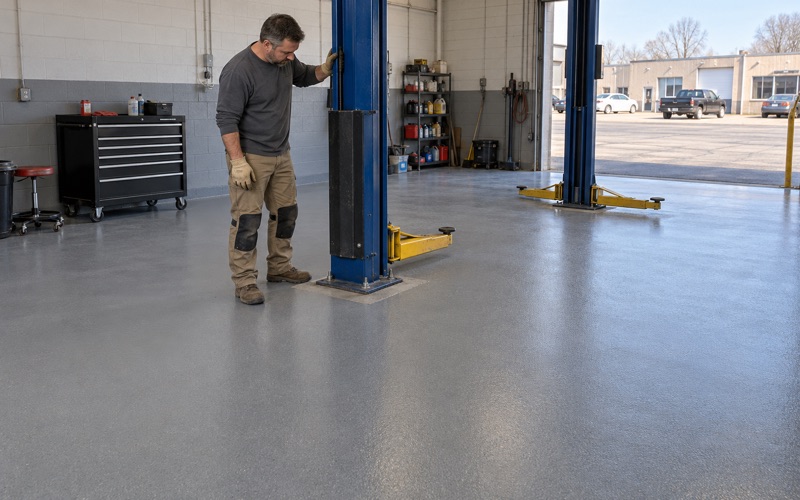
For most plant floors we lay down 100% solids epoxy as the base, then mark aisles and walkways in a contrasting color before a polyaspartic or polyurea topcoat seals the lines in. Burying the markings under a clear wear layer keeps them from scuffing off at the first forklift turn. In high-traffic zones a quartz aggregate broadcast adds slip resistance across the walkway itself.
Where a full coating is not part of the scope, we can grind narrow lanes and apply marking material directly to the profiled concrete. That approach costs less up front, though it wears faster at turns and doorways. We explain the tradeoff in writing so the facility chooses with the maintenance cost in view, not just the install price.
Working around the hours a building has to run
A building coming back online usually has trades, installers and equipment movers working in the same space. We schedule plant floors around the hours the building has to keep running, including overnight and weekend windows. Sections are coated in phases so one area cures while another stays open for traffic.
Grinding dust is collected at the machine and slurry is contained on site, never washed toward a floor drain or a storm inlet. On Illinois jobs we use coatings that meet the state’s Part 223 VOC limits, which bind the applicator as well as the manufacturer, so the products we bring into an occupied building are ones we are allowed to apply there.
Other Belvidere Buildings Changing Hands
Re-tenanted industrial space
Belvidere is the county seat of Boone County, settled on the Kishwaukee River and part of the Rockford metropolitan area, and the assembly plant is far from its only industrial building. Any building that changes tenants or layout after sitting empty runs through the same sequence. Old lane lines come up so nobody mistakes them for new aisles, damaged concrete is repaired, and new markings go down to fit the new equipment.
A new tenant rarely inherits a floor that suits its operation. A distribution user wants wide forklift lanes and dock approaches, while a light manufacturer may need pedestrian walkways threading between workstations. We start from the tenant’s floor plan, not the previous occupant’s stripes, and quote the removal, repair and re-marking as separate lines.
Permits under Belvidere’s adopted codes
Coating a slab and replacing one are different questions for a building department. Before any job is scheduled, we ask the City of Belvidere Building Department whether that specific scope needs a permit. Ordinance 703H, enacted in November 2024, adopted the 2021 International Building Code and related codes with local amendments for permit applications after January 1, 2025.
If a slab section has to be cut out and replaced, that work may fall under those codes in a way a coating does not. We would rather ask the question up front than discover a permit issue halfway through a re-layout. The answer goes into the schedule so the facility knows the sequence before the first grinder arrives.
Homes and garages in an older housing stock
The same discipline applies to the residential work we take on here. More than a fifth of Belvidere’s housing units were built before 1940, and another large group went up in the 2000s, so slabs range from old, patched basements to newer attached garages. We moisture test both kinds before coating, because a dry-looking slab is not proof of a dry one.
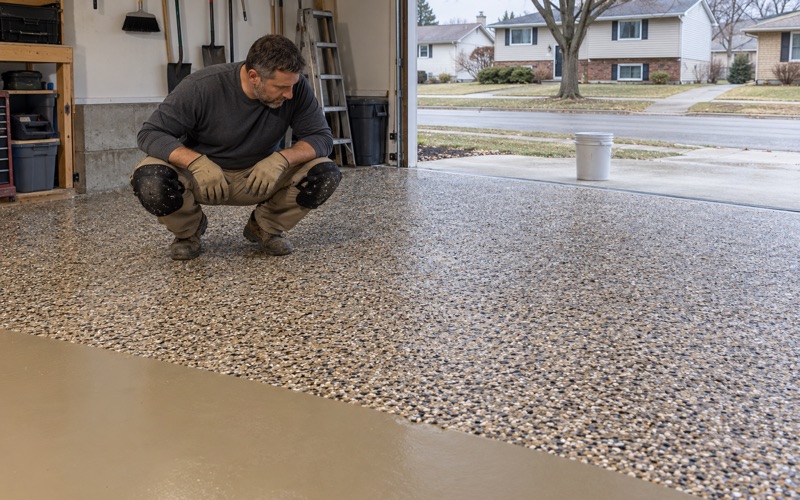
Warranty exclusions are read out before a home job is sold, with moisture named first. We do not sell a floor coating as a fix for water coming up through a slab, and we do not pretend it reduces radon. Garage floors get a system built for road salt and calcium chloride brine, the way a northern Illinois winter tracks it in on the tires.
- 20+ Years in Concrete Coatings
- Moisture Testing in Every Scope
- Free Written Estimates