Janesville Epoxy Flooring provides concrete floor repair in Janesville, WI, serving surrounding cities including Milton, Edgerton, Beloit, South Beloit and Evansville. We have spent more than 20 years reading cracks, joints and failing coatings before we quote, and we say plainly when a slab needs repair, or replacement, before it can be coated. Repair is often the step that decides whether a new floor lasts a decade or peels in a year.
Some customers call us for repair alone, to stop a garage floor from scaling or to keep a warehouse joint from breaking apart under forklifts. Others need repairs as part of a coating job. Either way, we diagnose what caused the damage first, because patching a symptom without understanding the cause usually means patching it again next year.
Our proposals list each repair and the material we will use, so you can see what is being fixed and why. Repair dust and slurry are collected on site, never washed toward a street drain or the Rock River. The sections below cover the repairs we handle most often and how they fit into a finished floor.
Concrete Floor Repairs We Handle
Crack Repair
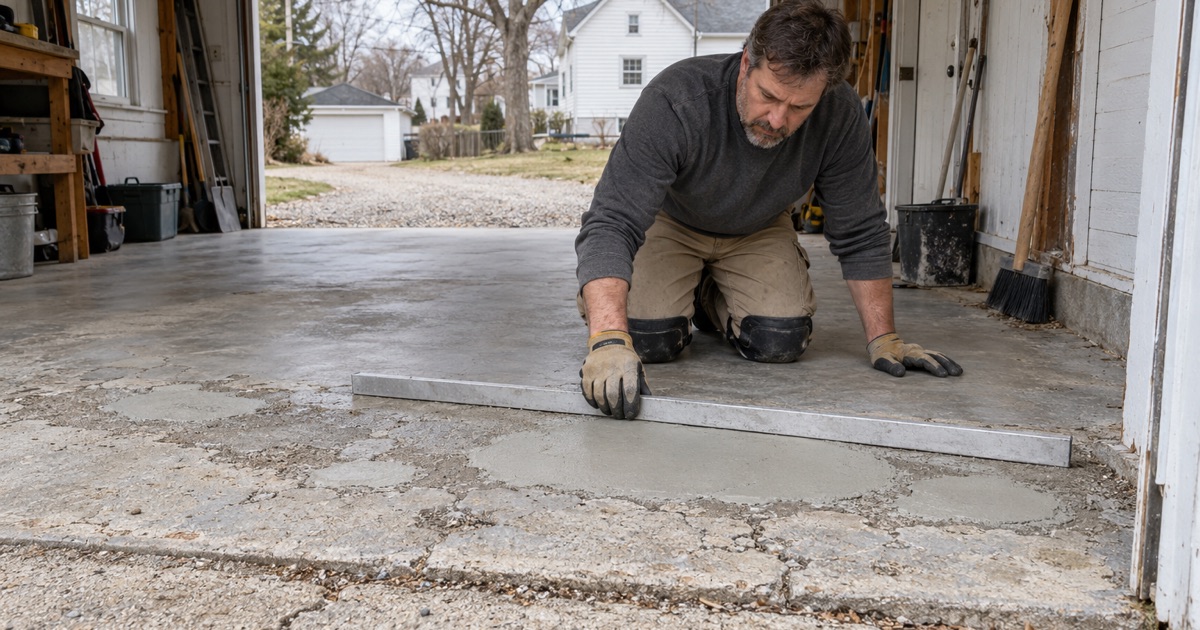
Cracks form as concrete shrinks, settles and moves with temperature, and almost every older slab has some. We route each crack open to a clean, solid edge, vacuum it out and fill it with a rigid epoxy or polyurea repair material. Once cured, the repair is ground flush with the surrounding floor so it can be coated or left bare.
Not every crack is the same, though. A crack that is offset in height, actively leaking or still widening is a sign of movement or water, and we tell you that before deciding whether a simple fill is enough.
Spalling and Salt Scaling
Spalling and scaling show up as flaking, pitting and broken surface concrete, often near garage doors and along driving lanes. In this area, the usual culprit is rock salt and calcium chloride brine carried in on tires, which soaks into the surface and breaks it apart as it freezes and thaws. Older slabs with weak surface paste are especially prone to it.
We grind away loose and weakened concrete down to sound material, then rebuild the surface with a repair mortar suited to the depth of the damage. A coating afterward keeps brine on top of the floor instead of letting it back into the concrete.
Joint Repair and Semirigid Filler
Control joints are designed break lines, but unfilled joints leave the slab edges exposed to impact. In plants, shops and warehouses, forklift and cart wheels chip those edges until the joint becomes a widening trench. We clean and rebuild damaged edges, then fill the joints with a semirigid filler that supports them.
That filler is firm enough to carry wheel traffic yet flexible enough to tolerate small slab movement. Filling joints before any coating goes over them is what keeps the coating from cracking along every joint line.
Repairing a Slab Before It Is Coated
Reading Old Coatings and Peeling
A peeling coating is evidence. Where it lets go, and how, tells us whether the problem was poor preparation, moisture, hot tire pickup or a product that was never right for the floor. We read that evidence before quoting, because coating over the same cause just repeats the failure.
Failed coatings are ground off completely, along with old sealers and paint. We never acid etch, and we never try to bond a new system to a layer that is already losing its grip.
When Replacement Beats Repair
Some slabs are past repair. A floor that has heaved, sunk unevenly, broken into loose sections or lost most of its surface may cost more to patch than to replace, and patching it may not hold. We say so honestly rather than selling a repair that will fail.
Replacing a slab is a different job from repairing or coating one, and it can carry permit and inspection requirements. We ask the city or village building inspector before anything is scheduled, so you are not caught by an inspection nobody planned for.
Moisture, Efflorescence and Pitting
White deposits, damp patches and pitting in a basement or garage floor can point to moisture moving through the slab. Repair material bonds poorly to wet concrete, and a coating over a moisture problem will blister. We test with a plastic sheet, calcium chloride or relative humidity method before repairing or coating those floors.
If readings run high, we adjust the repair materials and add a moisture-mitigation primer under any coating. Where the cause is water entering the space, we point that out, since no floor repair can fix it.
Residential and Commercial Concrete Repair
Garage and Basement Floor Repair
In homes, we repair scaled garage aprons, cracked basement slabs, damaged edges around sump pits and floor drains, and the patchwork left by decades of previous fixes. Many local garages and basements date from the 1960s and 1970s, and their slabs carry that history. We match the repair to the slab and to whether it will be coated afterward.
Every Wisconsin home repair job gets a written contract before any deposit is taken, and Illinois home jobs over $1,000 also receive that state’s consumer rights pamphlet. The contract lists each repair and its material.
Plant, Shop and Warehouse Floor Repair
Commercial floors take heavier abuse: forklifts, dropped parts, anchored machinery, chemicals and constant wheel traffic. We repair joints, rebuild spalled traffic lanes, patch around machine bases and fill cracks with materials that can take the load. Repairs are planned around the hours the building has to keep running, including overnight and weekend windows.
When a repaired floor will be coated, we sequence repair and coating together so the floor goes back into service once. When it will stay bare or be polished, we choose repair materials that grind and finish cleanly with the slab.
- 20+ Years in Concrete Coatings
- Moisture Testing in Every Scope
- Free Written Estimates