Janesville Epoxy Flooring has spent more than 20 years on epoxy-flooring in Evansville and the rest of Rock County, and the jobs here often arrive tangled up with a larger house project. A homeowner rewiring an older place or reinforcing a sagging beam wants the basement or garage floor finished too, and the question we hear most is whether the coating can ride along with the rest of the work.
Our answer starts with the slab, not the paperwork. Before we quote, we read the cracks, the joints and any old coating, and we tell you plainly when a floor needs repair or replacement before anything can go on it. Moisture testing is written into the scope as its own line, whether the slab sits under a basement or a garage.
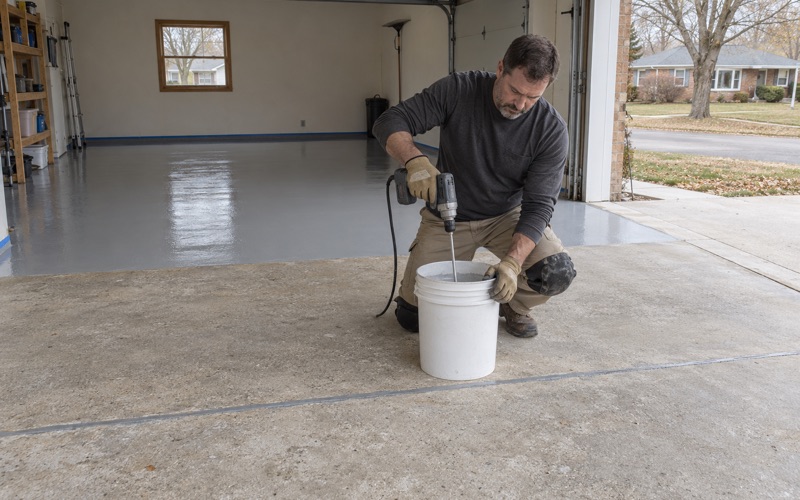
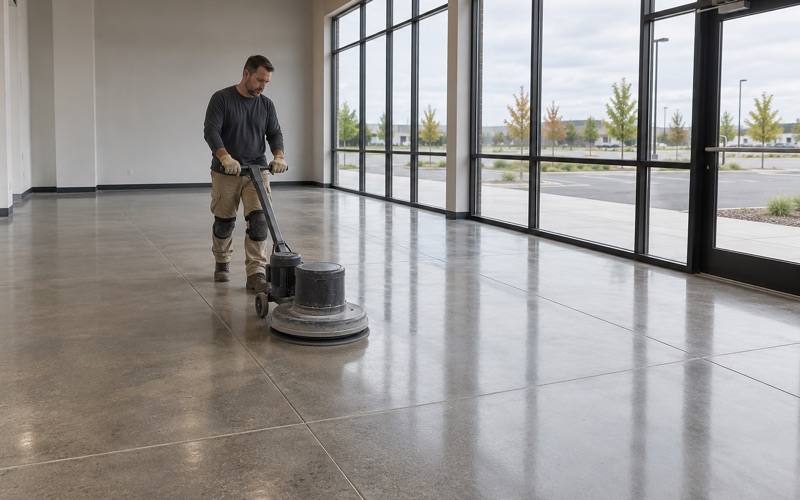
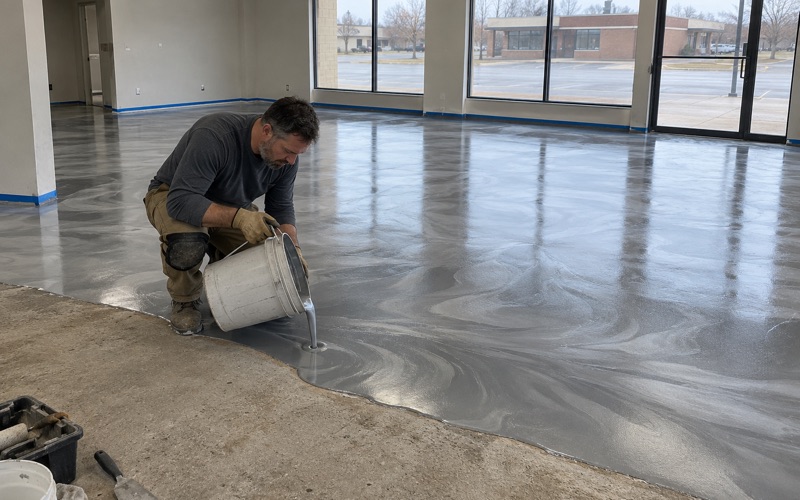
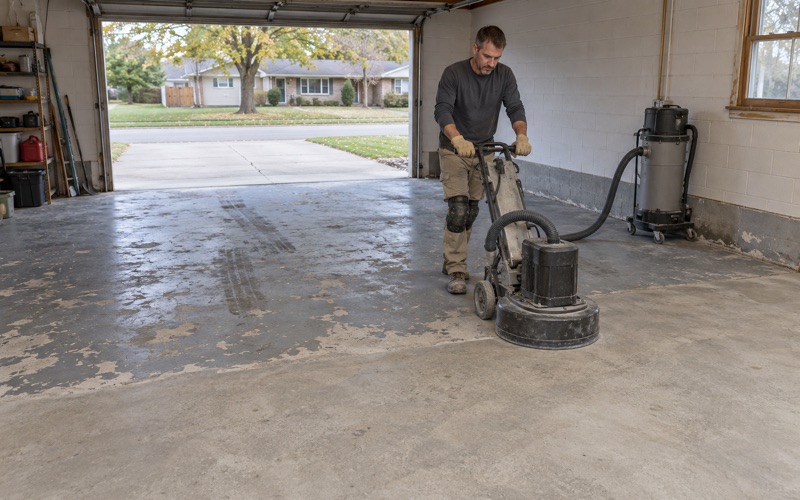
The proposal you get names the product, the system build and the finished thickness, so you can check what was quoted against what went down. On the surface itself, we open every slab with a diamond grinder or a shot blaster and never acid etch, because a coating only holds as well as the profile beneath it.
Evansville’s Historic Districts and the State Credit
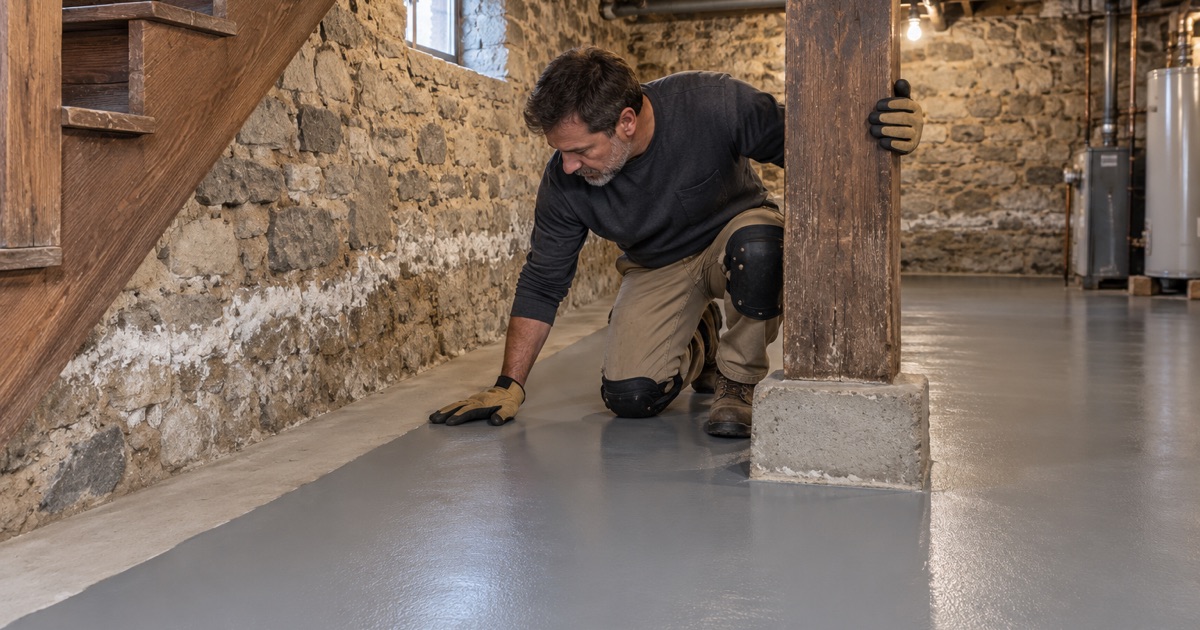
A good share of the homes we see in town carry historic standing, and that changes how a floor job fits into the calendar. It does not change how we prepare concrete, but it does change the order of trades and the way the bill is written.
One parcel in six
The city’s Historic Preservation Commission counted 384 historic parcels out of roughly 2,340 in its 2021 annual report. Those parcels sit across four historic districts listed on the National and State Registers, named on the commission’s map as the Evansville Historic District, Grove Street, South First Street Residential and Leonard-Leota Park, with 351 contributing buildings among them.
That is about one parcel in six. If your home contributes to a historic district, you are likely already weighing exterior work and system upgrades, and a basement or garage floor coating tends to come up partway through those conversations rather than as a project of its own.
What the Historic Homeowners Tax Credit returns
Wisconsin’s Historic Homeowners Tax Credit returns 25 percent of approved rehabilitation expenses on homes listed in the National or State Register or contributing to a district before work begins. The Wisconsin Historical Society reviews applications, and the Wisconsin Department of Revenue holds the final authority on eligibility.
The eligible work falls into named categories. The exterior of the house counts, such as roof replacement and painting, but not driveways or landscaping. So do the interior of a window sash when the exterior sash is also worked on, structural elements like reinforced beams, heating and ventilating systems, and electrical wiring or plumbing systems, though not fixtures.
Approval before the work starts
The program’s wording is direct: the work must receive approval before you begin your project. A homeowner also has to spend between $10,000 and $40,000 on eligible work within a two-year period, which means timing and paperwork matter as much as the work itself.
We have no role in that application and do not advise on it. What we can do is stay out of its way, by keeping our scope, our start date and our invoice clearly separate from whatever the credit application covers.
Looking for epoxy-flooring closer to Rockton? See Rockton Epoxy-Flooring.
Why a Floor Coating Sits Outside the Credit
Reading the category list, a decorative or protective floor coating does not appear on it. Only the Department of Revenue decides whether a given expense counts, and we never rule on a specific job, but we plan every Evansville proposal on the assumption that the floor stands apart.
Priced and invoiced on its own
If a basement plumbing replacement or a beam repair is part of a credit application, our coating does not belong mixed into that invoice. We write a separate proposal and a separate bill, so the costs you submit for review are not muddied by a line item that was never among the listed categories.
That separation also protects you if plans change. Should the credit work slip a season, the floor proposal still stands as written, with its product, system build and finished thickness unchanged and its own warranty terms read out before you sign, moisture exclusions named first.
Downtown rehabs on Main Street
The city’s downtown runs along Main Street between First and Union streets, and the comprehensive plan leans on the historic districts to keep it attractive. The Grange Store at 21 W. Main Street finished its rehab in 2021, and the commission reported that the applicant used both state and federal historic tax credits.
Income-producing buildings follow a different program than homes, and federal review can reach interior finishes as well as exteriors. On a commercial rehab like that, a floor finish may be part of the reviewed scope, so we coordinate with the owner and their consultant before choosing a system rather than assuming the homeowner rules apply.
Sequencing Floor Work After Structural or Plumbing Repairs
The order of trades is where most of our planning goes on a historic home. A coating applied too early gets cut, patched or stained by the crews that follow, and a patched epoxy floor never looks like the one in the proposal.
Let the pipes and beams go first
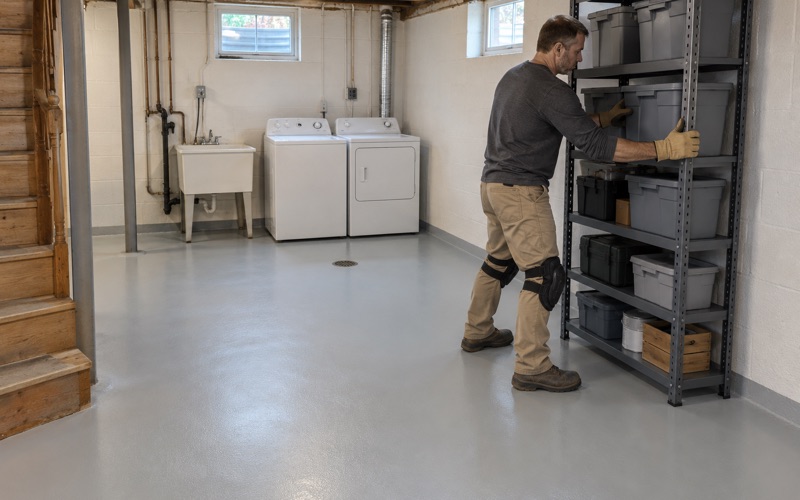
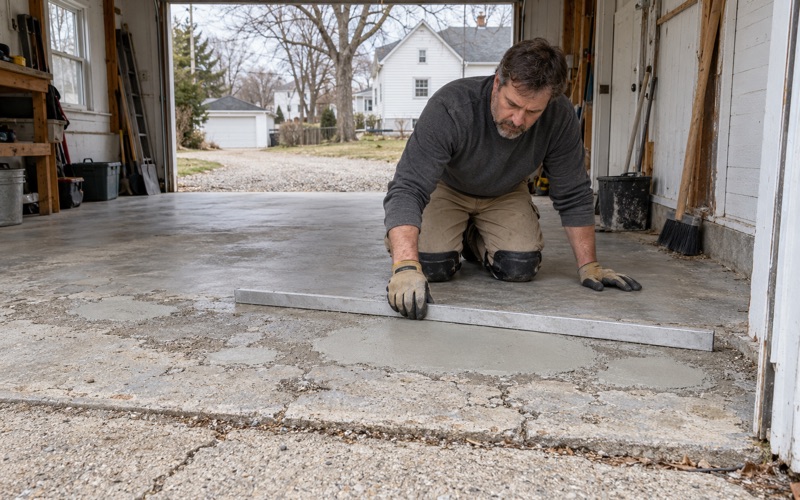
If a plumber needs to trench the basement slab, or a carpenter is shoring a beam with posts on new footings, that work should be finished and the concrete patches fully cured before we arrive. Fresh repair concrete holds more water than the old slab around it, and coating over it early invites trouble.
We ask homeowners for the schedule of every other trade before we set a date. When electrical or heating work is still open, we would rather wait a few weeks than coat a floor that a furnace installer will drag equipment across or a plumber will open again.
Testing the slab after the trades leave
Once the other crews are done, we test the slab before grinding. Depending on the floor, that can mean an ASTM D4263 plastic sheet test as a first read, ASTM F1869 calcium chloride kits for a vapor emission rate, or ASTM F2170 relative humidity probes set into the concrete.
Older basements in particular can hold moisture that a dry-looking surface hides. If the numbers come back high, we name a moisture-mitigation primer in the system build or tell you the floor should wait. A coating is a finish, never a fix for water coming through a slab, and we do not sell it as one.
Curing against slab conditions
We schedule curing against slab temperature and the dew point spread at the surface, not against a date on the calendar. A cold slab with moisture condensing on it is how amine blush forms on epoxy, and a topcoat over blush can lose its grip.
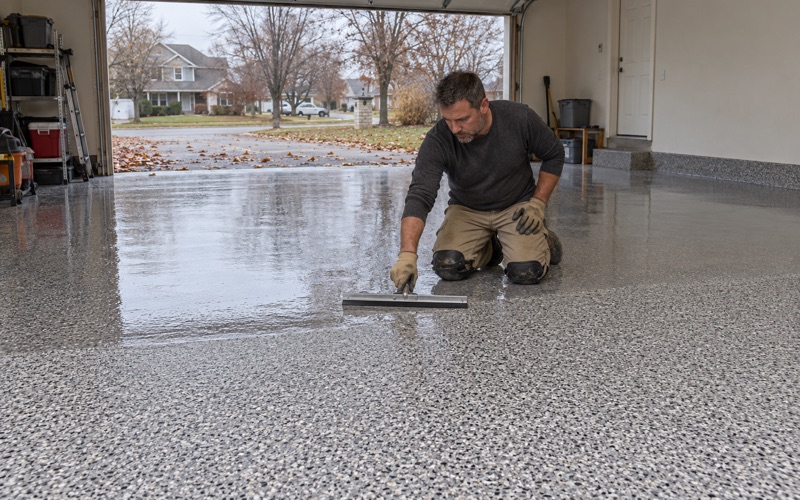
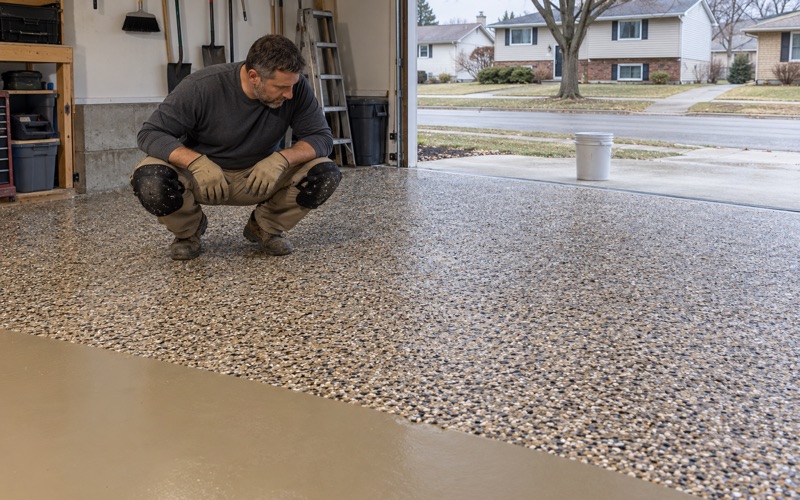
For an unheated garage, that sometimes means telling you the job has to wait for spring. When the conditions are right, a 100% solids epoxy base with a vinyl flake broadcast and a polyaspartic topcoat gives a garage floor real resistance to the road salt and calcium chloride brine that a Rock County winter carries in on the tires.
Interior Floors, the Commission and the Permit Question
Many owners of contributing homes assume every project has to go before the commission. For a floor coating, the more useful questions are which review applies to interior work and whether a permit is involved at all.
The Certificate of Appropriateness covers the exterior
The Evansville Historic Preservation Commission is made up of seven members appointed by the mayor. Its Certificate of Appropriateness application covers work on the exterior of a structure in a historic district or on a designated historic building or site, and in 2021 the commission reviewed 44 projects.
A basement or garage floor coating inside the house is interior work, so it does not go to the commission under that application. If your project also changes a garage door, a window or the siding, that exterior piece is a separate matter between you and the commission, and we keep our floor schedule independent of it.
Asking the inspector before we schedule
The City of Evansville works with General Engineering Company to issue permits for work that needs a credentialed inspector, a list that includes remodels and refinishing of existing structures. Minor alterations go through City Hall staff at 31 S. Madison Street, open weekdays from 7:30 a.m. to 4:00 p.m. at 608-882-2266.
The city’s page does not list floor coating either way, and the city has signaled a future move to an in-house inspector. So before any Evansville job goes on the calendar, we ask the inspector directly whether a permit is needed, because replacing a slab and coating one are different questions.
Newer homes across the rest of the city
Not every Evansville floor comes with a historic file. About 32.3 percent of homes in the city were built since 2000, and most owner households live in detached houses, many with attached garages poured in recent decades.
Wisconsin does not require a vapor retarder under an unconditioned attached garage slab, so a newer floor can still carry moisture. We test it the same way we would an old basement, grind it to the right ICRI surface profile, and keep grinding dust and slurry contained on site instead of washing it toward a street drain.
- 20+ Years in Concrete Coatings
- Moisture Testing in Every Scope
- Free Written Estimates