Janesville Epoxy Flooring has spent more than 20 years on epoxy-flooring in Fort Atkinson and across our service area, and the jobs here that ask the most of us are the floors that have already been under water. A basement or garage that took river water is a different starting point than a dry slab, and we quote it that way from the first visit.
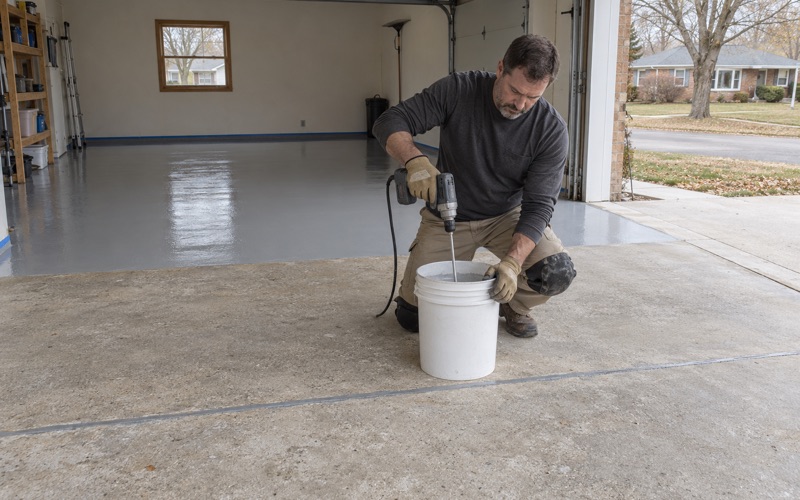
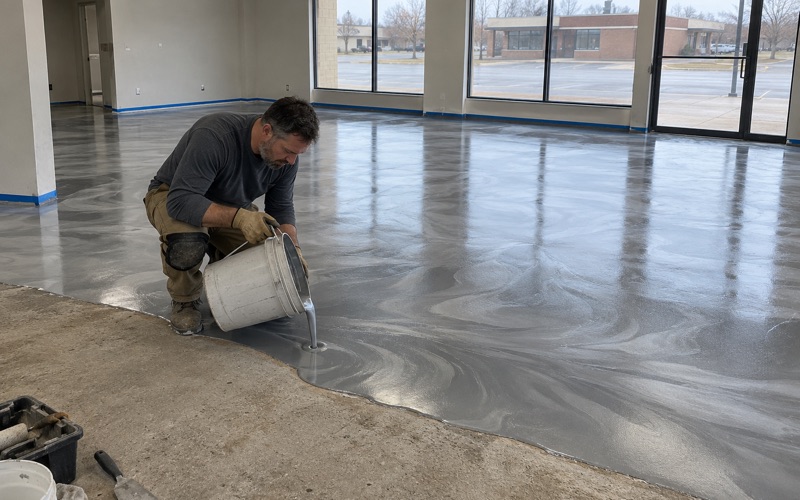
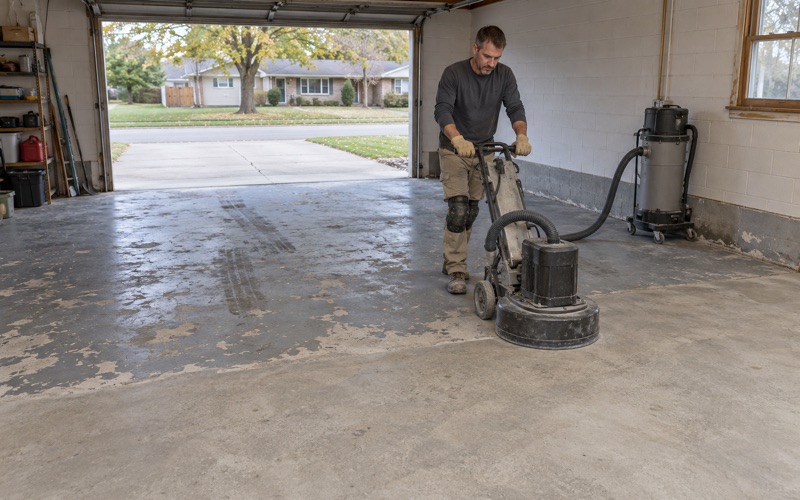
Our process starts with tools rather than chemistry. Every slab is opened with a diamond grinder or a shot blaster, never acid etched, and moisture testing appears as its own line in the scope. On a floor that has flooded, that test decides whether we coat this month or come back after the concrete has had time to give up what it absorbed.
What follows is how we approach a riverside floor: what the river gauge shows, how FEMA rates finish materials for flood exposure, why drying comes first, and where Wisconsin’s floodplain rules leave the decision with the city. A coating has a real job in a basement that floods, and it is a narrower job than some sellers describe.
The Rock River at Fort Atkinson, by the Gauge
A Record Crest of 20.9 Feet
The National Weather Service tracks the Rock River at Fort Atkinson on gauge FATW3, which USGS lists as station 05427085. On June 15, 2008 the river crested there at 20.9 feet, carrying 15,100 cubic feet per second, against a major flood stage of 18 feet. That crest sits at the top of the gauge’s historic list, nearly three feet above the major line.
The NWS impact notes put that number on the ground. At 18.5 feet, homes and businesses near the river are surrounded. At 20 feet, numerous roads flood, Highway 106 and North Shore Road among them. A crest like the 2008 one is the stage at which a riverside garage or basement floor becomes a moisture question for us rather than a footnote in the quote.
The Crests That Keep Coming Back
The 2008 record was not a one-off. The gauge recorded 18.12 feet on April 22, 2013, 17.4 feet on September 11, 2018, 17.22 feet on March 24, 2019, and 17.4 feet again on April 20, 2026. Earlier crests over 17 feet came in June 2004 and in April 2008, two months before the record.
At 17 feet the river walkway, a boat launch and some yards go under, and the Bark River backs into Nature Park near where it meets the Rock. At 17.5 feet the downtown riverside walkway closes and a few homes and businesses are surrounded. The gauge’s own history shows several crests in that range since 2004, not just the one everyone remembers.
Older Homes Near the Water
Fort Atkinson’s housing leans old and owner-occupied. Of 5,574 housing units in the Census five-year estimates, 1,299 were built in 1939 or earlier, and 68.5 percent of occupied homes are owned rather than rented. Basements of that era were poured to the practices of their day, and we do not assume we know what sits under the surface.
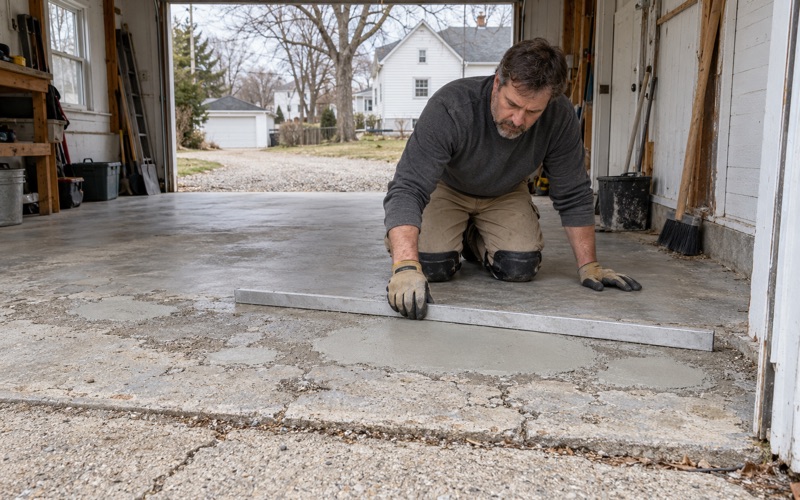
We bring that into the quote rather than the sales pitch. An old slab near the river may carry patching, paint or a previous coating over concrete that has been wet more than once. We read those cracks, joints and old layers before naming a price, and when the concrete needs repair or replacement before it can take a coating, we say so plainly.
Looking for epoxy-flooring closer to Stoughton? See Epoxy-Flooring in Stoughton.
What FEMA Rates as Flood Damage-Resistant Flooring
Technical Bulletin 2, Table 2
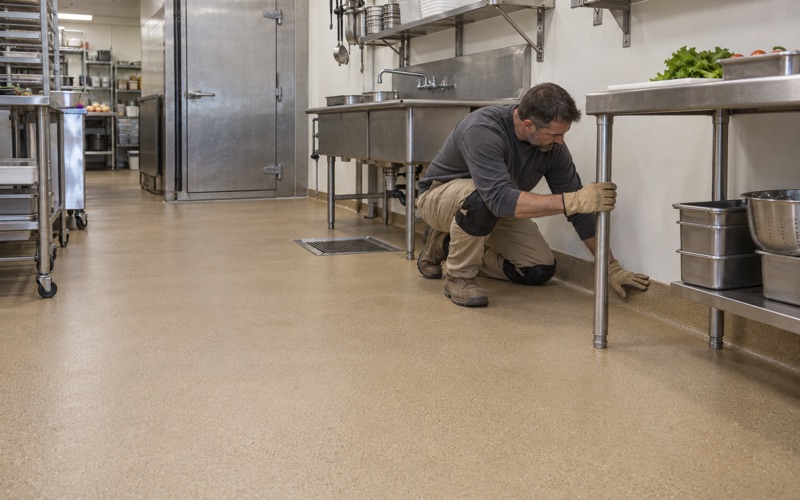
FEMA’s National Flood Insurance Program publishes Technical Bulletin 2, Flood Damage-Resistant Materials Requirements, most recently issued in January 2025. Table 2 rates common finish materials by whether they can survive contact with floodwater and the cleanup that follows. Formed-in-place epoxy flooring is rated Acceptable for floors, and so is formed-in-place polyurethane.
The same table rates carpeting, linoleum and asphalt tile Unacceptable. Ceramic or porcelain tile set in mortar is Acceptable, while the same tile laid with organic adhesives is not. For a below-grade room along the Rock River, that list explains why a seamless resin floor is a sounder choice than wall-to-wall carpet the table says will not come through the water.
What the Rating Means
Acceptable in Table 2 is a statement about the material, not about the room. It says a formed-in-place epoxy floor can be wetted, cleaned and dried without being ruined the way carpet or linoleum is. It says nothing about stopping water from entering a basement, and nothing about the concrete underneath staying dry.
That distinction matters to us because a coating is easy to oversell. A resin floor is a cleanable finish. It does not hold back a river, seal a foundation wall, or stop water pushed up through a slab by hydrostatic pressure, and we do not sell a floor coating as a fix for water coming up through concrete.
What We Put in Writing
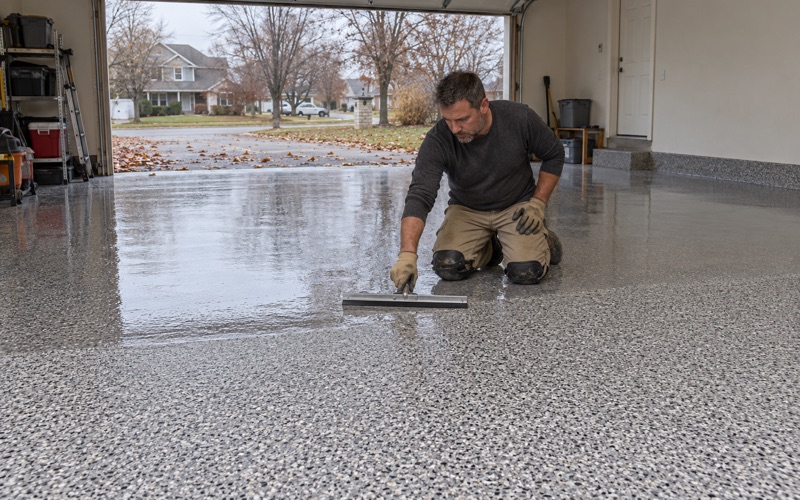
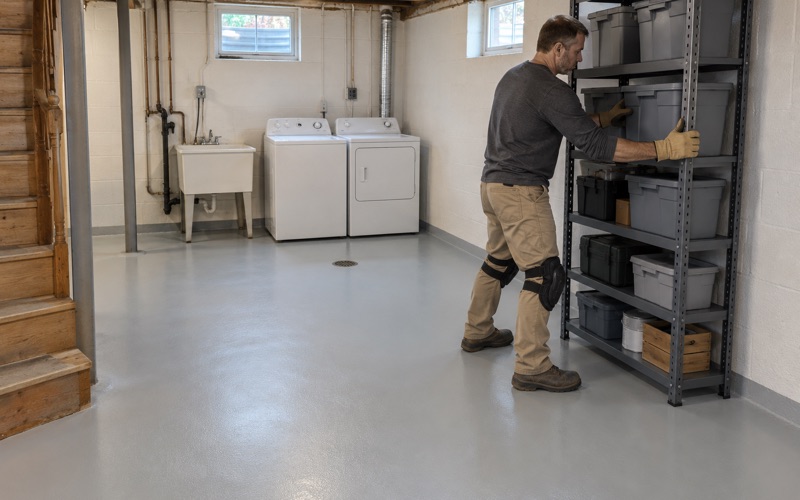
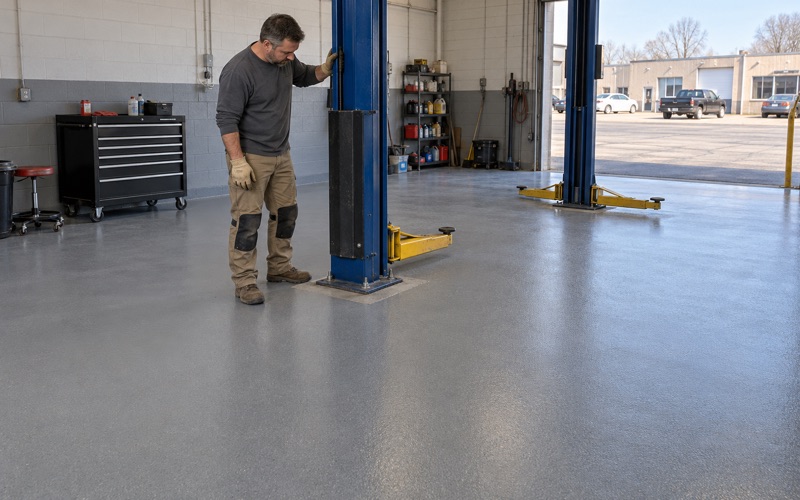
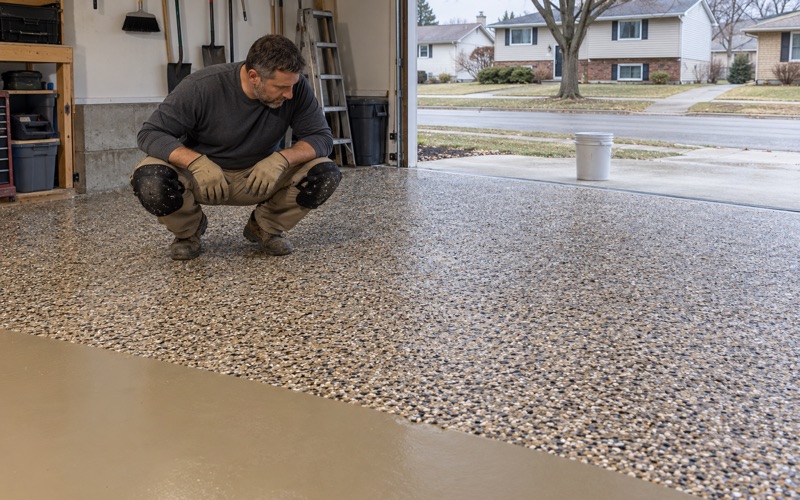
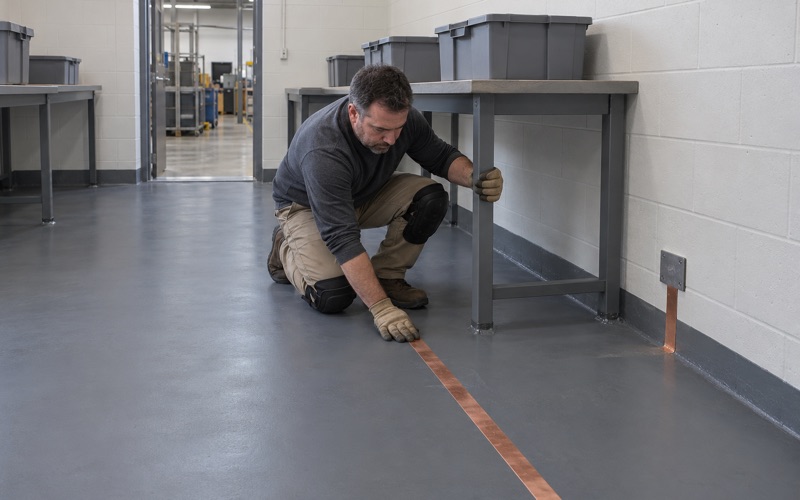
Our proposal names the product, the system build and the finished thickness, so a homeowner can check what was quoted against what went down. On a riverside basement that usually means 100% solids epoxy over a profiled slab, sometimes with a moisture-mitigation primer, and a topcoat chosen for how the room will be cleaned.
Warranty exclusions are read out before the job is sold, and moisture is the first one we name. A floor that takes river water again may need cleaning, drying and inspection afterward, and the paperwork should say who owns which part of that outcome before anyone has a reason to argue about it.
Drying a Slab After the Water Goes Down
Why a Wet Slab Cannot Be Coated
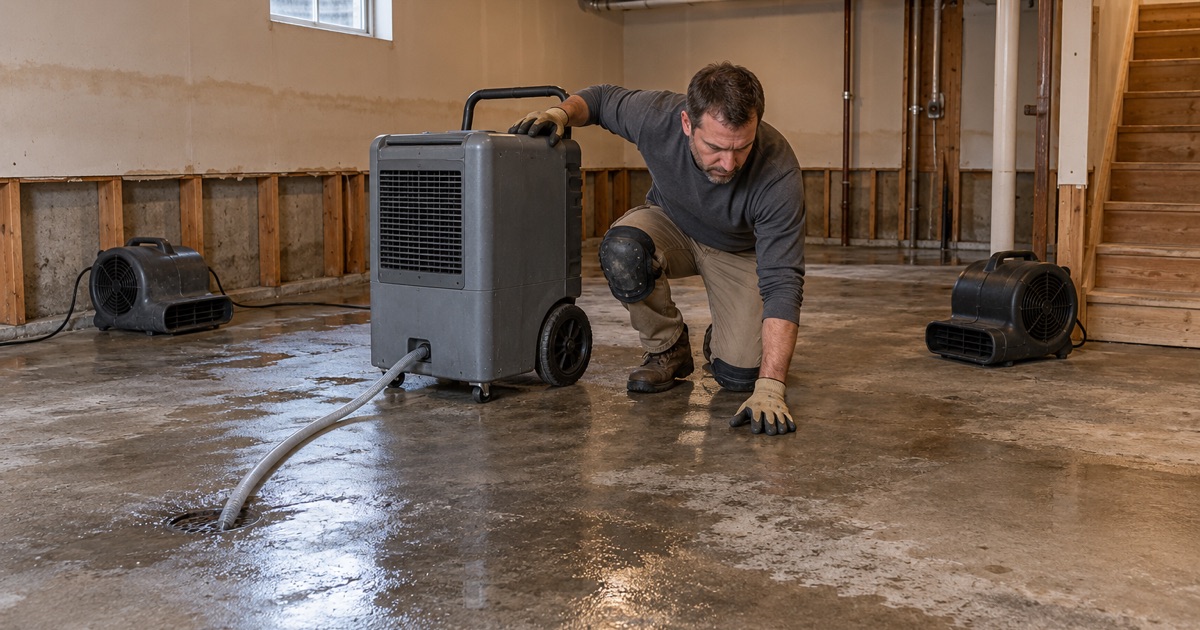
Once the river drops and the basement is pumped out, the concrete is still holding water. A slab soaks it up through its pores and gives it back slowly, and coating over that moisture traps it beneath the film. The usual results are blisters, lost adhesion, outgassing and pinholes, and a floor that fails from below rather than from wear.
That is trade practice rather than a local rule, and it is why we will not schedule a coating the week after a flood, however clean the floor looks. Surface water evaporating off the top tells you little about what the middle of the slab is doing, especially on a thick basement pour.
How We Test Before We Coat
Moisture testing is a written line item on every basement and garage job. A plastic sheet test under ASTM D4263 gives a quick read on whether moisture is coming up. Calcium chloride testing under ASTM F1869 measures the vapor emission rate, and in-situ relative humidity probes under ASTM F2170 read conditions inside the slab itself.
We compare those readings against the coating maker’s limits and the ASTM F710 thresholds before setting a date. If the numbers are too high, the honest answer is to wait, run dehumidification and test again. A moisture-mitigation primer can widen the window on some slabs, but it is a product choice we explain, not a way around a reading.
Preparing Concrete That Has Been Under Water
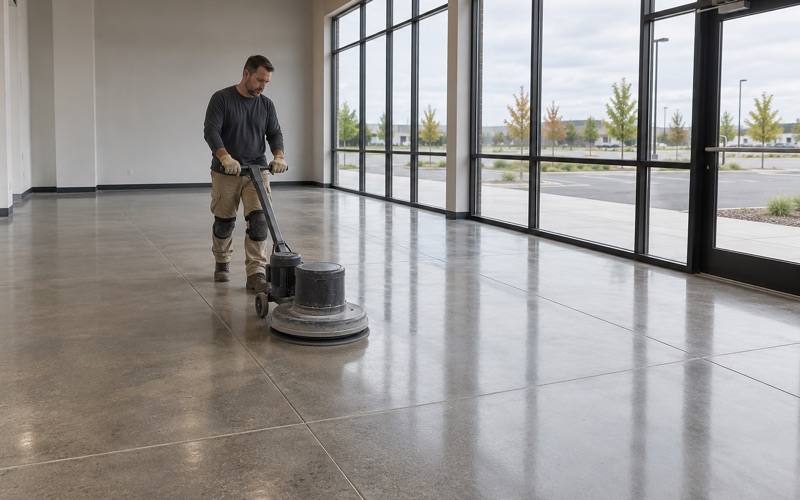
Floodwater leaves more than water behind. Silt, efflorescence and residue from cleaners settle into the surface, and an old coating may have loosened where it sat wet. Grinding with diamonds or shot blasting removes that layer and opens the slab to a measured ICRI CSP profile, so the primer bonds to sound concrete.
Grinding dust and slurry are collected on site and never washed toward a street drain or the river. Curing is then scheduled against slab temperature and the dew point spread at the surface, because a basement that has only just dried can still hold enough humidity to cause amine blush on a fresh epoxy coat.
Floodplain Rules and Ordinary Maintenance
Who Decides in Fort Atkinson
Wisconsin requires municipalities to adopt floodplain zoning that meets Administrative Code chapter NR 116, under section 87.30(1) of the state statutes. In Fort Atkinson, the Building Inspection Department issues building, electrical, HVAC and plumbing permits for all properties in the city, and the Building Inspector also serves as the Zoning Administrator. That makes one office the place to ask about a riverside project.
City Hall is at 101 N. Main St. We ask the inspector whether a job needs a permit before it goes on the schedule, because coating an existing slab and replacing one are different questions. We have not read the city’s own floodplain chapter or its flood maps, so we do not tell anyone where their property sits on them.
What NR 116 Says About Maintenance
NR 116.15 limits how much a nonconforming building in a floodplain can be modified, capping the total at 50 percent of its present equalized assessed value, with elevation costs left out. The rule also lists ordinary maintenance repairs that do not count as modifications, including internal and external painting, decorating and paneling, and the replacement of nonstructural components.
The code names painting, not floor coatings. Whether an epoxy floor in a riverside basement falls on the maintenance side of that line is the Zoning Administrator’s call, and we treat it that way. If a project bundles a coating with structural work, what counts toward the tally is a question for the inspector before any contract is signed.
Contracts and Timing
Every Wisconsin home job gets a written contract before we take a deposit, as ATCP 110 requires. For a floor that flooded, that contract also records the moisture readings we relied on and the date we expect to return. If the slab needs another month to dry, the schedule says so rather than leaving the homeowner to guess.
Jefferson County has bought out and demolished floodplain homes since 1995, including 45 residences after the 2008 floods, so some of the county’s most exposed riverside properties are already gone. For the homes still standing near the water, our work is narrower and practical: a cleanable floor over a dry, sound slab, put down when the concrete is ready.
- 20+ Years in Concrete Coatings
- Moisture Testing in Every Scope
- Free Written Estimates