
Janesville Epoxy Flooring has installed epoxy garage floors in Janesville, WI for more than 20 years, serving surrounding cities including Milton, Edgerton, Beloit, South Beloit and Evansville. Our garage systems are built on concrete that has been ground open, checked for moisture and repaired where it needs it, because the coating is only ever as good as the slab beneath it. A pretty floor that peels at the tire lines after one winter is not a floor we are willing to put our name on.
Most garage slabs we see in Janesville are decades old, with patches, old sealers, oil stains and hairline cracks that tell the story of every car that has parked on them. We read all of that before we quote, and if a slab is too far gone to coat, we say so plainly instead of selling a coating that cannot hold. When a floor is sound, we build a system for the conditions it actually faces here: cold slabs, road salt and hot tires.
Every proposal names the products, the system build and the finished thickness, so you can check what went down against what was promised. Moisture testing is written into the scope as a line item, and warranty exclusions are read out before you sign, with moisture first. The rest of this page walks through how an epoxy garage floor is built, start to finish.
How We Build an Epoxy Garage Floor
Reading the Slab Before Quoting
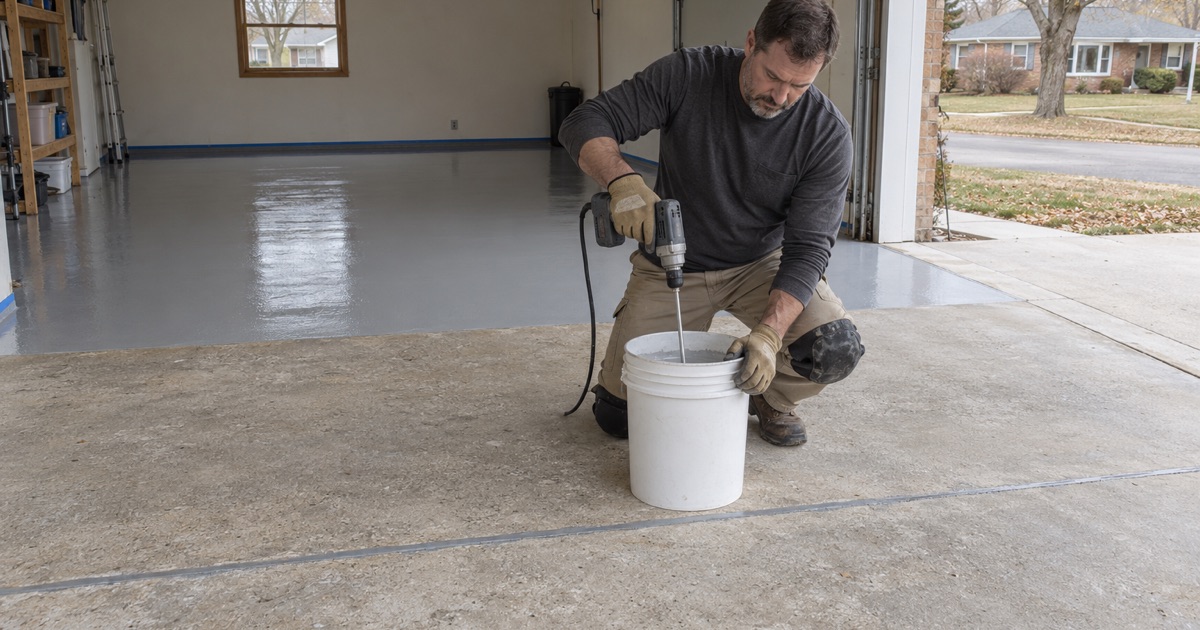
The first visit is an inspection, not a sales pitch. We look at cracks, spalled areas, old coatings, joint condition and any white staining or dampness that hints at moisture. We also check the slope, because a garage floor needs to keep shedding water toward the door or drain after it is coated.
That inspection decides the scope and the price. A clean, sound slab needs grinding and a standard system, while a floor with failing patches or a peeling old coating needs more preparation first. Either way, you see every line item before you decide.
Diamond Grinding the Garage Slab
We open every garage floor with a diamond grinder, and use a shot blaster where the slab calls for it, to reach a measured ICRI surface profile. Grinding removes old sealers, paint, laitance and the troweled skin that keeps a coating from biting into the concrete. A dust collector runs on the grinder the whole time, so the debris goes into a bag and not into your house.
We do not acid etch. Acid leaves an uneven profile, can leave residue behind, and does nothing about sealers, which is one of the main reasons store-bought garage coatings let go. A ground slab gives the base coat a fresh, porous surface to lock into.
Crack, Spall and Joint Repair
Cracks are routed out and filled with a rigid epoxy or polyurea repair material, then ground flush so they disappear under the coating. Spalled spots near the door, where salt and freezing have done the most damage, are rebuilt to a level surface before the base coat goes on.
Control joints get a decision of their own. We can fill them so the floor reads as one continuous surface, or honor them so the slab can still move at its designed break lines. We explain the trade-off for your slab rather than making that choice silently.
Moisture, Cold and Salt in a Rock County Garage
Moisture Testing the Garage Floor
Wisconsin’s Uniform Dwelling Code requires a vapor retarder under most new slabs, but SPS 322.38 exempts an unconditioned attached garage. That means many local garage floors were poured directly on the ground with nothing below to slow moisture rising through the concrete. A floor that looks dry can still push enough vapor to blister a coating from underneath.
So we test before we coat. Depending on the slab, that may be an ASTM D4263 plastic sheet test, an ASTM F1869 calcium chloride test or an ASTM F2170 relative humidity probe. If the readings run high, we add a moisture-mitigation primer or advise against coating, rather than leaving moisture to show up as a warranty claim.
Curing Against Slab Temperature and Dew Point
Epoxy cures by chemical reaction, and that reaction slows sharply in a cold slab. Local station normals record roughly 142 to 148 nights a year at or below 32 degrees, so a garage that sits unheated through the winter can stay far too cold for a proper cure well into spring. We check the slab temperature and the dew point spread at the surface before every coat.
If the numbers are not right, we wait. Coating too close to the dew point invites amine blush, a waxy film that weakens the bond between layers. We would rather move your start date than leave you with a floor that never reaches full hardness.
Road Salt and Calcium Chloride Brine
Every Rock County winter, tires carry rock salt and calcium chloride brine into the garage, where it puddles and soaks into bare concrete. As that brine freezes and thaws inside the surface, it breaks the top layer apart, which is why so many older garage floors are pitted and scaled near the door. A sealed, coated surface keeps the brine on top where you can squeegee it out.
We build garage systems specifically for that exposure, with a full-thickness base coat, a flake broadcast that adds texture, and a chemical-resistant topcoat. The coating protects the concrete instead of wearing through at the parking spots by the end of the season.
Choosing Your Garage Floor System
100% Solids Epoxy Base Coat
The base of most of our garage systems is a 100% solids epoxy, meaning it contains no solvent or water that evaporates away as it cures. What we roll onto the floor is what stays there, so the finished thickness matches what the proposal says. Thin water-based kit products shrink as they dry and leave a film too thin to resist hot tires.
That solid base also bridges minor surface imperfections and bonds hard into the ground profile. It is the layer doing most of the structural work, and it is not where we cut corners to hit a price.
Vinyl Flake Broadcast
While the base coat is still wet, we broadcast vinyl flakes across the floor, either as a partial scatter or a full broadcast to rejection. Flake hides dust, salt residue and tire marks, adds subtle grip underfoot, and comes in blends from quiet grays to bold multicolor mixes. Chip size changes the look as much as color does.
A full broadcast also adds body to the system, since the topcoat locks the flakes into a thicker, more durable layer. We bring physical samples so you can see the blend on the floor rather than on a screen.
Polyaspartic Topcoat and Hot Tire Pickup
The topcoat is what your tires actually touch. We usually finish garage floors with a polyaspartic or polyurea topcoat, which resists hot tire pickup, chemicals and abrasion and holds its color under the sunlight coming through an open garage door. Plain epoxy topcoats tend to amber over time in daylight.
Polyaspartic also cures quickly across a wider temperature range than epoxy, which helps on shoulder-season jobs. We can add a fine anti-slip additive to the topcoat for garages where wet winter floors are a concern.
Home Garages and Working Garages
Residential Attached and Detached Garages
Under SPS 321.203, a dwelling’s garage floor has to be concrete or another noncombustible material that resists petroleum products and slopes toward the door, a drain or grade. The code does not require a coating, so an epoxy floor is a choice, and we keep that slope working as we build it. Attached and detached garages can sit on very different slabs, which is another reason we test rather than assume.
For homeowners, the payoff is a floor that cleans up with a squeegee and a hose, does not dust, and makes the garage feel like part of the house. Many people use the coated space as a workshop, gym or hobby area as well as for parking.
Fleet Garages and Service Bays
Commercial garages, from small fleet buildings to auto service bays, take heavier loads, more fluids and constant traffic. We build those floors thicker, choose topcoats rated for oils, brake fluid and cleaners, and add texture where technicians walk on wet concrete all day. Work is scheduled around the hours your bays have to stay open.
Where joints carry carts, jacks or vehicles, we fill them with a semirigid filler so the edges do not break down under the wheels. The goal is a floor that keeps working through years of service traffic, not just one that looks good on opening day.
- 20+ Years in Concrete Coatings
- Moisture Testing in Every Scope
- Free Written Estimates