Janesville Epoxy Flooring has spent more than 20 years on concrete coatings, and our epoxy-flooring in Harvard starts with a question many homeowners never think to ask: what is actually in the can? Illinois sets a ceiling on the solvent a floor coating may carry, and that ceiling follows the product all the way onto the slab, not just to the checkout counter.
That matters because the rule is written around the person holding the roller as well as the store that sold the pail. When we coat a garage, a basement or a shop floor here, the choice of system and whatever happens to it in the mixing bucket are our responsibility, and we plan the job that way from the first walk-through.
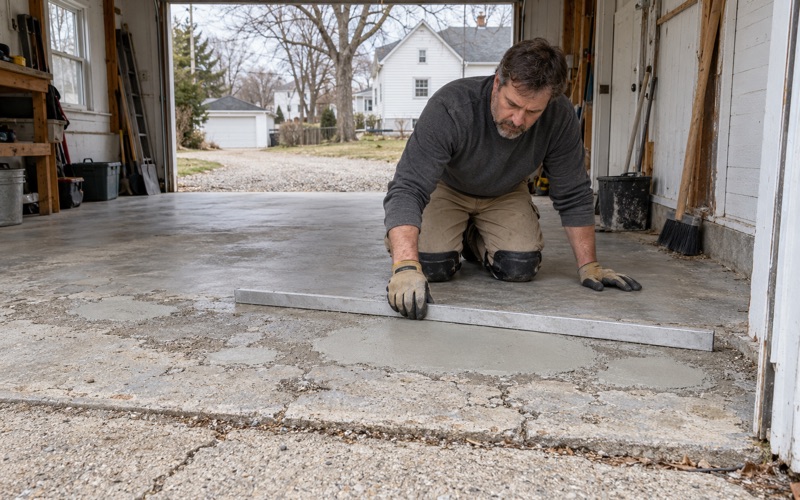
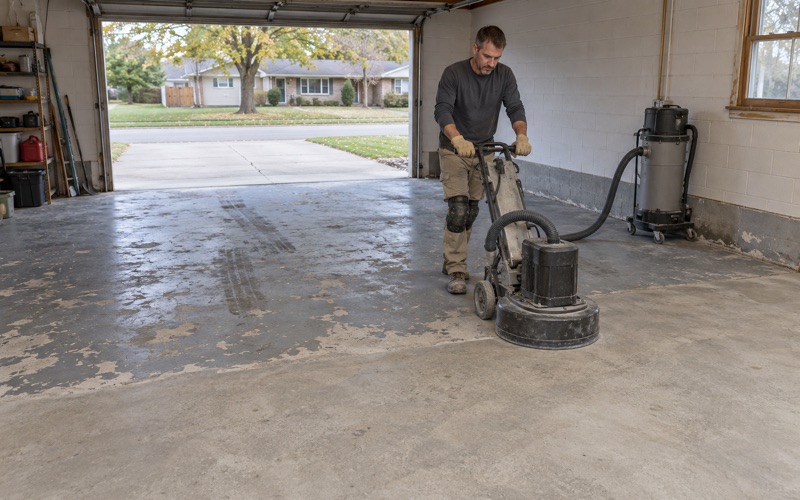
Before any of that, the slab gets opened with a diamond grinder or shot blaster rather than acid, and moisture testing appears as its own line in the proposal. The sections below explain the air-quality rule, why it lands on the installer, and how it shapes the products we put down on a local floor.
Harvard, McHenry County and the Illinois VOC Ceiling
Where Harvard sits on the air-quality map
Harvard is a city of 9,469 people at the 2020 census, in McHenry County, 63 miles from the Chicago Loop at the last stop on the Union Pacific Northwest Line. The EPA’s Green Book lists McHenry County, as a whole county, inside the Chicago nonattainment area for the 2015 eight-hour ozone standard, alongside Cook, DuPage, Kane, Lake and Will.
Ozone forms when volatile organic compounds, or VOCs, react in sunlight, and coatings are one source of them. That is the background to why Illinois watches what floor products release as they cure. It is worth being precise, though: nonattainment status does not create a separate, tighter floor-coating rule for this county. The coating limits we work under apply statewide.
What the state caps in a floor coating
Illinois’ architectural coatings rule, Part 223 Subpart C, sets limits for coatings manufactured on or after July 1, 2009. A floor coating may carry no more than 250 grams per liter of VOC, about 2.1 pounds per gallon. Industrial maintenance coatings, the heavier-duty category used in plants and some commercial settings, are capped at 340 grams per liter.
The rule carries exemptions, including aerosols, containers of one liter or less and coatings meant for use outside Illinois. None of those describe a two-car garage floor or a shop slab. For a real floor job in Harvard, the 250 and 340 figures are the numbers that govern, and we check product data against them before a proposal goes out.
What the cap does not do
A VOC limit governs what a coating releases, not how well it bonds or how long it lasts. A compliant product put over a dusty, unprofiled or damp slab will still peel. That is why we treat the rule as one filter on product choice, sitting behind the surface preparation and moisture testing that decide whether any coating holds at all.
Looking for epoxy-flooring closer to McFarland? See McFarland Epoxy-Flooring.
Why the Rule Reaches the Installer
Applying is covered, not only selling
Part 223 reaches past manufacturing and sale. Its prohibition extends to anyone who solicits the application of a coating or applies one. Under the federal architectural coatings rule, 40 CFR 59 Subpart D, only the maker or importer carries the obligation, which is the standard on the Wisconsin side of the line. In Illinois the applicator answers for it too.
In practice, a product’s label is not the end of the question. If a coating does not meet the Illinois limit for its category, putting it down on a Harvard floor is the problem, regardless of where it was bought or who recommended it. We treat that as part of our job rather than something to hand back to the customer after the fact.
Product bought somewhere else
We sometimes meet homeowners who have already bought a solvent-borne kit online or from a store in another state, where no comparable state rule applied at the counter. Bringing it home does not change the math. If we are asked to apply it, we read the technical data sheet first and decline a product that runs over the limit for its category.
Because whoever applies the coating carries the compliance question, our proposal names the exact product, the system build and the finished thickness. That gives an owner a document to check against what actually went down, whether the job is a basement in an older home, a newer attached garage or a small commercial floor on the edge of town.
What this does not mean
None of this comes with a credential. Illinois issues no license to general, flooring or coatings contractors, and we hold no county or city credential for this work. What we can say is narrower and checkable: on Illinois jobs we choose coatings that meet the state’s VOC limits, and the proposal shows exactly which ones were used.
Thinning, Cold Garages and Staying Under the Limit
Why thinning is the real risk
The rule also bars an applicator from thinning a coating beyond its applicable limit. Adding solvent raises the VOC content of what reaches the floor, so a product that leaves the factory compliant can stop being compliant in the mixing bucket. That is the step where a well-meaning crew most easily drifts out of bounds without noticing.
The temptation usually shows up in an unheated garage. Cold resin thickens, drags behind the roller and refuses to level, and a splash of thinner seems like the quick fix. We do not reach for it. Thickened material is a sign the conditions are wrong for the day, not a sign that the product needs cutting.
Scheduling instead of thinning
Curing on our jobs is scheduled against slab temperature and the dew point spread at the slab surface, not the calendar. When a garage cannot be brought to workable conditions, we say plainly that it has to wait for spring rather than forcing a thinned coat that risks the limit and a poor bond in the same move.
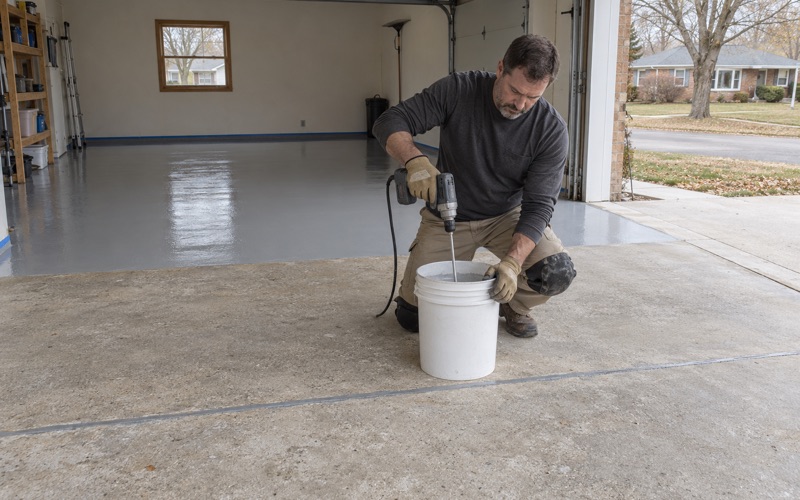
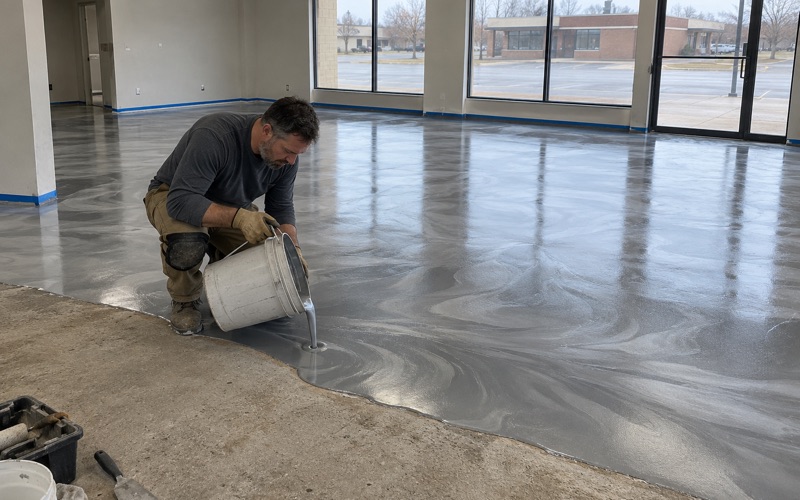
Where a job has to go ahead, we pick a system whose data sheet supports the conditions we can actually provide, and we keep the product exactly as supplied. A floor applied straight from the can, at the thickness the proposal named, is easier to verify and less likely to show amine blush, pinholes or soft spots later.
Testing comes before any product choice
No product rescues a slab that is pushing moisture. We test before coating, using ASTM F1869 calcium chloride kits or ASTM F2170 in-situ relative humidity probes where the job calls for them, and the results decide whether a moisture-mitigation primer goes down first. Warranty exclusions are read out before the job is sold, with moisture named first.
Choosing a Compliant System for a Harvard Garage, Basement or Shop
Homes across Harvard’s housing stock
Harvard’s housing splits between an older core, with 593 of 3,285 units built in 1939 or earlier, and a wave of 1990s and 2000s growth. About 40.3 percent of occupied homes are rented, and three-to-four-unit buildings make up a noticeable share of units. A landlord coating a shared garage and a homeowner finishing a basement face the same VOC question.
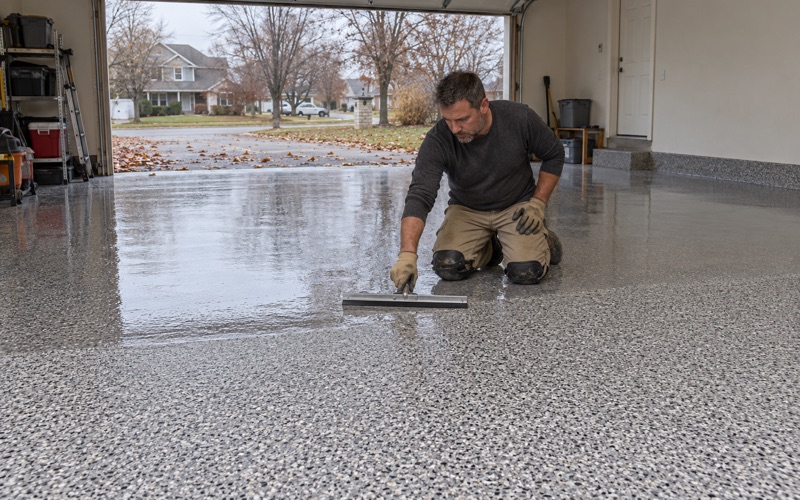
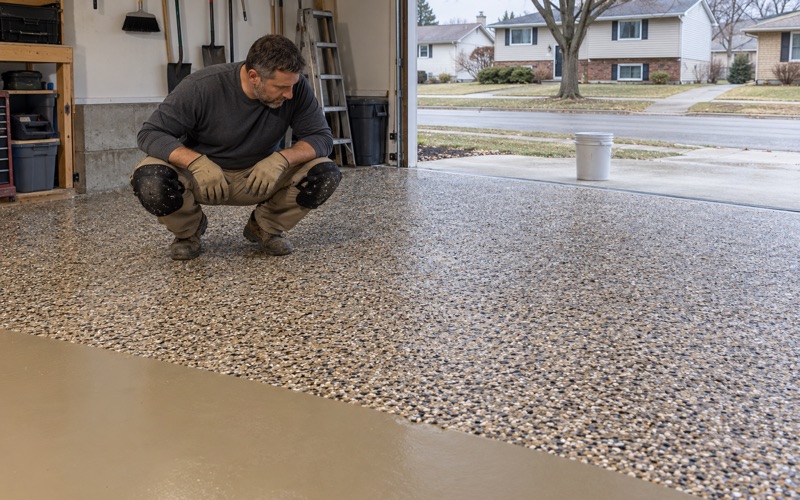
For a residential garage, we usually look at a 100% solids epoxy base, which carries little solvent by its nature, with a vinyl flake broadcast and a polyaspartic or polyurea topcoat. Garages see road salt and calcium chloride brine carried in on tires, so we build for that chemical exposure and for hot tire pickup as well.
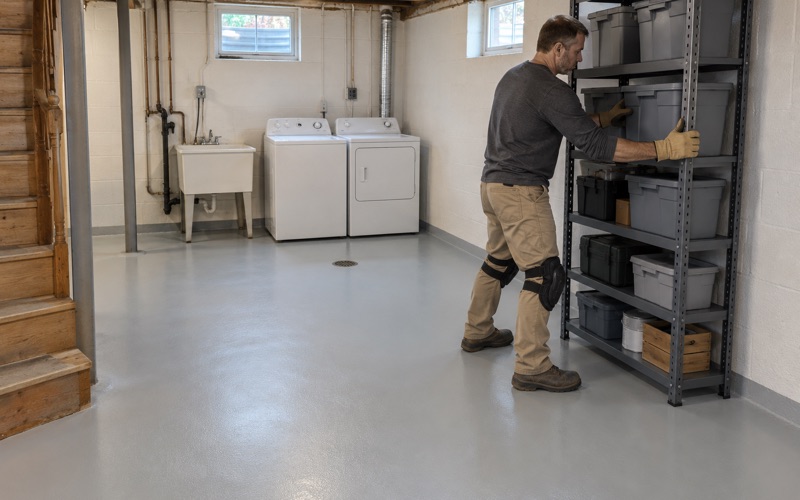
Basements in older homes get moisture testing before anything else, and we never present a coating as a fix for water coming up through a slab. Where readings allow a coating, a moisture-mitigation primer under the epoxy is often the deciding layer, and we confirm the product data against the 250 grams per liter ceiling for floor coatings.
Shops, plants and the former Motorola campus
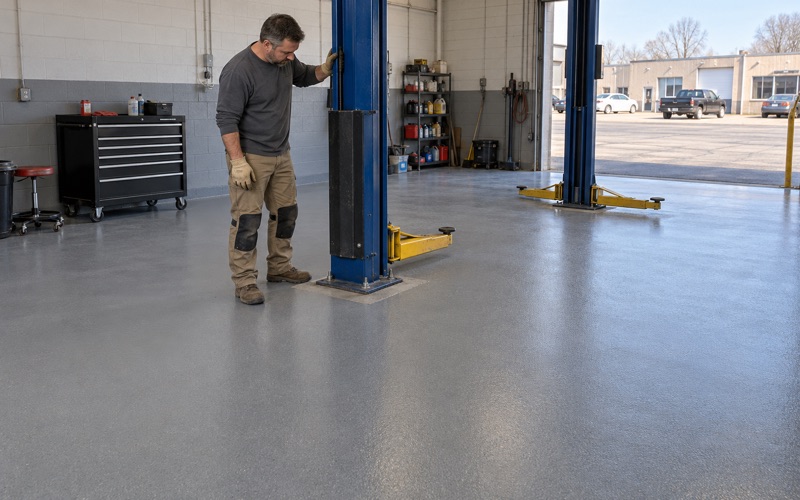
Harvard also carries an industrial base. Motorola’s plant opened in 1997, employed more than 5,000 at its peak and shut in 2003, and the 1.8-million-square-foot property later took on nitrile-glove production. We have no relationship with any plant there, but heavier floors like these are where the industrial maintenance category, capped at 340 grams per liter, enters the conversation.
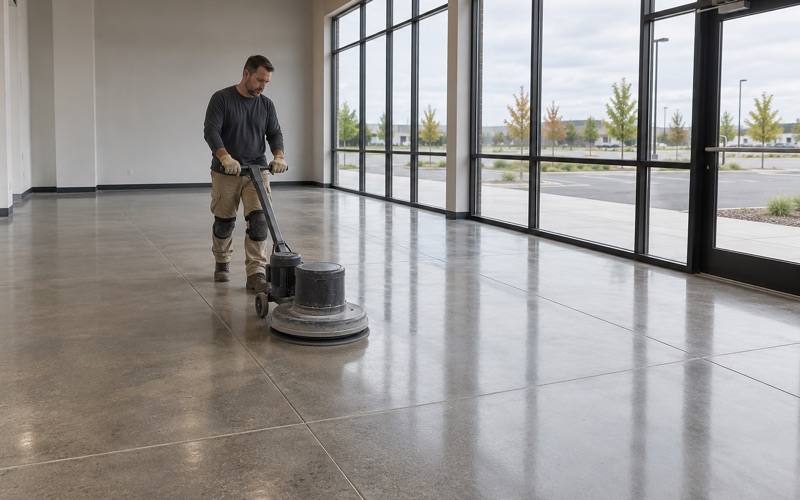
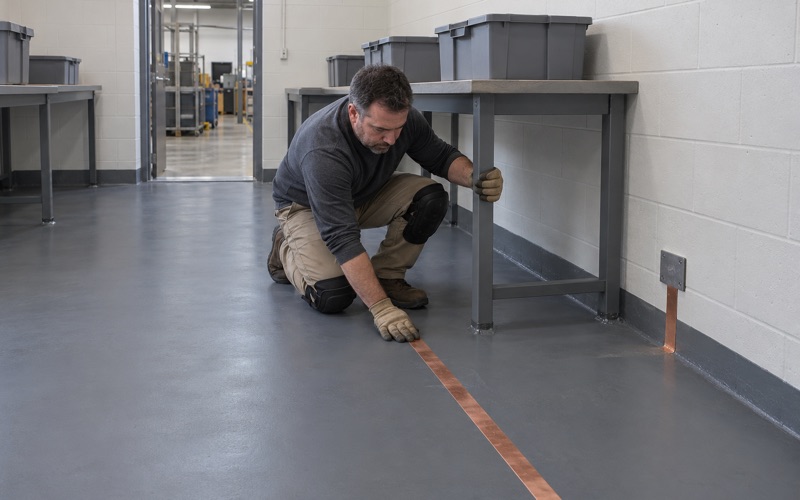
On a shop or warehouse slab, joints are filled with a semirigid filler before coating so forklift and cart wheels do not chip the edges, and grinding dust and slurry are collected on site rather than washed toward a drain. Work is scheduled around the hours the building has to keep running, including overnight and weekend windows.
Permits and who to call
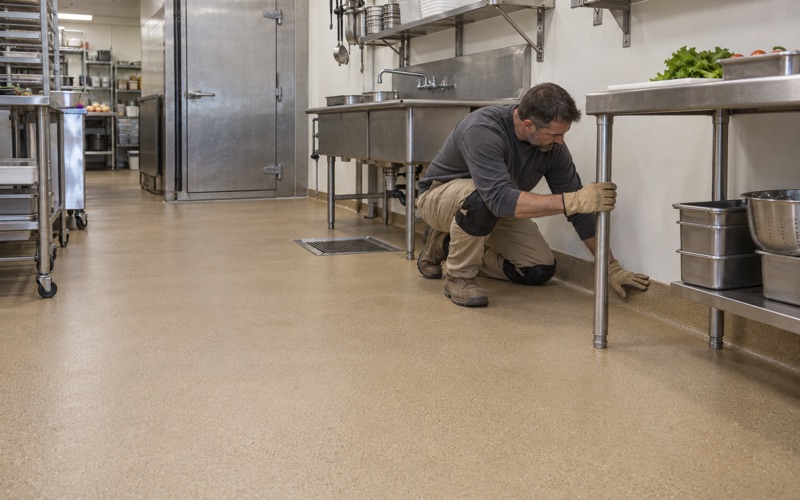
Coating an existing slab and replacing one are different questions, so we ask the City of Harvard Building Department at 201 W. Diggins St whether a job needs a permit before it is scheduled. The city code lists the 2021 International Residential Code. A new food establishment or extensive remodel also goes through McHenry County Department of Health plan review first.
- 20+ Years in Concrete Coatings
- Moisture Testing in Every Scope
- Free Written Estimates