Janesville Epoxy Flooring has spent more than 20 years on epoxy flooring in Jefferson and the surrounding part of Wisconsin, and the jobs that teach us the most are the floors that came with a building rather than the ones poured for it. A slab that has served another owner holds marks of every use it has seen, and most of those marks never made it into a file.
Our approach to those floors starts before any price is written. We look at the cracks, the joints and whatever coating is still clinging to the surface, and we tell an owner plainly when a section needs repair or full replacement before a coating can be trusted on it. A coating laid over a problem simply hides it for a season.
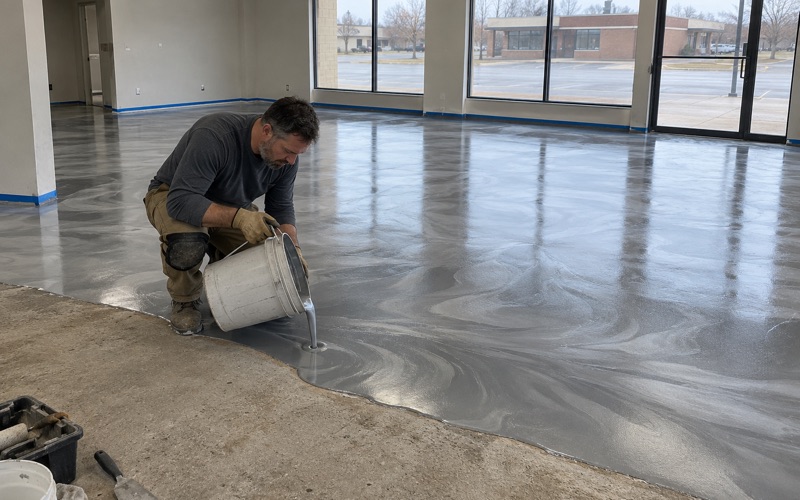
From there the work follows a fixed order: test, grind, repair, then coat with a system sized for the traffic the building will actually carry. Our written proposal names the product, the system build and the finished thickness, so a facilities manager can hold the finished floor up against the quote and see whether the two match.
When a Jefferson Building Changes Hands, the Floor Comes Along
A Pet-Food Plant Growing Next Door
Jefferson’s clearest example sits at 111 W. Plymouth St., where Nestle Purina has made pet food since 1910. According to BizTimes Milwaukee in April 2025, the plant added a new warehouse of nearly 35,000 square feet, put in robotic palletizers and now runs three lines that can make wet pet food. That is a great deal of product to store and move.
The same report says Purina bought the former Timewell Drainage Products building next door for $2.29 million to use as warehouse space. We have no connection to Purina and have done no work at either building; plant floors of that kind are specialist bids run under the owner’s own contractor rules. The pattern behind the purchase, though, is one we see across the city.
Other Industrial Floors Finding New Uses
Purina is not the only case. Palermo Villa has announced it will convert the former Tyson plant in Jefferson into a frozen pizza plant, which means another large floor is moving from one owner’s process to another’s. Smaller shops and storage buildings around the county seat change tenants on a quieter scale, and each one hands over a slab.
None of those transfers comes with a floor history attached. A buyer gets a deed, an inspection report and a set of keys, but rarely a record of what was spilled, patched, sealed or painted over across the decades. For a coating contractor, that missing record is the first problem to solve, and it cannot be solved by looking at the surface alone.
What an Old Slab Carries Forward
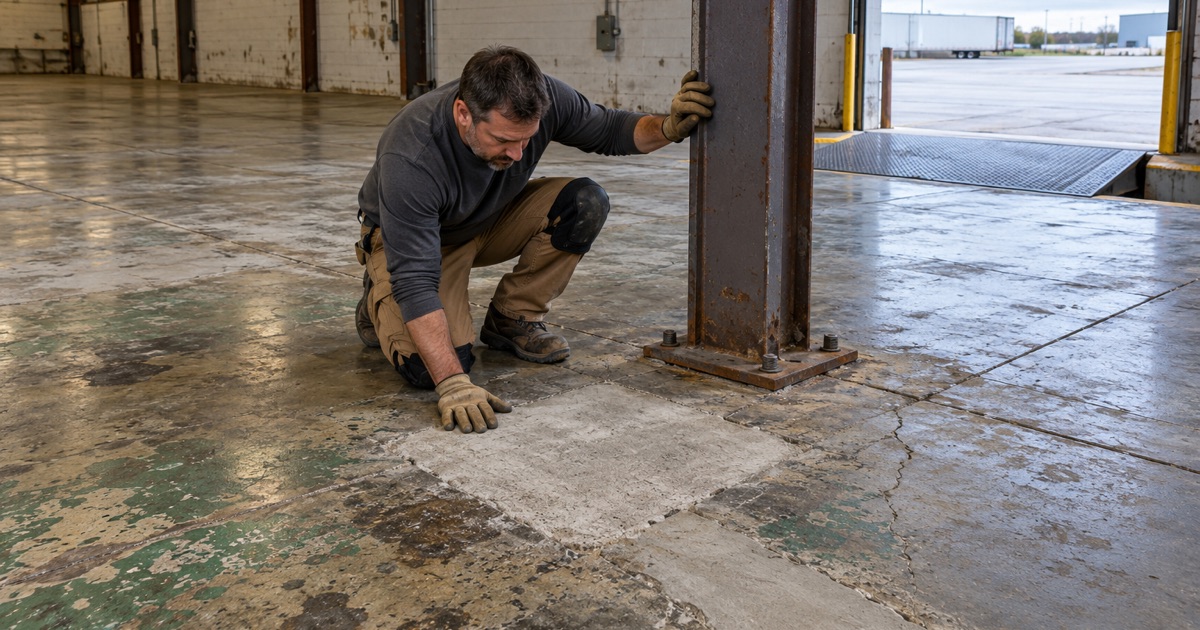
A reused industrial floor often shows a familiar set of leftovers. There may be worn coatings from different eras, sawcut trenches filled with mismatched patch material, oil and chemical stains soaked deep into the concrete, and cracks that have been moving for years. Some of these are cosmetic, while others will lift a new coating within months.
Old drains and trench lines deserve a careful look in any building that once handled a wet process. Patches over those cuts often settle or debond at the edges, and a forklift wheel crossing a hollow patch will find it fast. We sound those areas, mark them, and price their repair as separate line items so the scope stays honest and easy to compare.
Looking for epoxy-flooring closer to Oregon? See Epoxy-Flooring in Oregon.
Reading and Testing a Floor Nobody Documented
Walking the Slab Before We Quote
Our first visit is a slow walk with a hammer, a straightedge and a flashlight held low to the floor. We map cracks by width and pattern, note which joints have spalled, and check whether the existing coating is bonded or only resting on the concrete. That map becomes the basis of the scope rather than a guess made from the doorway.
When a section of the slab is too far gone, we say so. Badly heaved or crumbling areas sometimes need to be cut out and replaced before any coating makes sense, and an owner is better served hearing that at the walk-through than after a new floor fails over it. Replacement and coating are different jobs, and we treat them that way.
Moisture Testing as a Line Item
Moisture is behind many coating failures on older concrete, and a dry-looking warehouse floor is not proof of a dry slab. Testing appears as its own line in our scope. Depending on the floor, we use ASTM F2170 in-situ relative humidity probes, ASTM F1869 calcium chloride kits, or an ASTM D4263 plastic sheet test as a first screen.
The readings decide the primer. Where vapor emission runs high, a moisture-mitigation primer goes down before the build coats, and where the numbers are low, a standard primer does the job. Our warranty exclusions are read aloud before the job is sold, and moisture is the first one named, because no coating holds when vapor pushes it off from below.
Identifying What Is Already on the Floor
Old coatings are not all the same. A thin paint, a worn epoxy, a sealer and a urethane all grind differently and leave different residues, and some older products cannot be bonded over at all. We test small areas, check how the existing layer responds to grinding, and look for signs of oil contamination that a grinder alone will not remove.
Stains get the same scrutiny. Some lift with degreasing and a pass of the grinder, while deep oil saturation can keep weeping up through new material and cause outgassing and pinholes in the finish. Knowing which kind of stain we are dealing with before quoting is the difference between a fair price and a change order halfway through the job.
Grinding Off the Past and Repairing the Damage
Mechanical Preparation, Never Acid
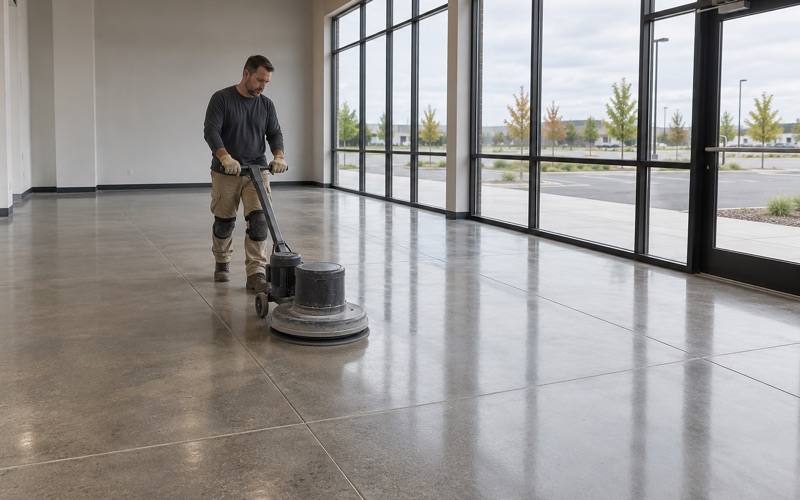
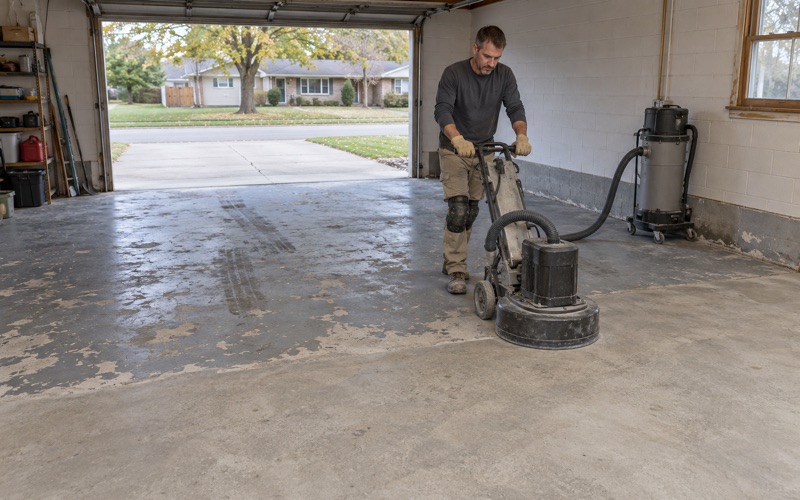
Every floor we coat is opened with a diamond grinder or a shot blaster, and we do not acid etch. On a reused slab that matters even more, because etching cannot remove an old coating and does little against embedded residue. Mechanical preparation takes the surface down to sound concrete and leaves a measurable profile for the primer to grip.
We aim for an ICRI CSP profile matched to the system going down, usually rougher for a thick build than for a thin one. Dust and slurry are collected on site with vacuum equipment and never washed toward a storm drain. A building that stays open during the work also needs that dust kept away from its stored product and packaging.
Cracks, Trenches and Old Patches
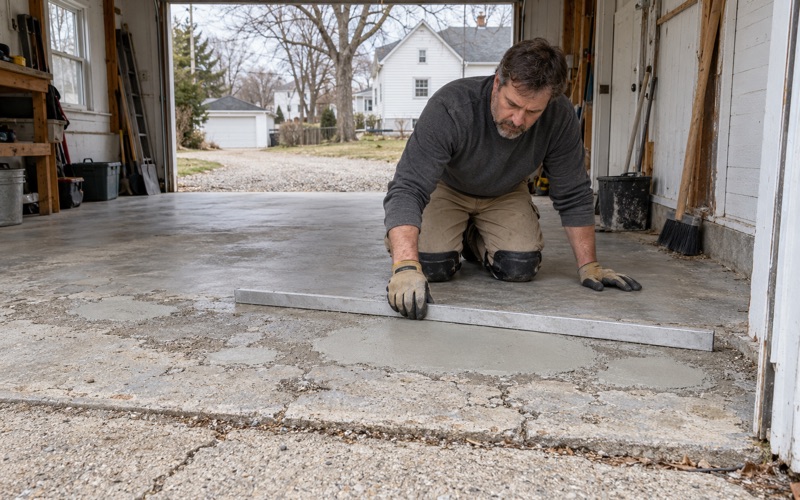
Cracks are cleaned out, and active ones are routed and filled with a material that can tolerate some movement, while dormant cracks get a rigid repair. Failed patches over old trenches are cut back to sound edges and rebuilt flush with the surrounding slab. The goal is a single plane that a pallet jack or forklift crosses without a bump or a hollow spot.
Control joints get their own treatment. In warehouse and plant floors we fill joints with a semirigid filler before any coating goes over them, so forklift and cart wheels do not chip the edges as they roll across. Joints left open or bridged with a rigid coating tend to break down first, and that damage then spreads outward into the field of the floor.
Cleanable Surfaces for Food and Feed Storage
A converted building that will hold animal food raises one more question. FDA’s animal-food rule, 21 CFR 507.17(b), says the plant must be suitable in size, construction and design to facilitate cleaning, maintenance and pest control. It names no floor material, and no agency approves a particular coating, so the choice of what goes down rests with the owner and its own specialists.
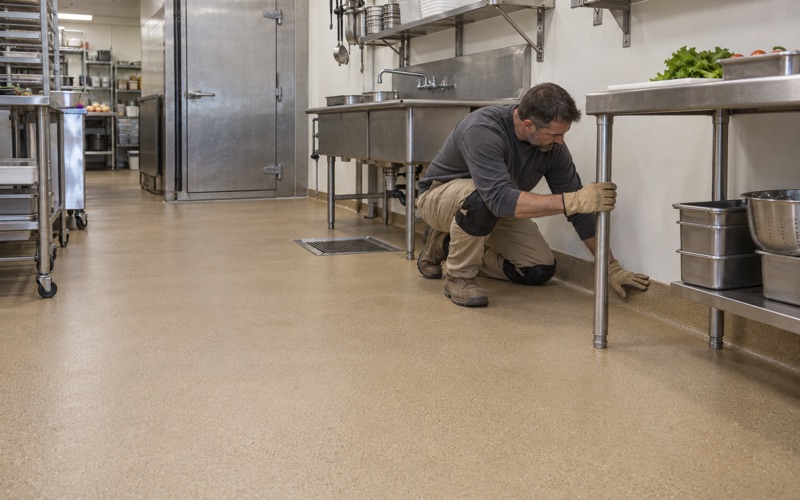
What the rule’s general language suggests in practice is a floor that can be swept and washed without trapping debris. Cracks, pits and old stains ground out and repaired, then sealed under a continuous coating, make the kind of surface that supports that goal. We describe that work plainly and leave compliance decisions to the owner’s quality team.
Choosing a System for Pallets and Forklift Traffic
Matching the Build to the Load
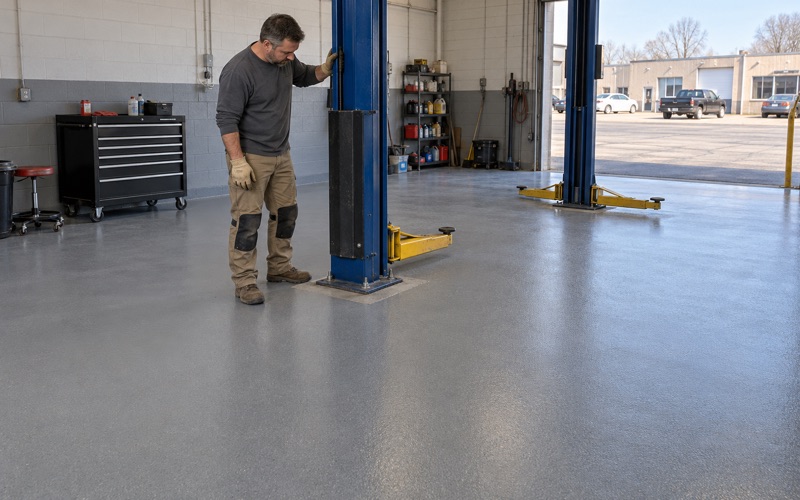
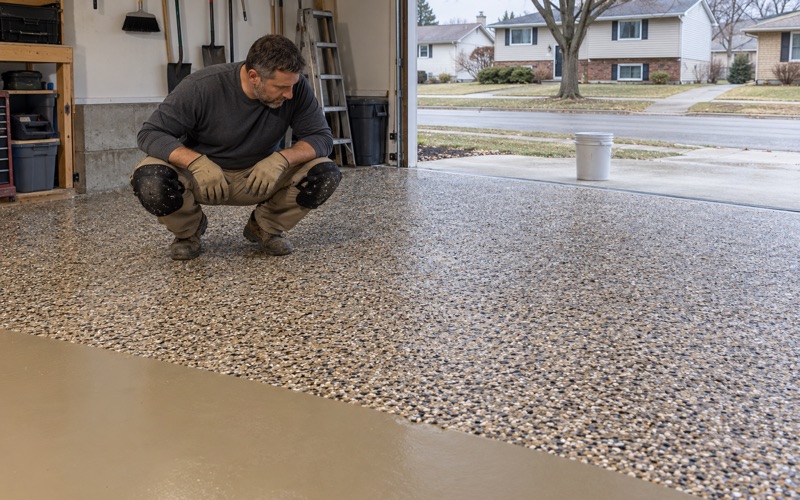
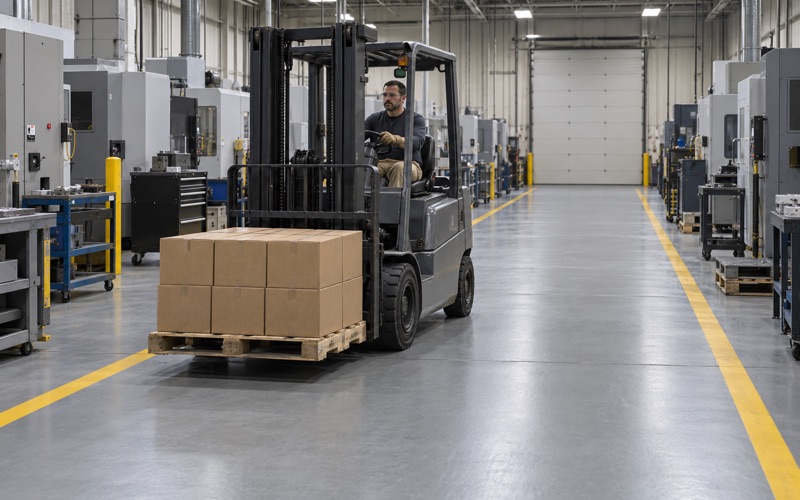
A warehouse floor in Jefferson that carries loaded pallets, pallet jacks and forklifts needs more than a thin decorative coat. We usually specify a 100% solids epoxy build at a thickness suited to the traffic, sometimes with a quartz aggregate broadcast for added wear resistance and slip control. The proposal states the finished thickness so it can be checked after installation.
Where the floor sees hot water washdown, heavy chemical exposure or thermal shock, urethane cement is often a better choice than epoxy. Where the owner wants a tougher wearing surface over an epoxy base, a polyurea or polyaspartic topcoat can take that role. We explain those tradeoffs before anyone signs, rather than leaving the choice to a product name on a quote.
Forklift damage concentrates in predictable places: dock doors, the ends of racking rows, and anywhere a truck pivots on a loaded wheel. We look at how traffic will move through a converted building and build extra thickness or aggregate into those zones. A uniform floor that ignores where the wear lands tends to show bare patches at the turns first.
Scheduling Around a Working Building
Most industrial owners cannot shut a building for a week while a floor goes down. We schedule plant, shop and warehouse work around the hours the building has to keep running, including overnight and weekend windows, and phase large floors so part of the space stays in use. Inside an operating food plant, the owner’s own contractor rules set the terms.
Curing follows slab temperature and the dew point spread at the surface rather than the calendar. A cold slab in an unheated building can encourage amine blush or slow the cure, so we measure before each coat goes on. When conditions are wrong, we wait, because a floor that cures properly will outlast one rushed back into service a day early.
Permits and Paperwork
Coating a floor and replacing a slab are different questions for a building department. In the City of Jefferson, inspection is contracted to General Engineering Company, and permits are applied for online, with work not to begin until a permit is approved. We ask before scheduling whether a job needs one, and the Town of Jefferson uses a separate inspector.
Commercial and industrial buildings fall under the state commercial building code rather than the Uniform Dwelling Code that governs houses. For a converted warehouse, slab replacement, new trench work or structural repair is the part most likely to draw a permit question, and we raise it with the inspector early so the schedule does not stall once the grinders arrive.
- 20+ Years in Concrete Coatings
- Moisture Testing in Every Scope
- Free Written Estimates