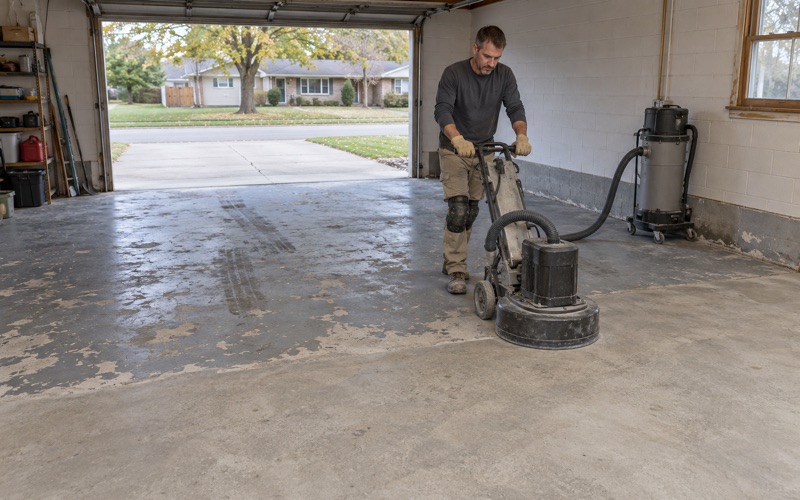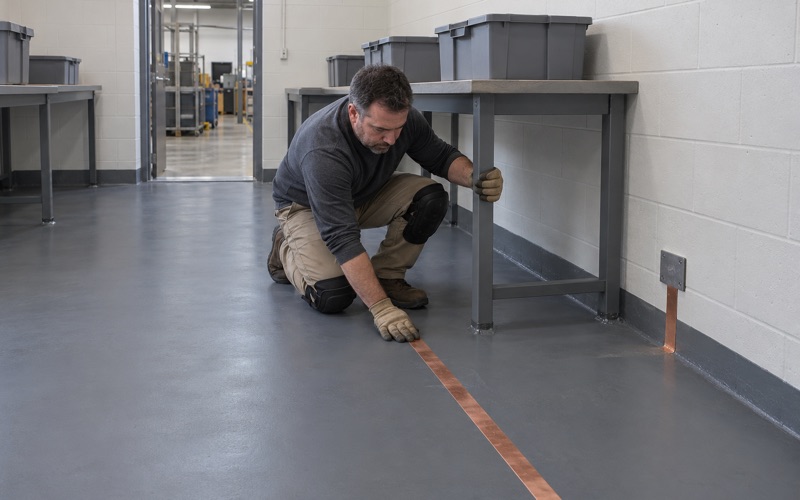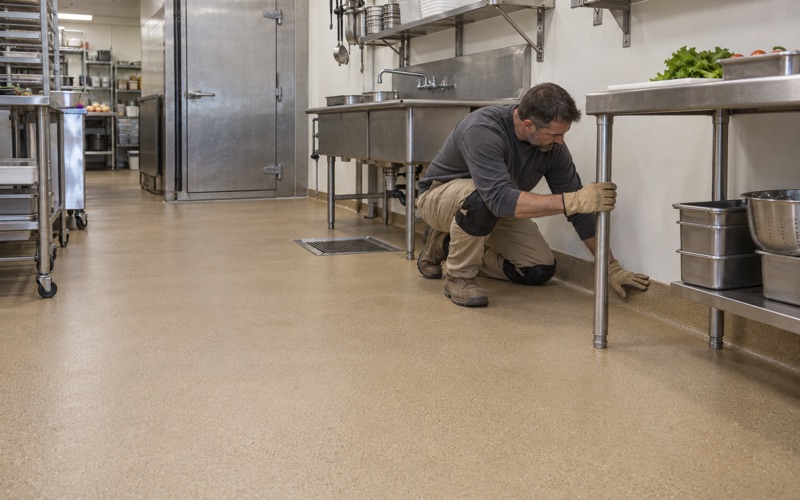
Janesville Epoxy Flooring has spent more than 20 years on epoxy flooring in Machesney Park and on both sides of the state line, and the first thing we do on any garage or basement job here is open the slab mechanically. A diamond grinder or shot blaster cuts the surface to a measured ICRI profile before a primer touches it. We never acid etch, because a rinsed acid leaves a profile nobody can check.
The second thing is a moisture reading. Testing sits on the proposal as its own line, whether the slab is under a basement or a two-car garage, so the result shapes the system instead of arriving as an excuse after a blister. Where the numbers call for it, a moisture-mitigation primer goes down first, and the quote says so in plain terms.
The third is honesty about the concrete itself. We read the cracks, the control joints and any old coating before we price anything, and when a slab needs repair or replacement before it can carry a coating, we say that out loud. In this village that judgment also decides which side of a permit line the work falls on, which is what most of this page is about.
Older Garages and a Floor Job With No Permit
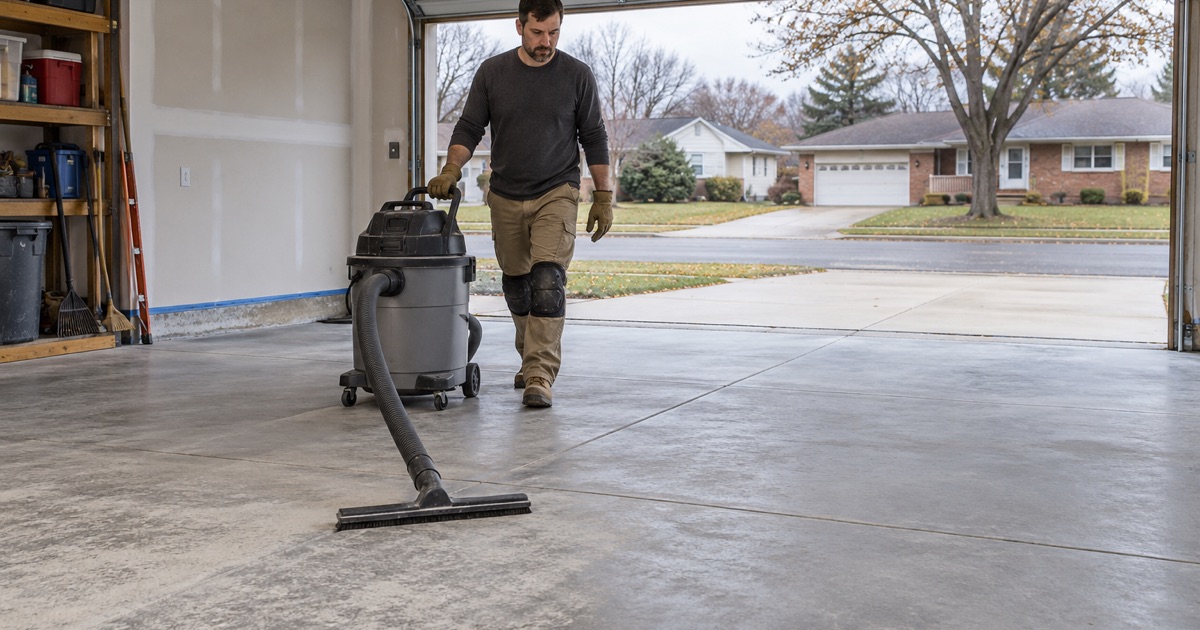
Machesney Park is a village in Winnebago County, part of the Rockford metropolitan area, and its housing is mostly owner-occupied detached homes: Census figures count 6,548 of them among 8,577 occupied units. About 4,151 housing units were built between 1950 and 1979, so a great many garage slabs here have carried decades of tires, salt and patching before anyone asks about a coating.
Carpeting and flooring sit on the no-permit list
The village permit page opens by saying that nearly all construction projects in Machesney Park require a building permit, then names a short list of home improvements that do not. Same-size siding and window replacements are on it, along with kitchen cabinets and countertops, and so are carpeting and flooring. A resinous coating on an existing slab belongs to that last category in any ordinary reading.
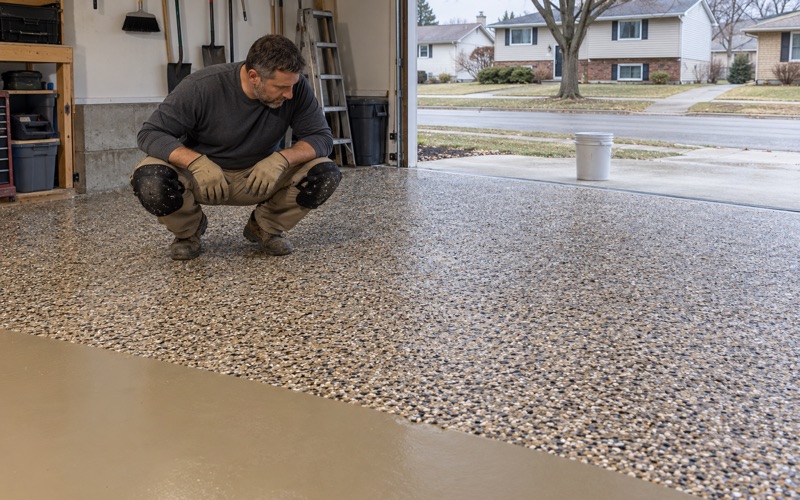
That is good news for a homeowner who wants a garage floor finished this season. A grind, a primer, a vinyl flake broadcast and a topcoat on concrete that is already there is a finish job, the same family of work as laying new flooring over an old subfloor. We still name the boundary in writing, because the list covers flooring, and it says nothing about replacing concrete.
What an older slab tends to show us
Slabs from the middle of the last century can carry patch layers, paint, old sealer and settlement cracks across a single bay. None of that is a reason to turn the job down, but each one changes the prep. Old coatings have to come off completely under the grinder, and a crack that moves with the seasons gets a different repair than a hairline that has sat still for years.
Basement prevalence across the village is unmeasured, so we do not assume a floor plan until we walk through the door. What we can measure is the slab in front of us. An ASTM D4263 plastic sheet test gives a quick first look, and in-situ relative humidity probes under ASTM F2170 give the number we actually price against.
Looking for epoxy-flooring closer to Loves Park? See Epoxy-Flooring in Loves Park.
When a Garage Floor Job Turns Into Concrete Work
The permit page draws a second line just as clearly. All proposed garages, whether attached to the house or detached, require a building permit, and driveways require their own driveway permit. Between those two rules and the flooring exemption sits a gray zone the page does not settle: work that replaces concrete rather than finishing the concrete already in place.
Coating an existing slab versus repouring one
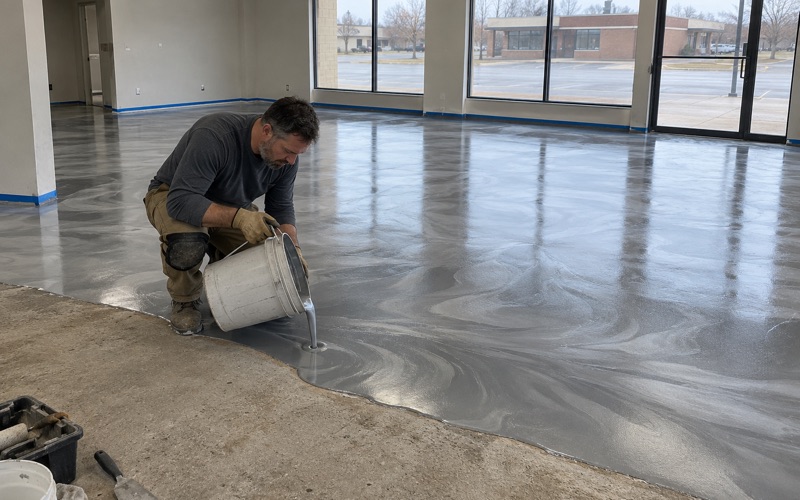
Coating means the slab stays. We grind it, fill the cracks, prime it and build the system on top, and the concrete underneath is the same concrete the house was sold with. Repouring means a saw, a breaker, a haul-off and a fresh pour, and that is a different trade with different questions attached to it, starting with what the village expects.
The village page does not say whether tearing out and replacing a slab inside an existing garage needs a permit, and we will not guess on its behalf. When our crack and joint survey says a slab cannot hold a coating, the proposal stops at that finding. The next step is a question for the village, not an assumption from us or a promise from anyone else.
Cracks, heave and spalled joints
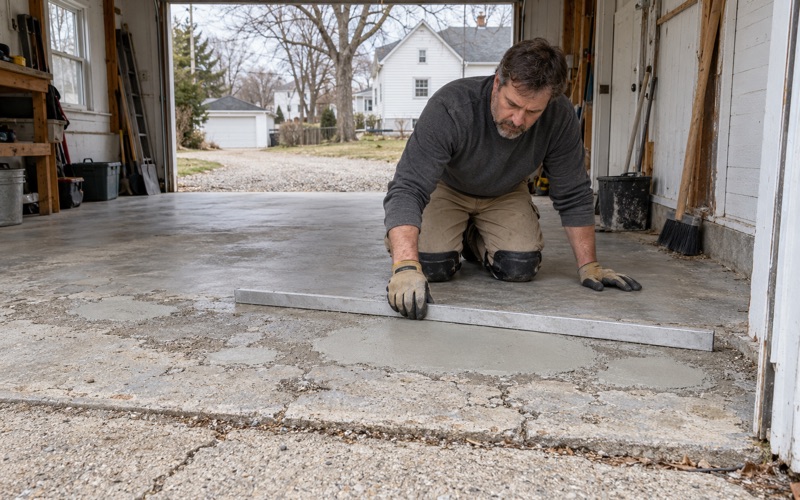
Most garage slabs fall well short of replacement. A spalled control joint can be rebuilt, a static crack filled and ground flush, and a scaled surface brought back with a cementitious patch before the primer goes down. Salt damage near the overhead door is common on floors that have seen many winters, and we price that repair as its own line.
Heave, or a broken section that rocks underfoot, is another matter. Coating over movement only buys a cracked floor a year later, so we document what we see with photos and measurements and explain why it fails our threshold. The decision about concrete work then stays with the owner and whoever they hire to do it.
New garages are a separate conversation
An owner building a new garage is already inside the permit process, because the village requires a building permit for every proposed garage, attached or detached. In that case the floor coating comes last, after the slab has cured and the building work is finished. We fit our schedule into that sequence rather than asking the builder to fit around ours.
Fresh concrete also needs time before it can be tested honestly. We wait until it gives a meaningful moisture reading, then grind, test and coat. Curing runs on slab temperature and the dew point spread at the surface, not the calendar, and we say plainly when an unheated new garage has to wait for spring.
Driveway Aprons, Permits and Erosion Control
The garage apron is where floor work most often bumps into the driveway rules. A coating that stops at the door threshold is flooring. An apron broken out and repoured to tie into the drive is concrete work connected to the driveway, and the village treats driveways as permitted work with paperwork of their own.
What the driveway permit asks for
A driveway permit application in the village carries an Erosion & Sediment Control Statement describing how soil and runoff will stay on the lot. Starting October 13, 2026, the fee is $30.00 for a driveway under 2,000 square feet and $50.00 above that. Separately, disturbing more than 1,000 square feet of ground calls for an Erosion Control Permit.
None of that applies to a coating that stays inside the garage. We raise it because owners often ask us to carry the job down the apron, and the honest answer is that a repour belongs to a concrete contractor working under that contractor’s own permit. Our proposal covers the slab we coat and stops at the threshold.
Keeping grinding dust and slurry on site
Erosion control is about soil, but the same principle governs our own mess. Grinding dust is pulled into a vacuum at the tool, and any slurry from wet work is collected and hauled away rather than hosed down the apron toward a street drain. A clean driveway at the end of the day is part of the job, not a courtesy we offer when it is convenient.
Salt is the other thing the apron brings in. Calcium chloride brine and rock salt ride the tires across the threshold all winter, so we build garage floors for that exposure, typically a polyaspartic or polyurea topcoat over a 100% solids epoxy body coat. The system is also specified to resist hot tire pickup on a floor that sees daily parking.
Asking Village Hall Before the Quote Is Signed
The cleanest way to handle a borderline job is to ask before anyone signs. Village Hall sits at 300 Roosevelt Road, and the Building Division answers at (815) 877-5432. We make that call ourselves when a job crosses from finishing a slab into replacing one, and we put the answer in the file before the work goes on the schedule.
The codes in force today
On May 5, 2025 the Village Board adopted the 2021 International Residential Code for one- and two-family dwellings, along with the 2021 IBC and the 2021 International Existing Building Code. Any concrete or structural work around a garage is judged against that code set. We have not read the local amendments, so we leave their content to the Building Division rather than paraphrase them.
For an existing house, the IEBC is the code that speaks to alterations and repairs, which is one more reason a slab replacement is a question for the village and not for a flooring crew. Our part ends at the slab surface, and we would rather wait a week on an answer than start work on the wrong side of a rule.
A written record when no inspector is involved
Because a coating sits on the no-permit list, no inspector ever looks at the finished floor, which makes the contract the record. On any Illinois job over $1,000 we provide the written contract and the consumer rights pamphlet the Illinois Home Repair and Remodeling Act requires, and the proposal names the product, the system build and the finished thickness.
Prep method and coat count go into it as well, so an owner can check what was quoted against what went down. We read the warranty exclusions aloud before the job is sold, with moisture named first, and we are clear that a floor coating is never a barrier against water rising up through the slab.
Coatings that meet Illinois VOC limits
Illinois sets VOC limits for architectural coatings under 35 Ill. Adm. Code Part 223 Subpart C, and those limits bind the person applying the product as well as the company that made it. Every primer, body coat and topcoat we bring to a Machesney Park garage is chosen to meet them, and the product data sheet travels with the proposal.
Low-solvent systems also suit an attached garage that shares air with the house. A 100% solids epoxy body coat carries very little solvent to begin with, and we ventilate during the topcoat regardless, keeping the overhead door cracked and the house door closed until the floor has cured enough to walk on.
- 20+ Years in Concrete Coatings
- Moisture Testing in Every Scope
- Free Written Estimates