Janesville Epoxy Flooring has spent more than 20 years on epoxy flooring in McFarland and the slabs around it, and most of what we coat here is a garage or basement floor under a house its owner lives in. Those jobs share a pattern: the coating itself is the simple part, and the questions worth asking come before the first pass of the grinder and after the last coat cures.
Before the work, the question is what the slab can take. We open every floor with a diamond grinder or shot blaster rather than acid, test it for moisture as a priced line in the scope, and read its cracks and joints before we put a number on paper. When a slab needs repair first, the proposal says so.
After the work, the question is what happens to the half-used kit of resin, the hardener left in the can and the solvent that cleaned the rollers. In Dane County those leftovers have a set destination, and a proposal from us names it, along with the product, the system build and the finished thickness.
Garage and Basement Slabs Under McFarland’s Owner-Occupied Houses
A village of detached houses, much of it recent
McFarland is a village in Dane County on Lake Waubesa, a suburb of Madison reached along U.S. Route 51. Census figures from the 2024 five-year survey count 2,419 owner-occupied detached homes here, which is 85.9 percent of the owner-occupied units in the village. Most of the floors we are asked to coat belong to those houses.
The same survey puts 36.5 percent of McFarland’s housing as built since 2000. That means the typical residential slab we see is a garage or basement floor poured somewhere between the 1980s and the 2010s. A newer slab is not automatically a dry or clean one, though, so its age changes how we start the inspection rather than what we conclude from it.
Reading the slab before we quote it
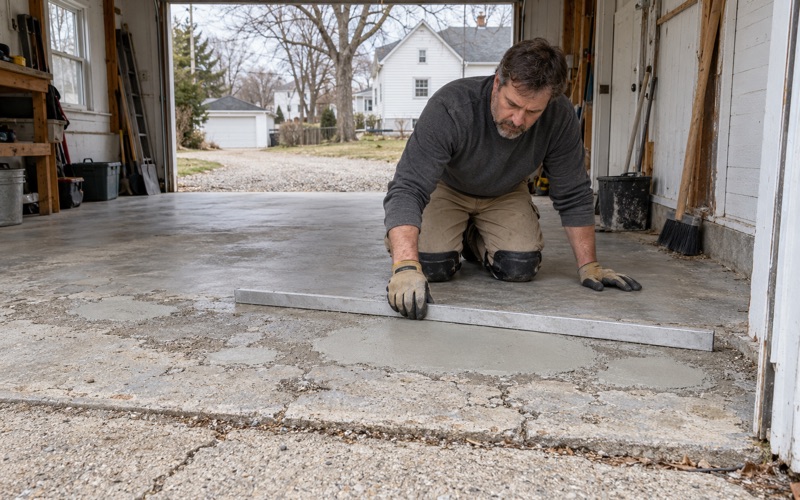
We start with the cracks, the control joints and any old sealer or paint already on the surface. A hairline shrinkage crack and a crack with one side higher than the other are different problems, and we say plainly when a floor needs repair or replacement before any coating should go over it. That conversation happens before a price, not after a failure.
Moisture testing is part of that first look on a basement slab and an attached garage slab alike. Wisconsin does not require a vapor retarder under an unconditioned attached garage slab, so a floor can look dry and still push vapor. We use ASTM F2170 in-situ relative humidity probes or ASTM F1869 calcium chloride tests, and the results decide whether a moisture-mitigation primer belongs in the build.
Opening the surface and building the system
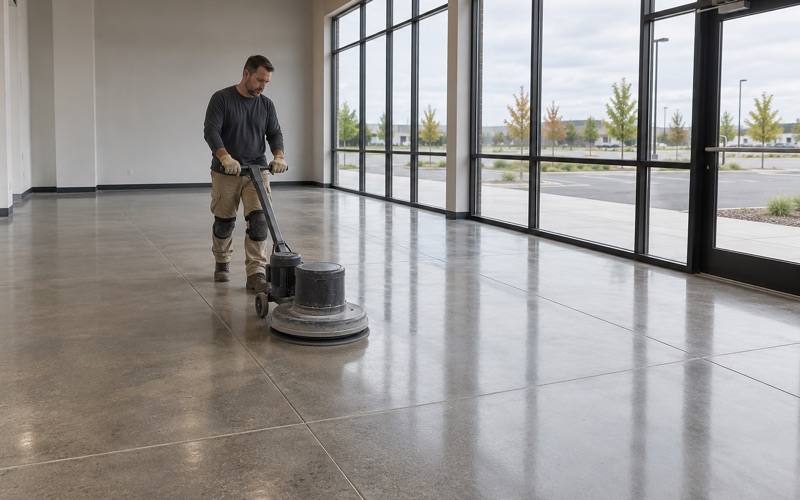
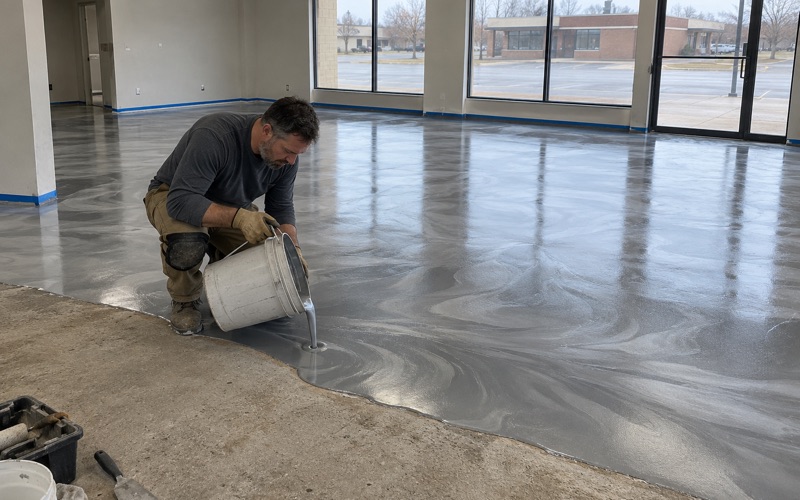
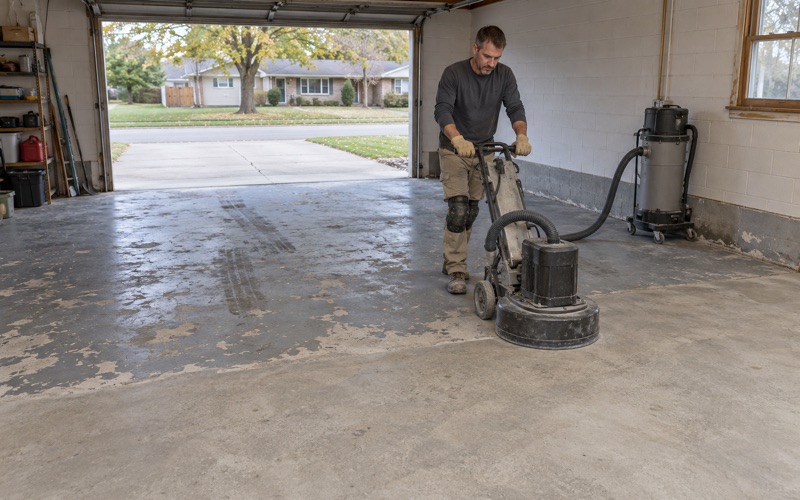
Every slab is ground or shot blasted to an ICRI CSP profile that suits the coating going down. We do not acid etch, because a mechanical profile is something we can see and measure across the whole floor. The dust is collected on site with the grinder rather than swept into a pile for someone to deal with later.
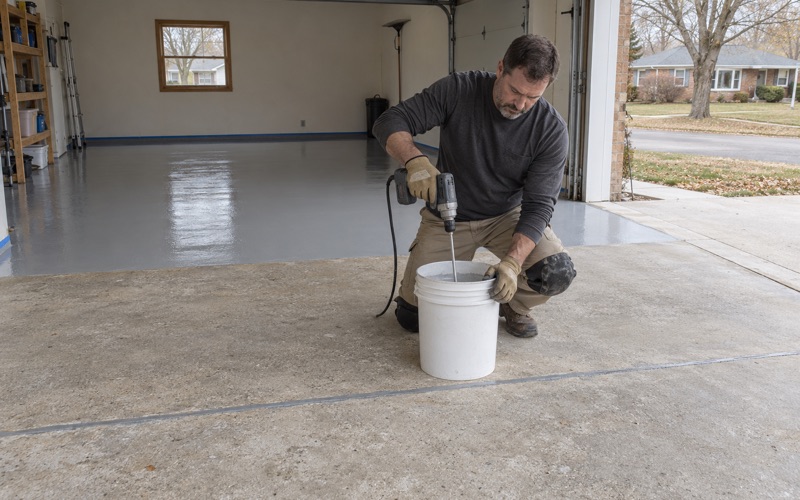
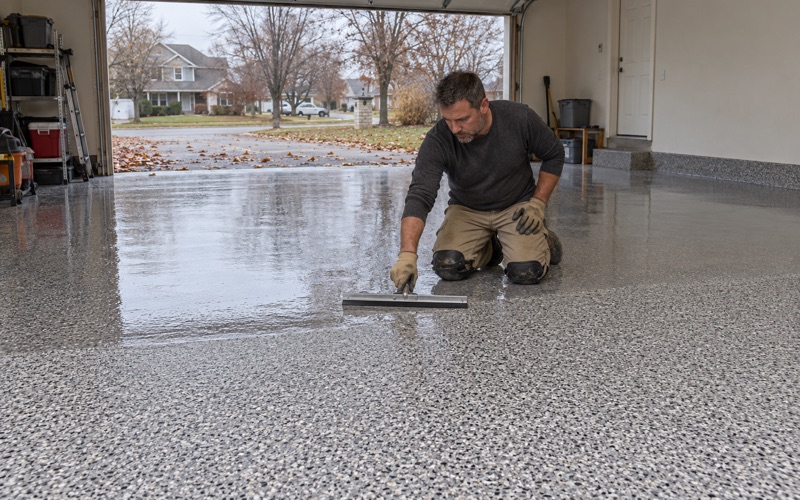
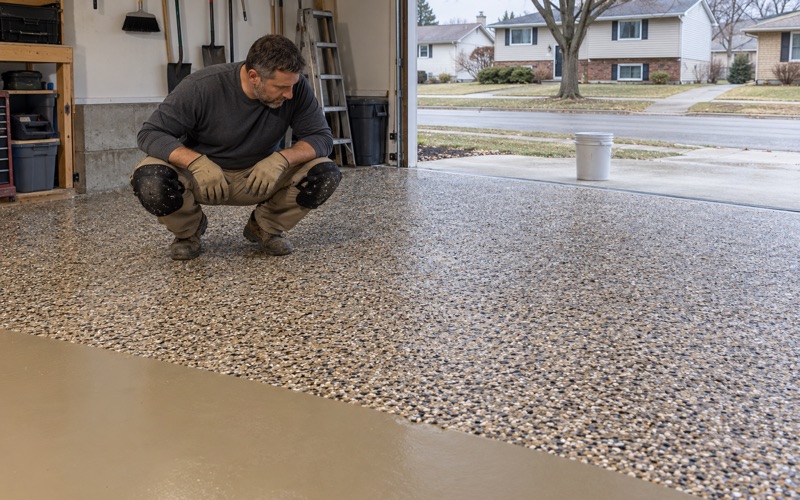
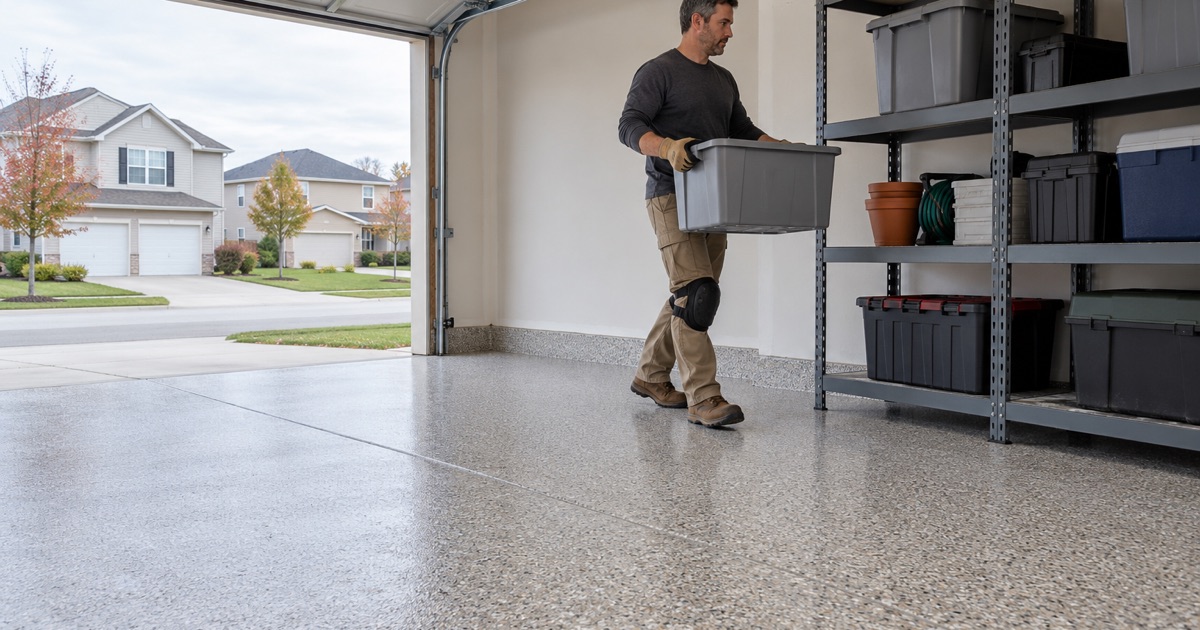
A typical garage build here is a 100% solids epoxy base with a vinyl flake broadcast and a polyaspartic topcoat, which resists hot tire pickup and the brine tracked in on winter tires. Curing is scheduled against slab temperature and the dew point spread at the surface, and an unheated garage in January may simply have to wait for spring.
Looking for epoxy-flooring closer to Lake Mills? See Epoxy-Flooring in Lake Mills.
Coating a Floor Versus Finishing a Basement
What the village permit list says
The Village of McFarland publishes a plain list of which projects need a building permit and which do not. Under the no-permit heading it names changing flooring, carpet, inlaid tile or wood, and it names painting. Under the permit heading it names finishing an unfinished basement, along with bathroom and kitchen remodeling, electrical and plumbing work, decks and driveways.
Read together, those entries suggest that a coating on a garage floor or an existing basement floor is treated as flooring work. We quote the village’s own wording here rather than interpreting it for any particular job, because a permit question about a real house belongs to the people who issue the permits, not to the contractor hoping to start on Monday.
When a coating is part of a bigger basement project
The line moves when the floor is one step in finishing an unfinished basement. If framing, wiring, a bathroom or heating is going in and the coating is the last layer of that project, the work sits inside a project the village lists as needing a permit. In that case the floor follows the schedule of the larger job and its inspections.
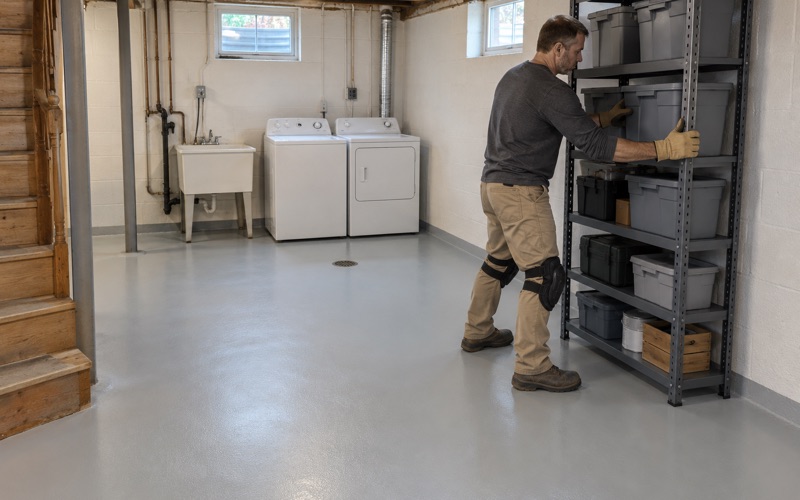
Finished living space also changes what we expect from the slab. A basement turned into a family room is closed in, carpeted in places and heated, so a slab that pushed vapor into an open storage room can trap it under a new floor. That is why we test before we coat and read the warranty exclusions aloud, with moisture named first.
Asking before the job goes on the calendar
When a McFarland job touches more than the floor, we call the village’s Community and Economic Development Department at 5915 Milwaukee St. before it is scheduled. The building inspector there works by appointment, and a five-minute question settles whether a permit applies. Replacing a slab and coating one are different questions, and we do not guess at either.
Every Wisconsin home job also gets a written contract before any deposit is taken, as the state’s ATCP 110 home improvement rule requires. The contract carries the same product names, thickness and exclusions as the proposal, so nothing about the floor is decided verbally.
Where Leftover Resin, Hardener and Solvents Go
What Dane County’s Clean Sweep accepts
A floor job rarely uses every drop. There is often part of a kit of resin and hardener left, a can of sealer, and solvents used for cleanup. In Dane County those go to Clean Sweep, the county’s hazardous waste drop-off at the Dane County Landfill, 7020 Maahic Way, Madison, not into the household trash or down a drain.
The county’s accepted list names adhesives, epoxy and resins, architectural coatings, sealers, solvents and paint thinners, degreasers, and solvent-based driveway sealer. That covers most of what a garage or basement coating leaves behind. Containers should stay labeled and closed, and empty containers are not part of the program, so what goes in the car is the product that remains.
Household trips and what they cost
As of the county’s page and its March 2025 flyer, Dane County households pay $15.00 per trip with proof of Dane County residency, and out-of-county households pay $75.00. McFarland homeowners fall under the in-county rate. Fees, hours and lists change, so it is worth checking the county page before loading the trunk.
The same flyer lists landfill hours of 7:15 a.m. to 3:15 p.m. Monday through Friday and 8:00 a.m. to 10:45 a.m. on Saturday, with a coordinator line at 608-838-3212. A homeowner who finished a small touch-up after we left can bring a single quart as easily as a full kit.
Business drop-off by appointment
Businesses use Clean Sweep differently. The county’s page says businesses must make an appointment before any drop-off, and that final costs for businesses, handled as Very Small Quantity Generators, depend on the materials and their weights. No flat business rate is published, so we do not quote one.
For a shop or warehouse floor on Terminal Drive or McFarland Court, that means leftovers are planned into the job rather than discovered on the last day. The owner of the waste, the appointment and the inventory of what is left all get decided while the scope is being written, not while cans sit in a corner of the building.
What Clean Sweep Will Not Take
Concrete, grinding debris and scraped coating
Clean Sweep’s not-accepted list names cement and concrete, empty containers and garbage. A floor job produces exactly those things: grinding dust, chipped concrete from crack repair, and old sealer or paint scraped off the slab. None of it belongs in the Clean Sweep car load, and it is a separate disposal question from the liquids.
We treat that debris as its own line in the plan. Dust is captured by the grinder’s collection system, chips are bagged on site, and slurry is kept on the slab rather than rinsed toward the driveway. Where the material ends up is agreed with the customer before work starts, not settled by whichever bin happens to be nearby.
Lead paint chips and asbestos
The county list refuses lead paint chips outright and sends asbestos to a separate process: call the landfill for a permit. Older basement floors sometimes carry paint, tile or mastic from decades past, and McFarland has houses from before 1940 as well as its newer neighborhoods.
We do not test for lead or asbestos and do not describe any floor as free of either. When old paint or tile is on a slab we are asked to grind, we say so in writing and stop that portion until the owner has the material identified. Grinding an unknown coating is not a step we take on assumption.
Writing the leftovers into the proposal
The simplest way to handle all of this is to put it on paper. Our proposals list what will be left over, which liquids are bound for Clean Sweep, and how the grinding debris and any scraped coating will be bagged and handled, so there are no surprises on the final day.
That page sits next to the product name, the system build, the finished thickness, the moisture results and the warranty exclusions. A homeowner in McFarland can check every one of those against the floor that went down and against the cans that went to the landfill.
- 20+ Years in Concrete Coatings
- Moisture Testing in Every Scope
- Free Written Estimates