Janesville Epoxy Flooring installs metallic epoxy floors in Janesville, WI, serving surrounding cities including Milton, Edgerton, Beloit, South Beloit and Evansville. A metallic floor uses metallic pigments suspended in clear epoxy to create a marbled, three-dimensional finish that looks like flowing stone, molten metal or deep water. After more than 20 years of grinding and coating concrete, we know that the beauty of the finish depends just as much on the slab underneath as on the artistry on top.
Metallic is the most unforgiving system we install. Its thin, reflective layer shows every ridge, patch and pinhole in the concrete, so preparation goes further than it does for a flake or solid color floor. We grind the slab flat, repair every crack and test for moisture before we ever open a can of pigment.
Your proposal names the primer, the base color, the metallic coat, the topcoat and the finished thickness, so what went down can be checked against what was quoted. We walk through colors and the style of movement with you in advance, and we read the warranty exclusions before you sign, with moisture first on the list.
How a Metallic Epoxy Floor Comes Together
Metallic Pigments in Clear Epoxy
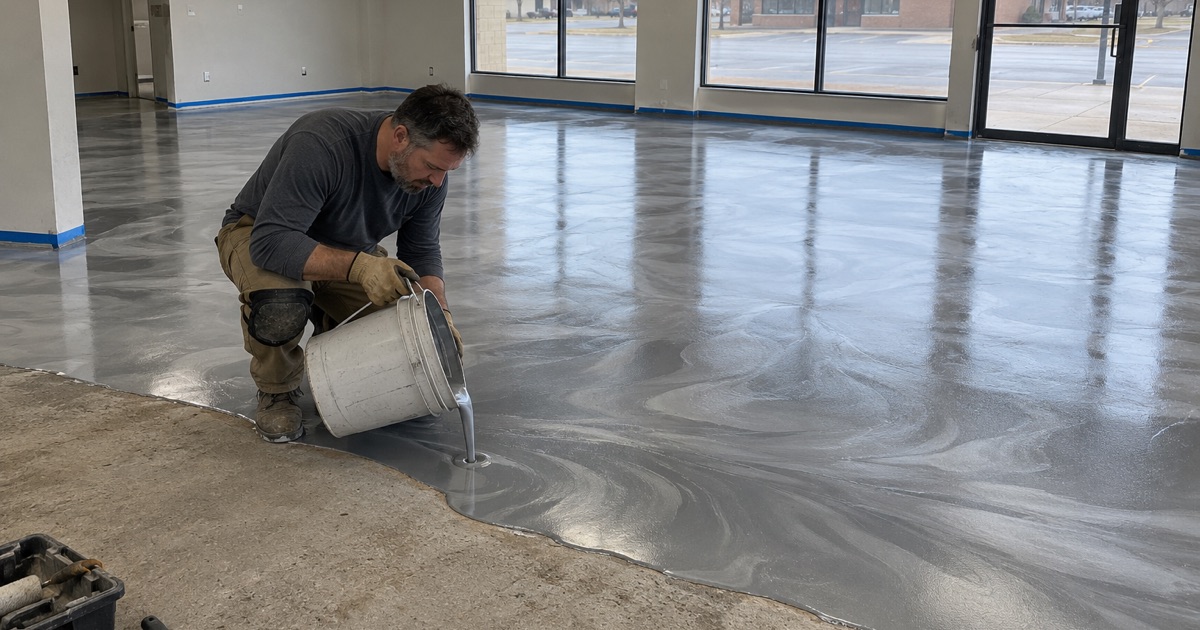
Metallic pigments are fine reflective particles mixed into a clear epoxy. As the epoxy flows across the floor, the particles move, settle and catch the light at different angles, creating swirls, veins and depth. The effect changes as you walk across the room, which is what makes these floors so striking.
The base color beneath the metallic coat shapes the final look as much as the pigment does. A dark base deepens the contrast, while a lighter base gives a softer, more pearlescent result.
Hand-Worked, One of a Kind
Every metallic floor is manipulated by hand while the epoxy is still fluid. Rolling patterns, brushes, sprayed solvent and directional movement all change how the pigment settles. That hand work is why no two metallic floors are ever identical, even with the same colors.
It also means installer experience shows in the result. The difference between an elegant, flowing floor and a muddy, blotchy one usually comes down to timing and technique during those working minutes.
Planning Colors, Movement and Lighting
Before installation day, we plan colors, the amount of movement and the overall style with you, from a subtle pearl sheen to bold marbling. We prepare sample boards so you can see the colors in your own lighting. Natural light, LEDs and warm bulbs can make the same floor look quite different.
We also consider furniture, rugs and traffic patterns. A floor that will be mostly covered may suit a calmer design, while an open showroom floor can carry dramatic movement.
Preparing a Slab for a Metallic Finish
Grinding for Flatness
A metallic floor reflects light like a mirror, so the slab needs to be flatter than it would for most other systems. We diamond grind the whole surface to remove high spots, trowel ridges and old coatings, and to reach a measured ICRI profile for bonding. We never acid etch, because it leaves residue and an uneven profile.
Where the slab has low spots, we may use a self-leveling underlayment or an epoxy skim coat to bring it flat. That extra step is often what separates a wavy metallic floor from a smooth, glassy one.
Repairing Cracks So They Do Not Telegraph
Cracks, patches and old repairs tend to telegraph through a thin metallic layer, showing up as lines or shadows in the finished floor. We route out cracks, fill them with a rigid repair material and grind them flush. Control joints get a decision, since a moving joint will eventually crack any coating laid over it.
If a slab has extensive cracking or failing patches, we discuss whether a metallic finish is the right choice. Sometimes a flake system or a polished concrete floor is the better fit for that concrete.
Moisture Testing and Outgassing
Moisture pushing up through a slab can cause blisters and adhesion failure, and it is especially visible under a clear metallic layer. We test with calcium chloride or relative humidity methods before quoting, and add a moisture-mitigation primer where readings call for it. Basements always get this testing.
Outgassing, where air escaping from the concrete forms bubbles and pinholes, is another risk. A sealing primer coat and careful timing against falling slab temperatures keep the metallic layer free of craters.
Installing the Metallic Floor
Primer and Base Color Coat
After grinding and repair, we apply a primer that seals the concrete’s pores and bonds deep into the ground surface. A tinted base coat follows, giving the metallic layer a consistent color beneath it. Both coats are applied only when slab temperature and dew point are in the right range.
The base coat also gives us one more chance to spot and fix imperfections. Any pinhole or flaw we catch here is one that will not show up under the metallic coat.
The Metallic Coat
The metallic epoxy is mixed, poured and spread, then manipulated while it flows to create the planned movement. This is the most time-sensitive part of the job, and we staff it so every section is worked before the epoxy begins to set. Consistent technique across the floor keeps the design looking intentional.
Once placed, the metallic layer is left to self-level and cure undisturbed. We control dust and traffic in the space during that window, keeping fans, pets and foot traffic away, because a stray footprint, hair or wind-blown dust settles permanently into the surface. Heating and air conditioning are set to hold the room steady, since a sudden temperature swing can change how the pigment settles in its final minutes.
Clear Topcoat for Wear and Color
A clear topcoat protects the metallic layer from scratches, chemicals and wear. Where the floor sees daylight, we use a UV-stable polyaspartic or urethane topcoat, because epoxy alone tends to amber and dull the colors. An anti-slip additive can be mixed in for areas that get wet.
The topcoat sheen can be adjusted too. High gloss shows the most depth, while satin reduces glare and hides fine scratches.
Metallic Floors for Homes and Businesses
Residential Basements, Rooms and Garages
In homes, metallic epoxy turns basements, bars, family rooms and home offices into a showpiece. Basements are a natural fit once moisture readings confirm the slab can hold a coating. In garages, metallic looks dramatic but shows salt residue and tire marks more than flake does, so we discuss how your garage is used before recommending it.
Every Wisconsin home job gets a written contract before any deposit, and Illinois home jobs over $1,000 also receive that state’s consumer rights pamphlet. The contract spells out the colors, the system and the finished thickness.
Commercial Showrooms, Salons and Retail
Metallic floors make a strong impression in showrooms, salons, boutiques, restaurants, offices and lobbies. The seamless surface is easy to clean, and the custom design can echo a brand’s colors. In busy commercial spaces, we specify a harder topcoat and slip resistance where customers walk in from wet or snowy sidewalks.
We schedule commercial installations around business hours, using evenings and weekends where needed. Products are selected to meet the VOC rules for the state the job is in, including Illinois limits that bind the applicator as well as the manufacturer.
- 20+ Years in Concrete Coatings
- Moisture Testing in Every Scope
- Free Written Estimates