Janesville Epoxy Flooring installs polyaspartic floor coating systems in Janesville, WI, serving surrounding cities including Milton, Edgerton, Beloit, South Beloit and Evansville. After more than 20 years of coating concrete, we use polyaspartic where its strengths matter most: fast cure, color that holds in sunlight and a tough surface that shrugs off hot tires and road salt. It is not a magic product, and we do not sell it as one, but on the right floor it is hard to beat.
Polyaspartic is a fast-reacting member of the polyurea family. We use it as a topcoat over a 100% solids epoxy base, and as a full system on its own where a quick return to service matters. Either way, the coating still depends on the slab underneath, so every job starts with diamond grinding, crack repair and moisture testing written into the scope.
The proposal names the polyaspartic product, the layers in the system and the finished thickness, so what was quoted can be checked against what went down. Warranty exclusions are explained before you sign, with moisture at the top of the list. Below is what a polyaspartic floor is, where it earns its place and what it takes to install one properly.
What a Polyaspartic Floor Coating Is
Polyurea Chemistry, Tuned for Floors
Polyaspartic coatings are aliphatic polyureas formulated to give installers a workable window that pure polyurea does not allow. The result is a coating that cures quickly, bonds well, stays slightly flexible and resists abrasion, chemicals and ultraviolet light. That combination makes it a natural top layer for floors that face sun, salt and heavy wear.
Because it is aliphatic, a polyaspartic topcoat holds its color in daylight far better than an aromatic epoxy. That matters on any floor where sunlight comes through a garage door, a storefront window or a skylight.
Polyaspartic Compared With Epoxy
Epoxy is excellent at building thickness and locking into ground concrete, and it is forgiving to apply because it cures slowly. Its weaknesses are ambering under ultraviolet light and a long wait before the floor can be used. Polyaspartic reverses those traits, curing quickly and staying color stable, but it is thinner per coat and less forgiving.
That is why many of our systems combine the two. A 100% solids epoxy base does the bonding and building, a flake or quartz broadcast adds texture, and a polyaspartic topcoat takes the wear and the sunlight.
One-Day Floor Systems
A full polyaspartic system can often be ground, coated, broadcast and topcoated in a single day. For a homeowner, that means less time with the garage out of use, and for a business it means a shorter shutdown. Not every floor is a one-day floor, though, and we say so when it is not.
Slabs that need major crack repair, old coating removal or a moisture-mitigation primer take longer, because each of those steps needs its own time to work. We plan the schedule around the slab rather than promising a speed the concrete cannot support.
Where Polyaspartic Earns Its Place
Garages Facing Salt, Sun and Hot Tires
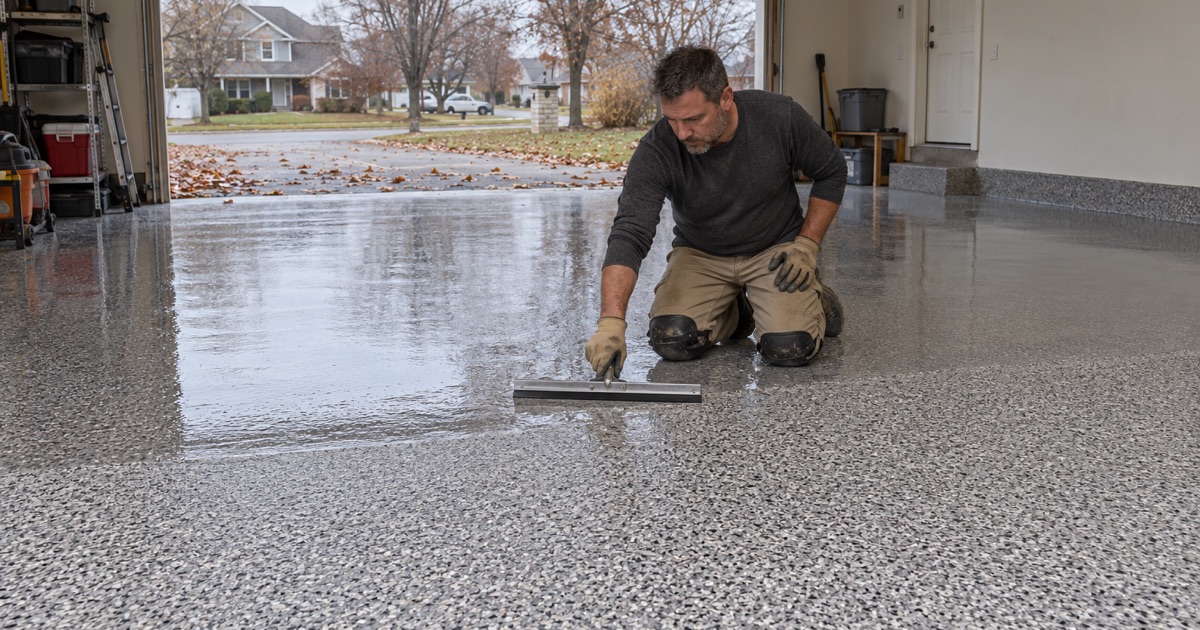
A Rock County garage takes a beating: rock salt and calcium chloride brine dripping off the car, hot tires that soften weaker coatings, and sunlight through an open door. A polyaspartic topcoat resists all three better than an epoxy topcoat does, which is why we specify it on most of our garage floors.
Hot tire pickup is the failure homeowners remember most, where the coating lifts off with the tire after a warm drive. A hard, well-bonded polyaspartic topcoat over a properly ground and built base is what keeps that from happening.
Cool-Weather and Shoulder-Season Work
Polyaspartic cures at lower temperatures than standard epoxy, which widens the window for coating work in spring and fall. That flexibility is useful here, where cold slabs limit when an ordinary epoxy can cure to full hardness. It does not make the coating immune to winter, however.
We still check slab temperature, air temperature and the dew point spread at the surface before every coat. If an unheated garage is simply too cold, we tell you it needs to wait rather than gambling on a cure that may not complete.
Commercial Floors That Need to Reopen Fast
Storefronts, showrooms, offices, clinics and light commercial spaces often cannot close for the days a standard epoxy needs. A polyaspartic system lets us coat in the evening or over a weekend and hand the floor back quickly. For spaces that see hot washdown or thermal shock, urethane cement is usually the better answer, and we will say so.
We phase larger commercial jobs in sections and schedule around the hours the building has to stay open. Joints in working areas get a semirigid filler first, so carts and pallet jacks do not chip the edges.
Installing Polyaspartic the Right Way
Grinding for a Fast-Curing Coating
A fast-curing coating has less time to soak into the surface, so preparation matters even more than it does with epoxy. We diamond grind or shot blast every slab to a measured ICRI profile that gives the coating a clean, open surface to grip. We never acid etch, since that leaves residue and an uneven profile.
Grinding also removes old sealers and paint that would block the bond entirely. Dust is collected at the grinder, and any slurry stays on site instead of being washed toward a drain.
Working Within a Short Pot Life
Polyaspartic gives the crew a limited time between mixing and setting, and that window shrinks as temperatures rise. We mix in measured batches, spread and back-roll quickly, and keep a consistent wet edge so there are no lap marks or thin spots. This is where experience shows, because mistakes set before they can be fixed.
Crew size and staging are planned around the square footage before the first batch is mixed. A rushed or understaffed polyaspartic job tends to show its seams.
Humidity, Dew Point and Moisture
Polyaspartic cure is affected by humidity, and coating too close to the dew point can cause cloudiness, bubbling or poor adhesion between layers. We measure conditions on the day and adjust timing accordingly. Ground moisture rising through the slab is a separate question, which we answer with moisture testing before the job is scheduled.
If calcium chloride or relative humidity readings run high, a moisture-mitigation primer goes down first, or we advise against coating that slab. A fast-curing topcoat cannot hold back moisture pushing up from below.
Polyaspartic for Homes and Businesses
Residential Garages and Basements
For homeowners, polyaspartic means a floor back in use quickly, a topcoat that keeps its color, and a surface that cleans with a squeegee and hose. It works well over a flake broadcast in garages and as a durable clear coat over decorative basement systems. Basements always get moisture testing first, because a coating is never a fix for water coming through a slab.
Every Wisconsin home job gets a written contract before any deposit, and Illinois home jobs over $1,000 also get that state’s consumer rights pamphlet. The contract names the product, the system and the finished thickness.
Business and Light Industrial Floors
In commercial and light industrial spaces, a polyaspartic topcoat resists oils, cleaners and abrasion while keeping the floor bright and easy to clean. We add slip resistance where the floor sees water or grease, and choose products that meet the VOC rules for the state the job is in. On Illinois jobs, those limits bind the applicator as well as the manufacturer.
We can work overnight or on weekends so production and customers are not disrupted. The aim is a floor that goes back into service quickly and keeps performing long after the reopening.
- 20+ Years in Concrete Coatings
- Moisture Testing in Every Scope
- Free Written Estimates