Janesville Epoxy Flooring has spent more than 20 years on epoxy flooring in Rockford and across the state line, and the first thing we do on an old basement or garage floor is find out what is already on it. A painted slab is not a blank slate. Before a grinder touches it, we want to know whether that paint is the kind federal rules treat as a lead question.
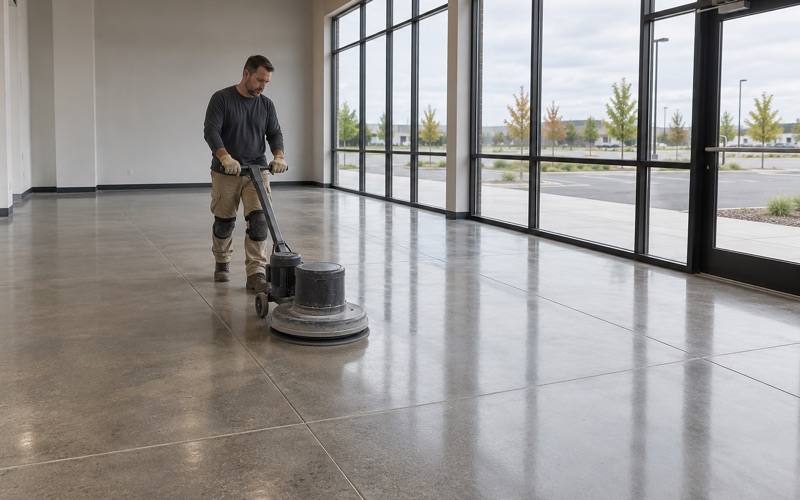
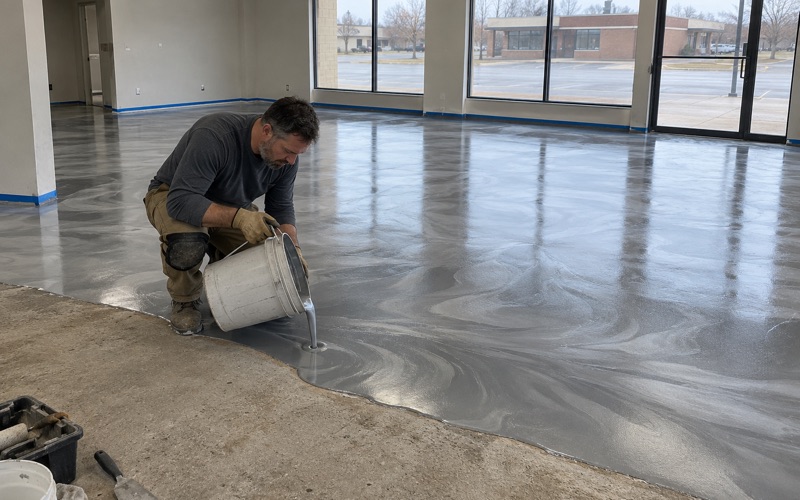
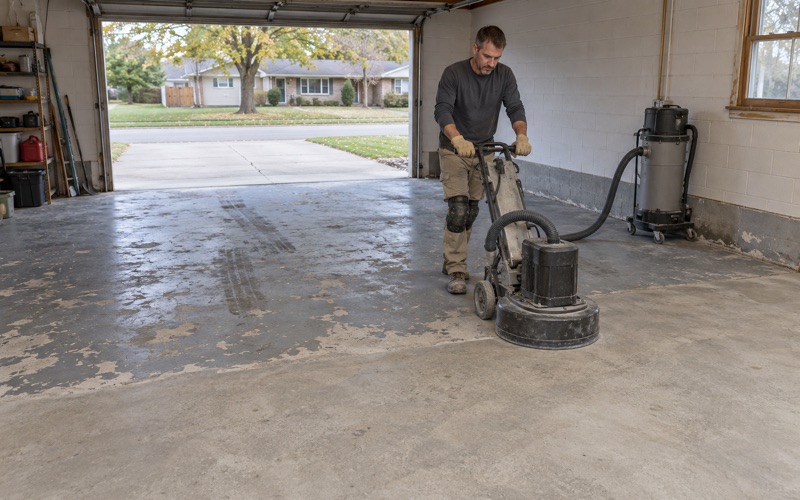
That order of work matters because a coating only bonds to concrete that has been opened mechanically. We use a diamond grinder or a shot blaster on every job and never acid etch, which means old paint has to come off as dust or debris. How that dust is captured is the part of the job a homeowner rarely sees and should ask about first.
This page walks through what changes when the floor sits in an older house: when EPA’s renovation rule covers the prep, how old paint gets tested, what a shrouded grinder with a HEPA vacuum does, and why rentals with young children get extra attention. Everything else, from moisture testing to the finished system build, follows once the old surface is handled properly.
Rockford’s Older Housing and the Paint on Its Floors
How old the housing stock runs
Rockford is the county seat of Winnebago County and the most populous city in Illinois outside the Chicago metropolitan area, with 148,655 residents at the 2020 census. Its housing is old. Census survey estimates count 50,079 of 67,423 housing units built before 1980, about 74 percent, and 15,093 built in 1939 or earlier, roughly 22 percent of the city’s homes.
The city sits on the banks of the Rock River in far northern Illinois and spans parts of Winnebago and Ogle counties. Across that footprint, detached houses, attached units and two- to four-unit buildings stand side by side, and the 1950s alone account for 11,146 units. Each building era tends to leave a different floor behind, from bare troweled concrete to thick, glossy enamel.
Why old floor paint changes the job
Paint applied before 1978 can contain lead, and a gray or red basement floor that has been recoated three or four times may carry layers from several eras. Grinding is how we open a slab for epoxy, and grinding painted concrete turns those layers into fine dust. That is the moment the lead question stops being theoretical and starts shaping the job.
No source counts how many floors in the city are painted, and age alone does not settle anything either way. A 1950s garage may have bare concrete, and a newer home may have a floor painted with old leftover stock. We treat the build era as the reason to ask, then let the federal work practices and a real test decide how the floor gets prepared.
Looking for epoxy-flooring closer to Fitchburg? See Fitchburg Epoxy-Flooring.
When EPA’s Renovation Rule Covers Floor Prep
Target housing and paid work
The EPA Renovation, Repair and Painting rule applies to renovations performed for compensation in target housing and child-occupied facilities. Target housing means housing built before 1978, with exceptions for housing for the elderly or persons with disabilities and for zero-bedroom units, unless a child under six lives there or is expected to. A paid floor coating job is paid work.
Applying the rule to floor prep is a reading of how it is written rather than a separate line about floors. Stripping an old painted basement or garage floor for a new coating disturbs painted surfaces, so unless the paint has been shown to contain no lead, we plan the prep under the rule’s work practices in any home that qualifies.
What the rule says about machines
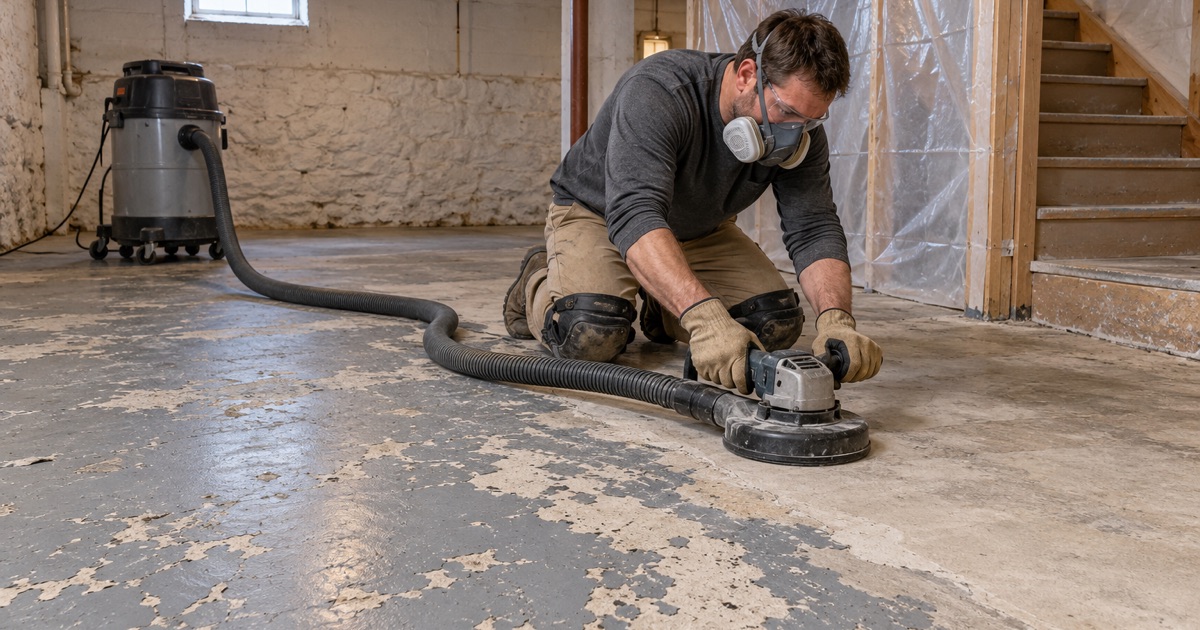
The rule is specific about equipment. Sanding, grinding, power planing, needle guns, abrasive blasting and sandblasting are prohibited on painted surfaces unless the machine has a shroud or containment system and a HEPA vacuum attachment collecting dust and debris at the point of generation. The machine must also be run so no visible dust or air escapes outside the shroud.
That language describes exactly the tools we use to profile a slab. A diamond grinder and a shot blaster are high-speed surface removal machines, so on a painted floor in a qualifying home they run shrouded and vacuum-connected or they do not run at all. We would rather plan that up front than discover the paint halfway through a job.
No torch, and limited heat
Open-flame burning or torching of painted surfaces is prohibited outright, and heat guns may only be used below 1,100 degrees Fahrenheit. Burning old coating off concrete was never a method we used, but homeowners sometimes ask whether a torch would speed things up on a thick, peeling floor. On a painted surface in an older house, the answer is no.
Heat guns have their place on trim, but they are a poor fit for a whole slab, and we do not use them to lift floor paint. Mechanical removal under a shroud is slower to set up and cleaner to finish. It also leaves the open concrete profile that a new epoxy or polyaspartic system needs in order to bond.
Testing the Paint, Then Grinding Under a Shroud
Ways to find out what is in the paint
The rule itself names how a painted component can be shown to contain no lead: a determination by a certified inspector or risk assessor, a test kit recognized by EPA, or a lab analysis of paint chips. Each method answers the same question with a different level of detail, and the right choice depends on how many layers are present and what the owner wants documented.
Testing is a decision the homeowner makes with whoever performs it, and the result belongs in the job file. Our part is to raise it during the estimate, explain the options, and build the prep plan around the answer. If no test is done, we treat the paint as if it contains lead and price the shrouded method from the start.
Reading the old coating at the estimate
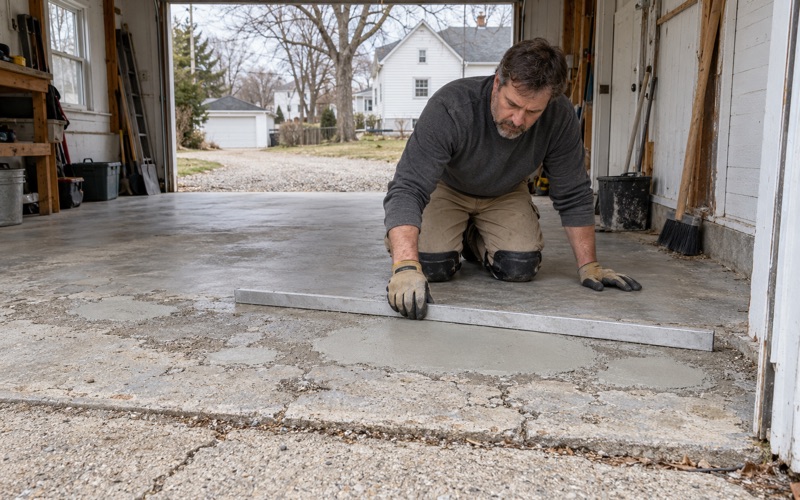
Our estimate visit already includes reading the cracks, joints and old coating before we quote, and the paint question fits there. We note how many layers show at a chipped edge, whether the paint is bonded or flaking, and where it stops. A slab that also needs crack repair or replacement before it can be coated hears that from us at the same visit.
The written proposal then names the product, the system build and the finished thickness, along with how the old paint will be removed. On an Illinois job over $1,000, that proposal becomes a written contract delivered with the consumer rights pamphlet the Illinois Home Repair and Remodeling Act requires, so the method you were promised is on paper before work starts.
Shrouded grinding in practice
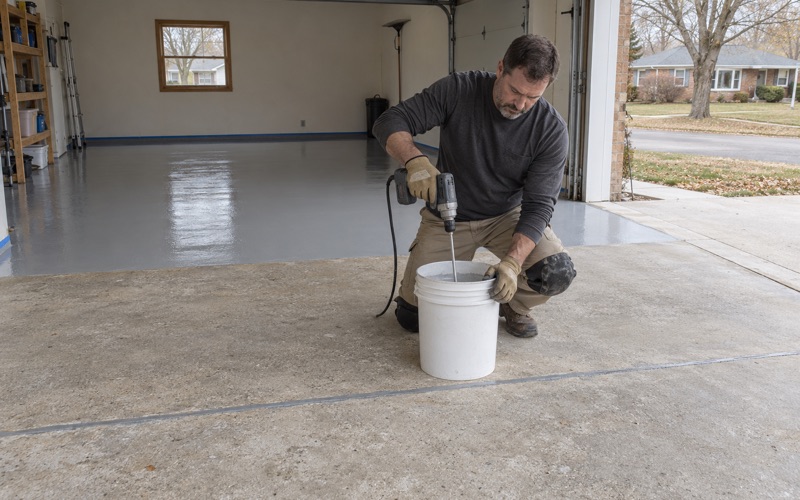
On a floor treated as lead-painted, the grinder runs with its shroud sealed to the slab and a HEPA vacuum pulling at the cutting head. Edges and corners get shrouded hand tools rather than open ones. The standard the rule sets is easy to check by eye: no visible dust outside the shroud, anywhere in the basement or garage.
Dust and debris collected that way stay in the vacuum and its bags until they leave with us. We collect grinding dust and slurry on site on every job and never wash it toward a storm drain, and old paint dust gets the same handling with closer attention to cleanup. After grinding, the surface should read as a clean, evenly opened profile.
Acid etching cannot remove paint, and on an old painted floor it would only wet the surface and spread contamination around. That is one more reason we open every slab mechanically. A shrouded grinder reaches a measurable surface profile on the ICRI CSP scale while capturing the old coating instead of rinsing it across the floor.
Rentals, Children Under Six and the Coating That Follows
Rented homes and young children
About 45.1 percent of Rockford’s occupied homes are rented, including 9,124 rented detached houses. When a landlord hires us to coat a floor in a unit built before 1978, the target housing definition and its exceptions turn on who lives there, including whether a child under six resides in the home or is expected to.
We ask that question at the estimate rather than assume the answer. A zero-bedroom unit or senior housing can fall outside the definition, but the exception ends if a young child is present. Tenants also deserve to know when grinding is scheduled, so we coordinate access, keep the work area closed off, and keep the shrouded setup in place until the floor is cleaned.
The county’s lead hazard work
Lead in older housing is not a new concern for local agencies. In October 2019 HUD awarded the Winnebago County Health Department a $3.4 million Lead Hazard Reduction Demonstration grant to find and remove lead-based paint hazards in low- and very-low-income privately owned housing in the Rockford area where children under six live or are likely to live.
That program targets jurisdictions with many pre-1940 rental homes and high childhood lead-poisoning rates. We have no connection to it, and a floor coating is not a lead hazard control method. Owners with questions about lead in their home, or about the grant, should contact the county health department directly before we schedule any grinding.
After the paint: moisture, salt, curing and permits
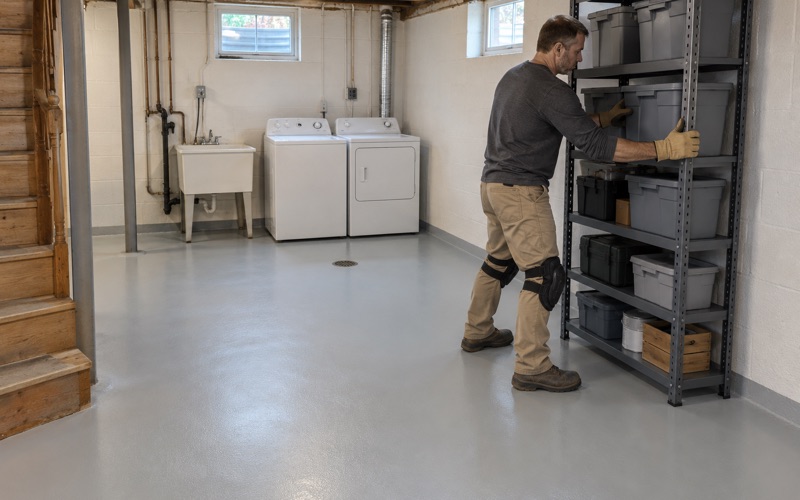
Once the old paint is handled, the floor is treated like any other slab we coat. Moisture testing is a line item in the scope, using methods such as ASTM F1869 calcium chloride tests or ASTM F2170 relative humidity probes. Warranty exclusions are read to you before the job is sold, with moisture named first, and a coating is never sold as a fix for water.
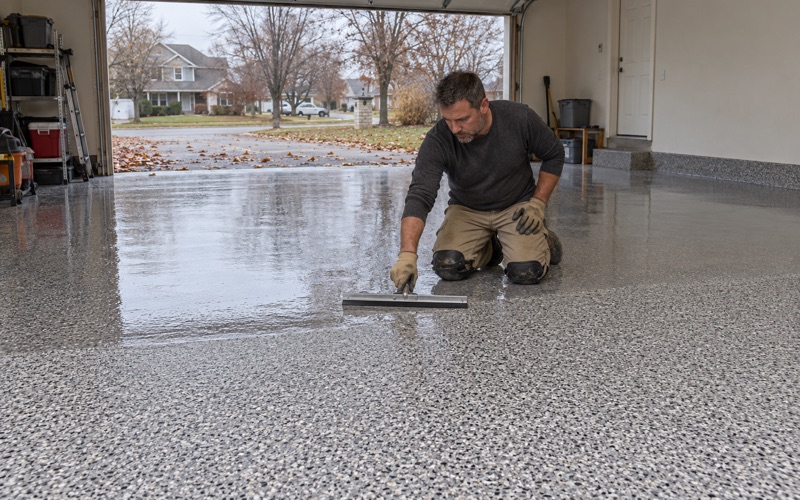
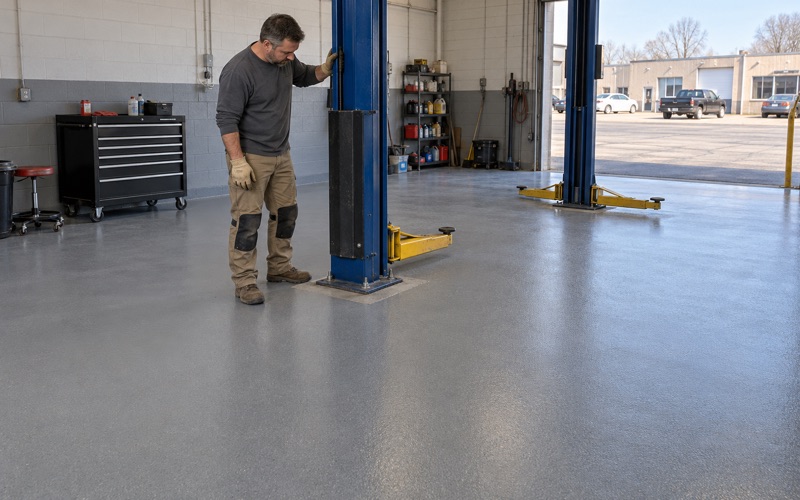
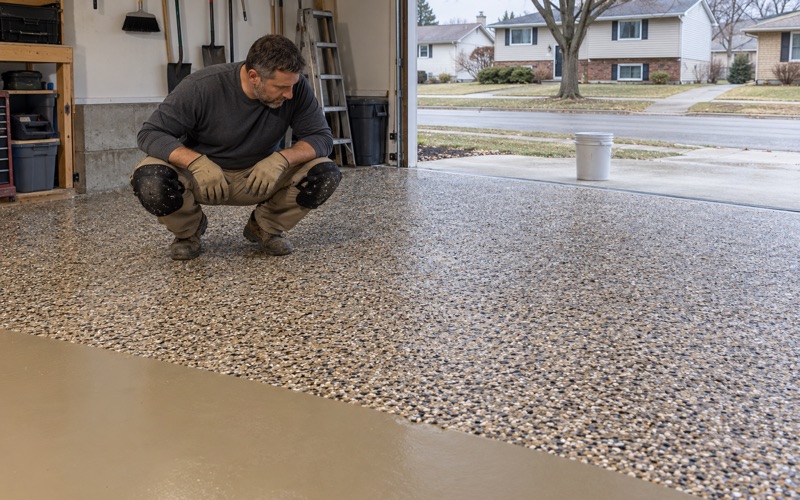
Garage floors get the build we use against road salt and calcium chloride brine tracked in on tires all winter. A 100% solids epoxy base with a polyaspartic topcoat and a flake or quartz broadcast resists that far better than the single coat of paint it replaces, provided the old paint came off properly underneath.
We use coatings that meet the VOC limits in Part 223 of the Illinois Administrative Code, which bind the applicator as well as the maker. Curing is scheduled against slab temperature and dew point rather than the calendar, so an unheated garage may have to wait for spring. Before scheduling, we ask City of Rockford Construction & Development Services whether the job needs a permit.
- 20+ Years in Concrete Coatings
- Moisture Testing in Every Scope
- Free Written Estimates