Janesville Epoxy Flooring has spent more than 20 years on epoxy-flooring work, and in South Beloit the first thing we settle is the paperwork, not the product. Illinois treats a coated garage or a resurfaced basement floor as home repair, so the owner here signs a different set of documents than an owner a short drive north would, and we put those documents in front of you before we quote a start date.
We do not treat that as a nuisance. The Illinois rule hands the owner a written record of what was promised, which is the standard we try to hold on every job anyway. Our proposals name the product, the system build and the finished thickness, so the contract and the cured floor can be checked against each other long after the crew has packed up and left.
This page covers what Illinois asks of a floor contractor, which buildings that rule reaches and which it does not, and what we think belongs in any coating contract before a grinder touches the slab. If you are comparing bids from several crews, the same questions work on every one of them, ours included, and the answers tell you a lot about how the floor will be built.
A Floor Job on the Illinois Side of the Line
Why Illinois law reaches a garage floor
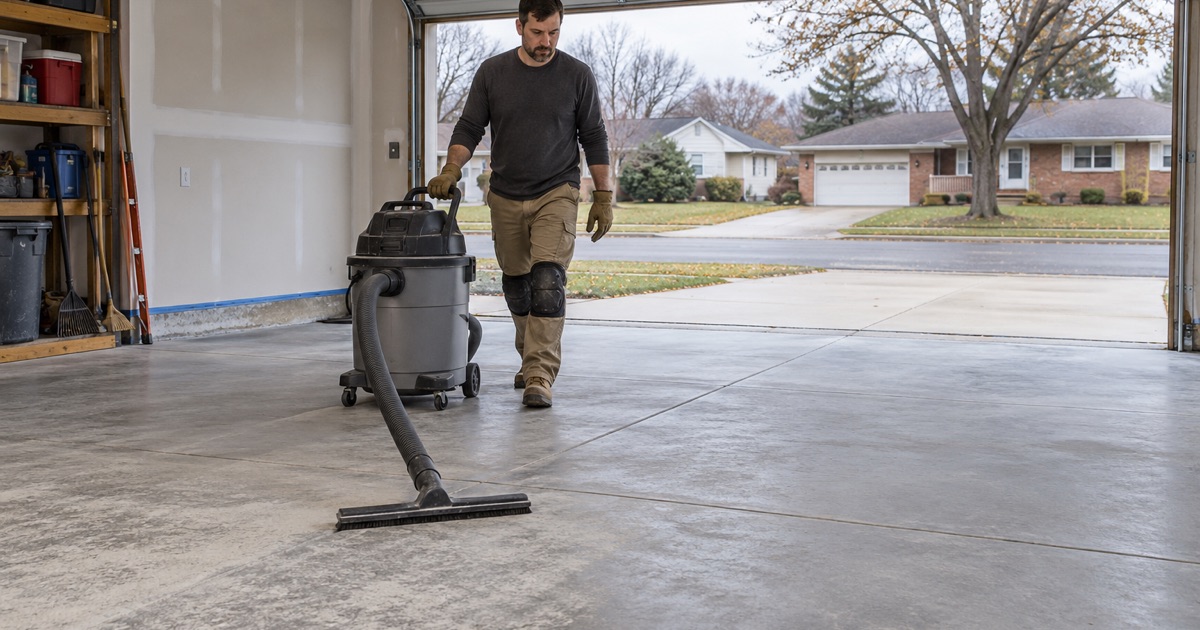
The Illinois Home Repair and Remodeling Act took effect January 1, 2000, and its definition of home repair and remodeling names driveways, basements and garages in so many words. A coated garage slab or a resurfaced basement floor sits squarely inside the law rather than in a gray area. The same definition leaves out carpet, and it leaves out maintenance or repair work under $500.
South Beloit is a city in Winnebago County, Illinois, a suburban extension of Beloit, Wisconsin, along the state line inside the Rockford metropolitan area. A crew can finish one garage in Beloit and start another in South Beloit the same afternoon, and the contract changes at the line even though the slab and the brine damage look identical. Wisconsin’s own home improvement rules govern the north side.
What the Act leaves out
The Act does not apply to original construction, and it does not apply to a dwelling with more than six units. It was written for existing homes and the small buildings people actually live in, which is where most of our garage and basement work in the city lands. A landlord with a big apartment building is the main owner it skips, and we cover that case further down.
The law also says nothing about how a floor should be built. It governs the transaction, the contract and the disclosures, not grinding profile or moisture limits. Those standards come from the industry, which is why our scope still carries an ICRI CSP surface profile target and a moisture test whether or not a particular job falls under Illinois law.
The houses the law usually lands on
Census estimates count 2,062 owner-occupied detached homes in South Beloit, out of 2,304 owner-occupied units in the city. Nearly every one is a residence under the Act, and so is the garage or basement attached to it. The housing is mixed in age, with 918 units built in the 2000s and 778 in the 1990s beside 476 built in 1939 or earlier.
Those age layers show up in the concrete. A slab poured in the 2000s and an older basement floor rarely carry the same cracking, joint condition or leftover paint. We read the cracks, joints and any old coating before quoting, and when a slab needs repair or replacement before a coating can hold, we say so in writing instead of selling a system that will peel.
Looking for epoxy-flooring closer to Evansville? See Epoxy-Flooring Services in Evansville.
The Written Contract and the Consumer Rights Pamphlet
Over $1,000, the contract comes first
For home repair or remodeling work over $1,000, the Act requires a written contract or work order before work begins. It has to state the total cost, including parts and materials, along with the business name and address. The enacted text says materials must be listed with reasonable particularity, which rules out a one-line estimate that reads only “garage epoxy” and a price.
The Act also makes it unlawful to start the work, or to charge for it, before that signed contract exists on a job over $1,000. We do not take a deposit or put a grinder on the calendar until the contract is signed. We treat the contract as owed whenever the total could cross that figure, because grinding, crack repair, primer and topcoat add up quickly.
The pamphlet and the acknowledgment form
Before the contract is executed, the contractor must give the owner a pamphlet titled Home Repair: Know Your Consumer Rights. It has to be a separate document in at least 12 point type, not a paragraph tucked into the back of a proposal. On a job of $1,000 or under, the pamphlet is still owed, just without the signed form.
Over $1,000, the owner and the contractor both sign and date a Consumer Rights Acknowledgment Form, in duplicate, so each side keeps a copy. It is one sheet of paper, but it records that the owner was told their rights before agreeing to anything. We hand ours across the kitchen table at the estimate, not after the floor is already down and drying.
What the pamphlet tells an owner to do
The pamphlet gives the owner 3 business days to cancel a contract if the sale was made at home. It tells the owner to get estimates in writing, to check with local and county government on whether permits or inspections apply, and to find out whether the contractor guarantees the work and carries proper insurance before signing.
It also recommends requesting lien waivers, which protect an owner from a supplier’s claim if a contractor never pays for materials. On the guarantee question, we read our warranty exclusions out loud before a job is sold, with moisture named first, so the owner hears exactly what the warranty does not cover while there is still time to walk away.
Small Rentals, Fourplexes and Larger Buildings
Where the six-unit line falls
The Act defines a residence as a single-family home or a dwelling of six or fewer units. A landlord coating the basement of a duplex or the garage stalls behind a fourplex hires under the same rules as a homeowner, with the same written contract and the same pamphlet. A twelve-unit building falls outside the Act altogether, by our reading of the enacted text.
South Beloit has both kinds of building. Census estimates show 41 units in two-unit buildings, 67 in three- and four-unit buildings, and 202 in buildings of five to nine, a group that straddles the line, so the count in the specific building decides it. Another 325 units sit in buildings of ten or more, where the terms come down to whatever the contract itself says.
What landlords get from us either way
We do not change our paperwork when the law stops requiring it. The owner of a ten-unit building gets the same written scope a homeowner gets, listing the product, system build, finished thickness and moisture test, because a shared basement or common garage fails for the same reasons a private one does.
Rental floors also have to fit around tenants. We schedule around the hours a building has to keep running, including overnight and weekend windows, so cars are moved, curing is not interrupted, and nobody parks on a topcoat that needed another day. The city has discussed a possible rental registry, though we found no adopted registration rule for landlords to follow.
Shop and warehouse floors sit outside the Act
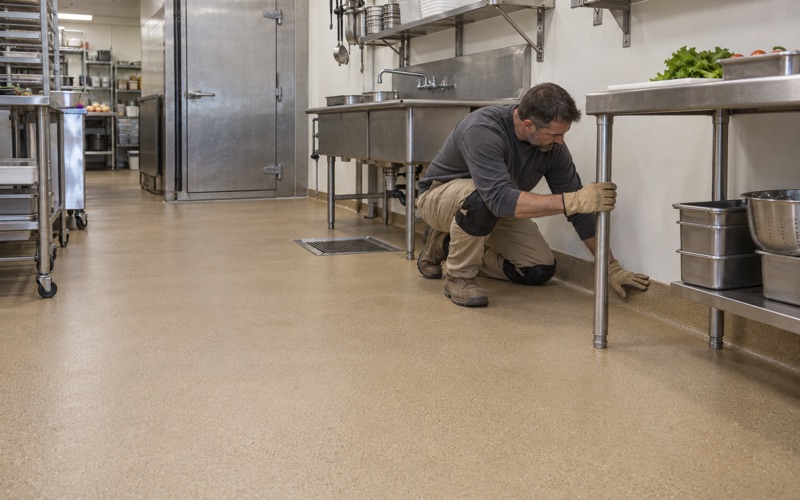
Commercial floors are not residences, so the home repair law does not reach them. South Beloit has a working industrial side, with machining shops, Rockford Manufacturing Group on Industrial Parkway and 23,956 square feet of industrial space listed for lease on Metric Road. Those contracts are negotiated business to business, and we fill joints with a semirigid filler before coating so forklift wheels do not break the edges.
What to Put in a Coating Contract Before Work Starts
Surface preparation and system build
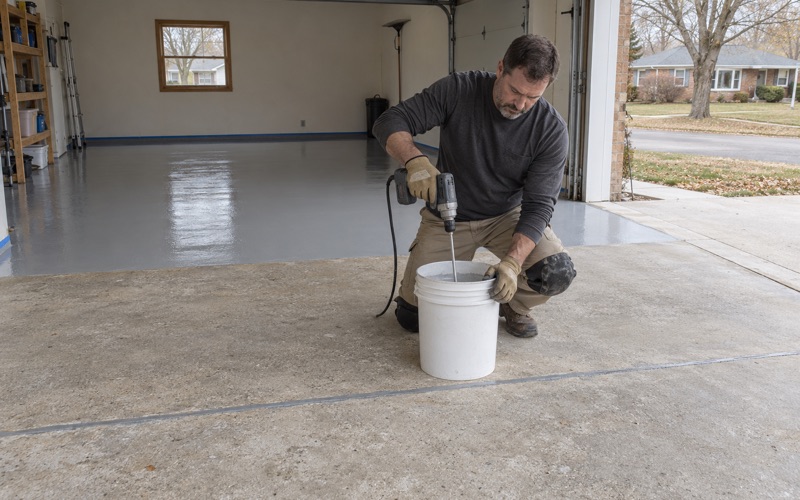
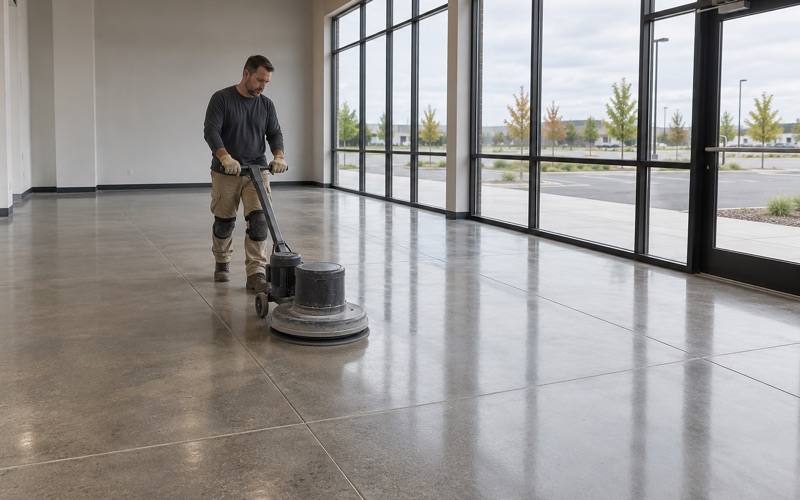
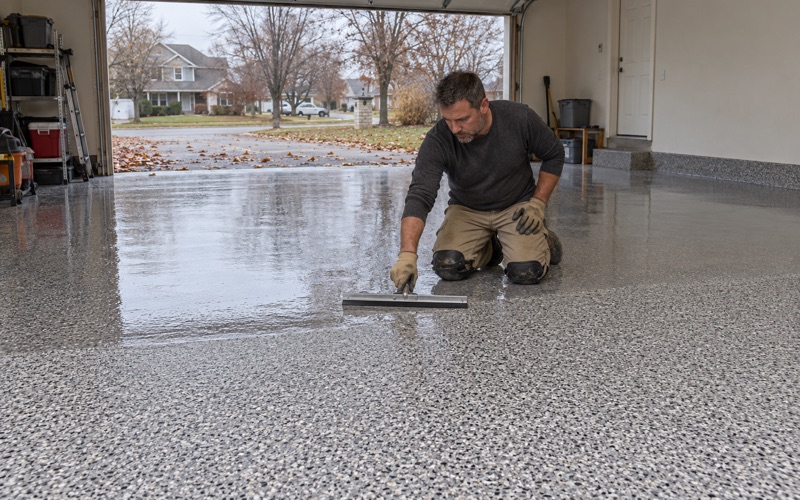
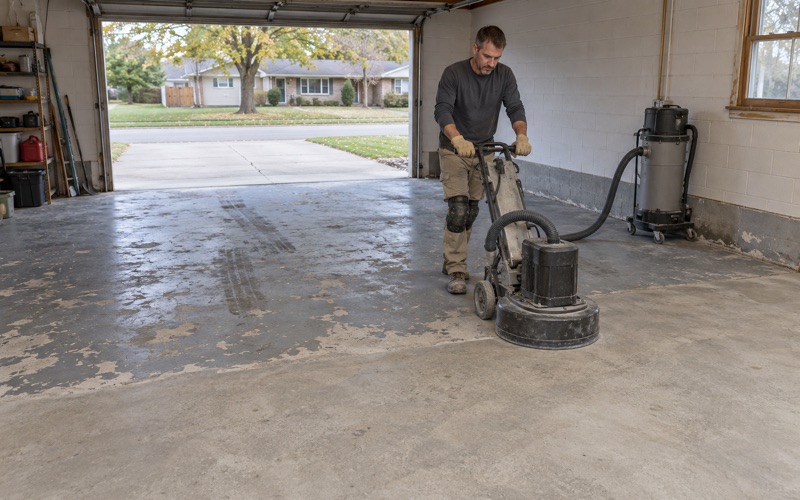
A contract that meets the Act’s particularity standard should say how the slab will be opened. Ours specifies diamond grinding or shot blasting to a stated ICRI CSP profile, and we never acid etch. It names the primer, the body coat, any vinyl flake or quartz aggregate broadcast, and the topcoat, whether that is a 100% solids epoxy, a polyaspartic or a polyurea.
Finished thickness belongs in the contract too. Without it, a thin roll-on kit and a full broadcast system can carry the same product name and very different service lives, and the owner has nothing to measure against. Naming the thickness lets anyone compare the floor that went down with the floor that was quoted, which is the whole point of listing materials with particularity.
Moisture testing as a line item
Moisture coming through the slab is a leading reason a garage or basement coating lets go, so we list testing in the scope instead of selling it after a blister appears. Depending on the slab, that means an ASTM D4263 plastic sheet test, ASTM F1869 calcium chloride readings or ASTM F2170 in-situ relative humidity probes, with a moisture-mitigation primer priced as an option.
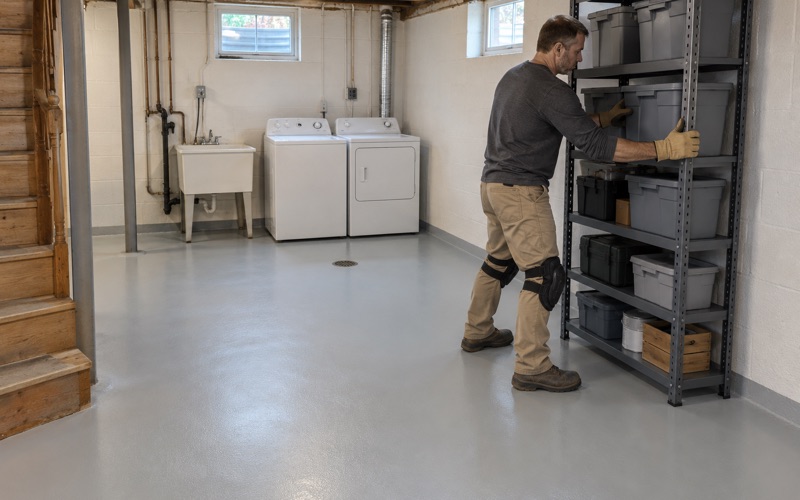
We do not sell a floor coating as radon mitigation or as a cure for water coming up through a slab, and the contract says so in plain words. If hydrostatic pressure is pushing water through a basement floor, that is a drainage problem to solve before any coating goes down, and we would rather lose the job than coat over it.
Curing, salt and permits
The contract should say when the floor can take foot traffic and when it can take a car. We schedule curing against slab temperature and the dew point spread at the slab surface rather than the calendar, and an unheated garage in January may have to wait for spring. Road salt and calcium chloride brine tracked in on tires shape our topcoat choice for every garage.
Permits deserve a line as well, since the pamphlet itself tells owners to ask. We check with the city building department before a job is scheduled, because coating a slab and replacing one are different questions. On Illinois jobs we also use coatings that meet the state’s VOC limits, which bind the applicator as well as the maker.
- 20+ Years in Concrete Coatings
- Moisture Testing in Every Scope
- Free Written Estimates