Janesville Epoxy Flooring offers epoxy flooring in Whitewater backed by more than 20 years in the trade, and this page is written for one reader in particular: the owner of a rental house whose basement or garage floor has to be finished between one tenant and the next. That timing changes how we schedule, test and cure a floor, so we explain it plainly before anyone signs a proposal.
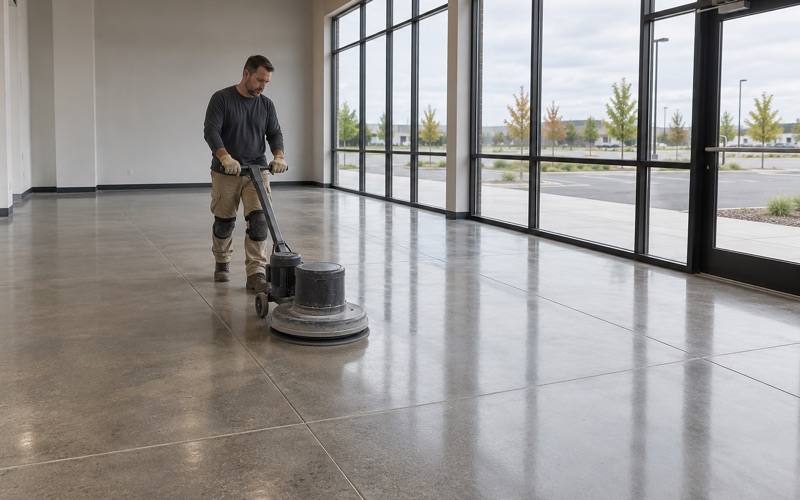
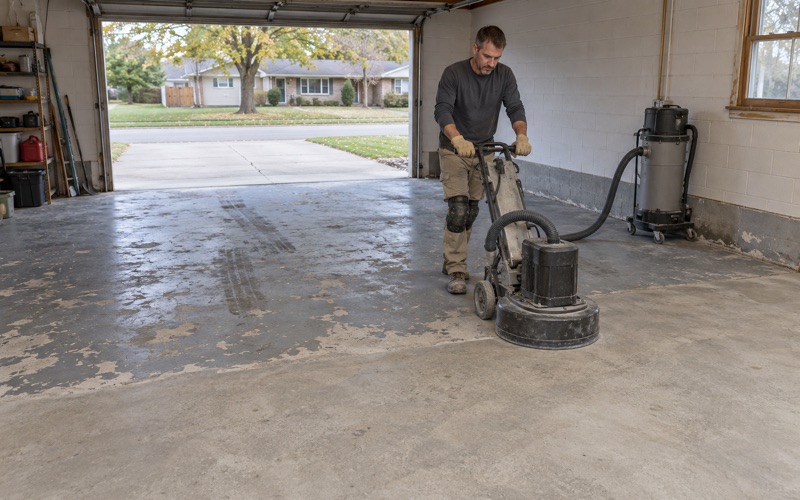
Every slab we coat is opened mechanically with a diamond grinder or shot blaster first, and we do not acid etch. Moisture testing sits in the written scope as its own line, on a basement slab or a garage slab, so a landlord knows what the concrete is doing before a coating is chosen rather than after it blisters under the next tenant.
The proposal names the product, the system build and the finished thickness, which gives an owner something to check against the floor that went down. Warranty exclusions are read aloud before the job is sold, moisture first. And because Wisconsin’s home improvement rule requires it, every job here gets a written contract before we take any deposit.
Rental Houses in a University Town and the Summer Gap
Whitewater is a city in Walworth and Jefferson counties, home to UW-Whitewater, and its housing looks different from most places we work. Census figures put 3,567 of 5,229 occupied homes in the rented column, or 68.2 percent, and 576 of those rentals are detached single-family houses with their own basements and garages.
Why landlords own so many of these floors
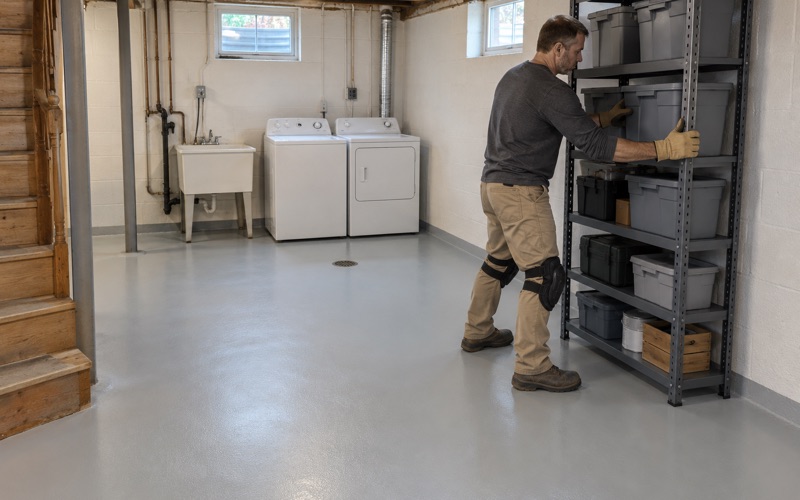
A detached rental house usually comes with the same concrete an owner-occupied one has: a basement slab under the furnace and laundry, and a garage slab that takes tires, bikes and whatever a household of tenants stores there. The difference is who pays for the floor and who lives with it. The landlord buys the coating, and a string of tenants walks on it.
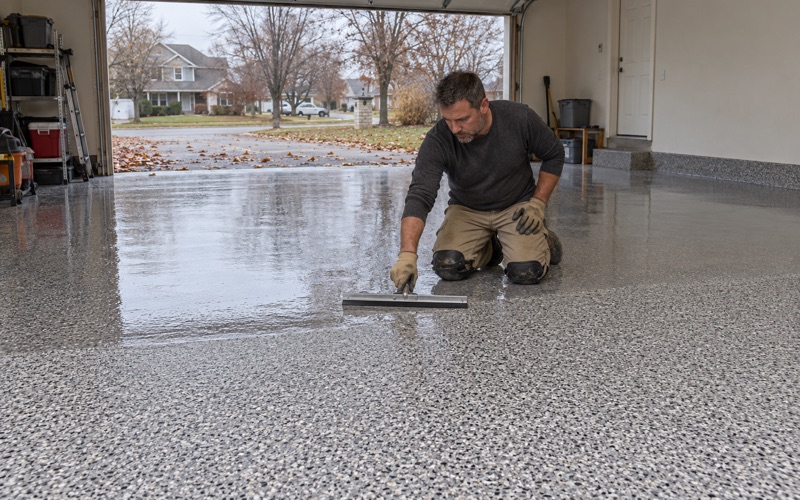
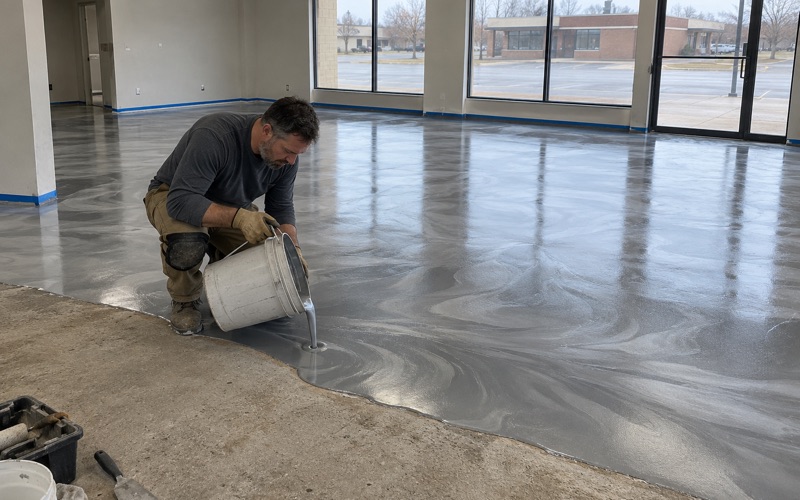
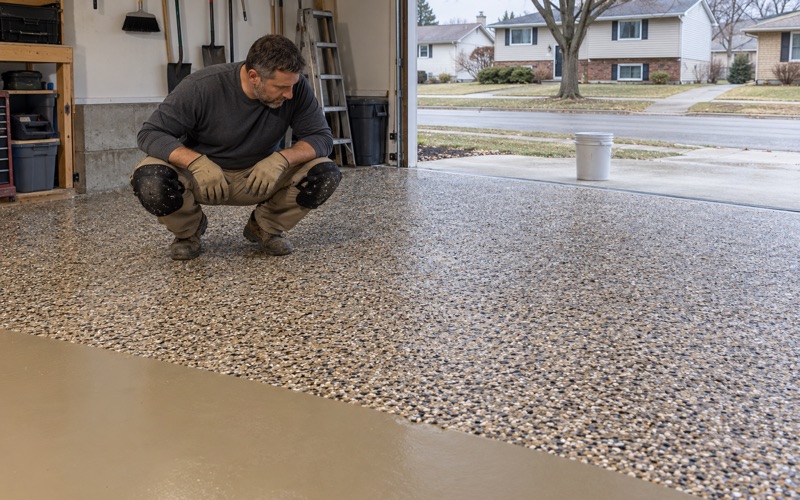
That split shapes what we recommend. A rental floor is judged at every turnover, so the build has to read clean after a year of student traffic, wet boots and moved furniture. We often point landlords toward a vinyl flake broadcast over 100% solids epoxy with a polyaspartic topcoat, because scuffs disappear into the pattern and small repairs blend in.
The window between a May move-out and a summer move-in
Off-campus listings posted through the UW-Whitewater housing site show how tight the gap can be. One Prince Street house runs its lease from July 31, 2026 to May 23, 2027, while a Center Street duplex starts June 26, 2026 and ends on the same May day. Those are individual listings, not a city calendar, and every landlord sets their own terms.
Where a house does sit empty from late May into summer, those weeks are the best chance to grind and coat a basement or garage floor without tenants, couches or bikes in the way. We book that window early, plan grinding, moisture testing, coating and cure as one sequence, and say before signing whether the dates leave enough room.
Curing against the weather, not the lease
A lease date is fixed, but a slab does not care about it. We schedule curing against slab temperature and the dew point spread at the slab surface, because a coat laid over a cold, damp slab can cloud with amine blush or fail to bond. Warm weather generally helps, though a humid stretch can still push a topcoat back a day.
If a landlord calls in November about a detached garage with no heat, we say plainly that it has to wait for spring rather than squeeze a coating into a cold month. Rushing a floor to beat a move-in date is how a landlord ends up with hot tire pickup by October and a second turnover spent on repairs.
Looking for epoxy-flooring closer to Roscoe? See Epoxy-Flooring Services in Roscoe.
Check-In Reports, Deposits and the Wear-and-Tear Line
Wisconsin’s rental practices code, ATCP 134, is a state rule rather than a Whitewater one, but it is the reason a floor’s condition matters so much at each turnover. It turns the basement and garage into part of the record a landlord and a tenant both look at when a lease begins and ends.
What ATCP 134.06 asks of a landlord
Before accepting a security deposit, a Wisconsin landlord must tell the new tenant in writing that they may inspect the unit and report preexisting damages or defects by a deadline at least 7 days after the tenancy starts. The tenant can also ask for the list of damages charged to the previous tenant. The deposit, or an itemized statement, goes back within 21 days.
Under ATCP 134.06(3), a landlord may withhold only what is reasonably necessary for tenant damage, waste or neglect, unpaid rent and certain utilities, and never anything for normal wear and tear. That line between ordinary use and real damage is where floor disputes tend to land, because an old stained basement slab makes it hard to say what changed during a lease.
Where a sealed floor helps, and where it does not
A sealed, one-color floor with no inherited oil stains or paint drips is simply easier to document. When the check-in report notes a clean coated slab, a later gouge or burn mark stands out, and so does the absence of one. That is a practical benefit for record keeping, not a legal standard, and we describe it to landlords in exactly those terms.
A coating changes nothing about what ATCP 134 counts as tenant damage or normal wear and tear, and no floor we install can promise any particular outcome when a lease ends. Scuffs in a topcoat after a year of use are still wear. What a good floor offers is a surface that cleans up well between tenants and makes the before-and-after comparison honest.
Disclosure and what a coating cannot fix
ATCP 134.04(2) requires a landlord to disclose any building or housing code violation they actually know about before a lease is signed or a deposit is taken. A cosmetic floor coating does not cure a violation, and we will not lay one over a problem as if it did. A heaving slab, an open drain or water coming through the floor needs a repair first.
We also do not sell a coating as waterproofing, radon reduction or a fix for water rising through a slab. When the cracks, joints or old coating tell us a basement floor needs repair or replacement before it can be coated, we say so in the quote, so the landlord decides with the full picture rather than discovering it at the next turnover.
Basement and Garage Floors a Landlord Owns
Most single-family rentals give a landlord two slabs to think about, and they fail in different ways. The basement fights moisture from below, while the garage fights salt and tires from above. We scope them separately even when both are coated in the same week.
Basement slabs in older rental stock
Whitewater’s housing spans eras, from 712 homes built in 1939 or earlier to 471 added between 2010 and 2019, so a landlord’s basement may be a century old or barely broken in. Age alone does not decide anything. What matters is the moisture the slab carries and the condition of whatever coating or paint a previous owner left on it.
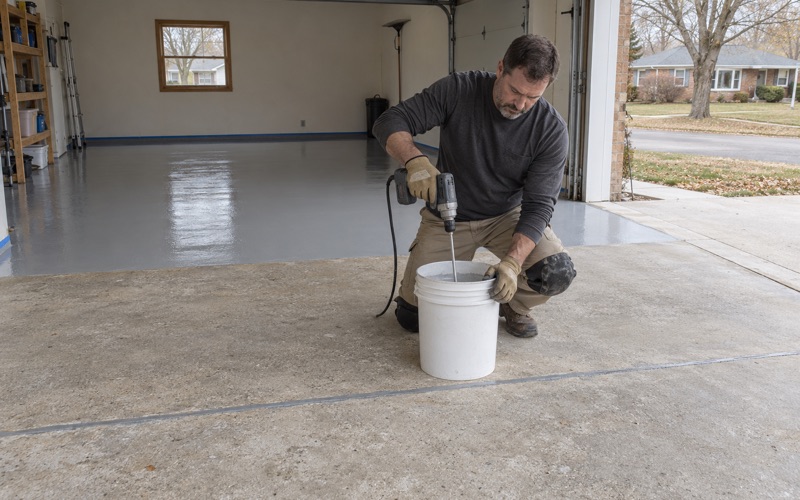
We test before we coat, using an ASTM F2170 in-situ relative humidity probe or an ASTM F1869 calcium chloride test as the slab calls for, and read the results against the product’s limits. A basement that reads high gets a moisture-mitigation primer or a frank recommendation not to coat, and that answer goes into the written warranty exclusions.
Garage floors that take a Wisconsin winter
A rental garage in Whitewater sees the same winter as any garage in southern Wisconsin, with tires carrying in road salt and calcium chloride brine for months. We build garage floors for that, starting from a mechanically profiled slab, then a 100% solids epoxy base and a polyaspartic topcoat that stands up to salt and resists hot tire pickup.
Wisconsin does not require a vapor retarder under an unconditioned attached garage slab, which means a garage floor that looks dry may still be moving moisture up through the concrete. We test it anyway. In a rental, a delaminating garage coating is not only a repair bill; it is a mess a tenant notices at move-in and writes down.
Joints, cracks and dust control
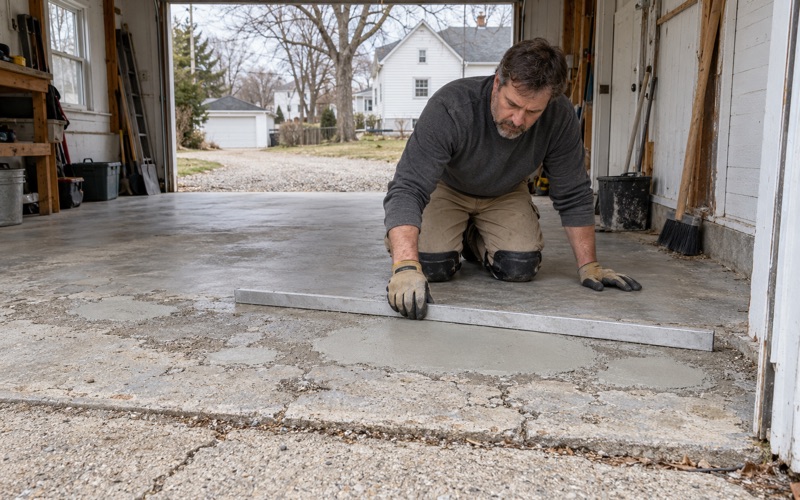
Before quoting, we walk the cracks, control joints and any flaking paint, and we tell a landlord whether the slab can take a coating as it stands. Grinding dust and slurry are collected on site and never washed toward a street drain, which matters when a garage apron slopes straight down to the street.
Where a garage doubles as a workshop or holds stored equipment, control joints get a semirigid filler before the coating goes over them, so wheels do not chip the edges. Cracks are routed and filled to suit the system. A crack that keeps moving gets named as one in the quote rather than hidden under a fresh coat.
Registration, Permits and Who Signs Off
Rental registration under Chapter 5.38
Whitewater’s Municipal Code Chapter 5.38, adopted by the Common Council in July 2008, makes it unlawful for a for-profit owner to rent residential units in the city without registering with the City Clerk. Nonprofit rental entities and government bodies are exempt. Rental registration is the only city rental rule we found, and it says nothing about floors or finishes.
So a coated basement is a choice a landlord makes for their own reasons, not something the city asks for. We have no relationship with the university, its off-campus housing site or any property manager, and we would rather a landlord hear that from us than assume a connection that does not exist.
Permits and Neighborhood Services
Building and zoning permits in the city go through Community Development and Neighborhood Services, whose permit list covers new homes, additions, remodels, roofs, siding, demolition, pools and fences. Coating an existing slab is a different question from replacing one, so we ask the building inspector whether a specific job needs a permit before we schedule it.
If a slab has to come out and be repoured, the Wisconsin Uniform Dwelling Code applies to the new work, and the state’s Dwelling Contractor credential attaches only to pulling a one- or two-family building permit. The Town of Whitewater is a separate government with its own contracted inspector, so the property’s address decides which office answers.
Who signs off on the finished floor
At the end of a job the landlord signs off with the proposal in hand: the product named, the system build and the finished thickness. We walk the floor together, note the cure time before tenants move belongings back in, and leave care instructions a landlord can pass along with the lease paperwork.
- 20+ Years in Concrete Coatings
- Moisture Testing in Every Scope
- Free Written Estimates